
Seared Scallops with Charred Cabbage and Brown Butter
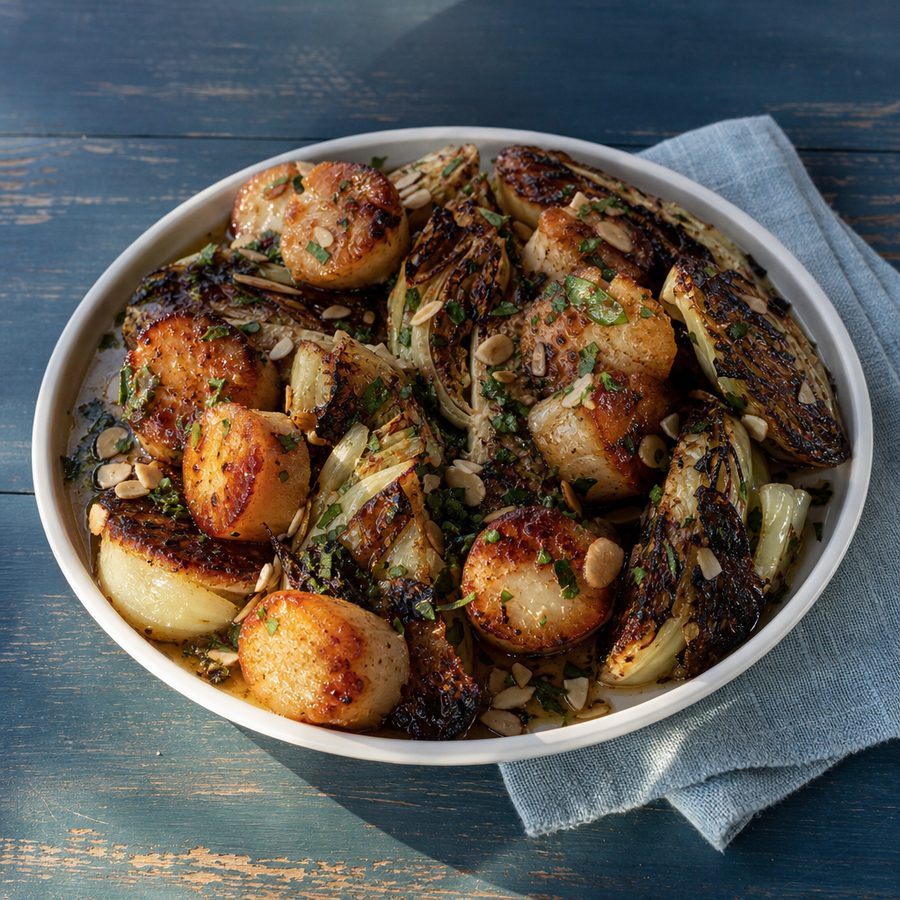
Cabbage wedges charred flat in a hot skillet, scallops seared ninety seconds a side in the same pan, and brown butter with thyme, lemon, and toasted almonds spooned over both.
Why You'll Love This Recipe
Scallops for breakfast sounds like a restaurant idea until you time it. The cabbage takes about twelve minutes and can sit on warm plates while you work, and the scallops themselves are done in three. That is the entire recipe. I started making this on mornings when I wanted something that felt like real cooking without giving up half an hour to it, and it has stayed in the rotation because it is the rare fast plate that does not taste fast. If you keep a bag of frozen scallops in the freezer, move four per person into the refrigerator the night before and this becomes a Tuesday.
Two things decide whether scallops sear or steam, and neither one is the pan. The first is water. Scallops come out of the package wet, and both flat faces need to be patted properly dry and salted only at the last second, because salt pulls moisture straight back to the surface. The second is space. Crowded scallops throw off steam faster than a skillet can drive it away, and they turn pale and springy instead of browning. Work in two batches with a finger of room between them, leave them completely alone for the first ninety seconds, and you get the deep gold crust the whole plate is built on.
Cabbage is the part people are surprised by. Cut through the core so the wedges hold together, laid flat in hot oil and left there, the outer leaves go dark and almost sweet while a short covered steam keeps the core juicy. Brown butter is what ties the two halves of the plate together. Butter cooked until the milk solids turn amber smells of hazelnuts and toast, and lemon juice stirred into it off the heat keeps something that rich from sitting heavy so early in the day. Sliced almonds toasted in the same pan go over everything for crunch.
Ingredients
- 1 1/2 lb dry-packed sea scallops (about 16), side muscles pulled off
- 1 small green cabbage (about 14 oz), cut through the core into 8 wedges
- 3 tbsp butter
- 2 tbsp garlic-infused olive oil, divided
- 1/3 cup sliced almonds
- 2 tbsp fresh lemon juice
- 1/4 cup chopped flat-leaf parsley
- 2 tsp fresh thyme leaves
- 1 tsp fine sea salt, divided
- 1 tsp freshly ground black pepper
Instructions
- Toast the almonds: Put the sliced almonds in a large dry skillet over medium heat and cook for 3 to 4 minutes, shaking the pan often, until they are gold at the edges and smell nutty. Tip them onto a plate right away, because they will keep browning in a hot pan and go bitter.
- Char the cabbage wedges: Add 1 tablespoon of the garlic-infused olive oil to the same pan over medium-high heat. Lay the wedges flat, season with 1/2 teaspoon of the salt, and leave them alone for 4 to 5 minutes, until the underside is deeply browned in patches. Turn onto the second cut face and give it 3 minutes more.
- Steam the cabbage through: Pour 1/4 cup of water into the pan, cover it at once, and cook for 3 to 4 minutes, until a knife slides into the core with only slight resistance. Lift the wedges onto four warm plates and wipe the pan dry with a paper towel, since any water left behind will stop the scallops browning.
- Dry and season the scallops: Pat the scallops very dry on both flat faces, pressing them between paper towels. Season with the remaining salt and half the black pepper only when the pan is already hot, not before. Wet or early-salted scallops steam instead of searing, and there is no fixing it once they are in the pan.
- Sear in two batches: Heat the remaining tablespoon of oil over high heat until it shimmers. Lay in half the scallops with space between them and do not touch them for 90 seconds, until the bottom is deep gold. Flip and give them 60 to 90 seconds more, until the sides are opaque and the center is just barely translucent. Repeat with the second batch.
- Brown the butter and plate: Lower the heat to medium, add the butter and the thyme, and swirl for 1 to 2 minutes until the foam dies down, the solids turn amber, and it smells like toasted nuts. Off the heat, stir in the lemon juice and the rest of the pepper. Spoon it over the cabbage and scallops, then finish with parsley and the toasted almonds.
Variations
- Red cabbage: Use a small head of red cabbage for wedges that stay firmer and turn a deep violet, and add an extra minute to the covered steam.
- Sesame and tamari: Swap the brown butter for 2 teaspoons of toasted sesame oil and 1 tablespoon of gluten-free tamari off the heat, and finish with sesame seeds in place of the almonds.
- Some heat: Add thin rings of jalapeno to the pan with the cabbage, or a pinch of cayenne to the butter as it browns.
- Ghee version: Use 3 tablespoons of ghee, which is already browned and will not separate, for a plate that carries no milk solids at all.
- Bigger plate: Serve the scallops over a cup of warm millet or quinoa per person so the brown butter has something to soak into.
Storage & Leftovers
Scallops are at their best the minute they leave the pan, so this is a plate to cook and eat rather than to store. If you have some left, refrigerate them in a sealed container for up to 2 days and plan on eating them cold, sliced across into coins over greens, which is genuinely good and avoids the reheating problem altogether.
If you would rather warm them, use a skillet over low heat with a teaspoon of butter and give them about 60 seconds, turning once. A microwave cooks a scallop a second time from the inside out and turns it rubbery in fifteen seconds. Brown butter separates when it is chilled and comes back together with gentle warmth.
The charred cabbage keeps better than the scallops do. Sealed in the refrigerator it holds 4 days, and it is worth cooking the whole head at once for that reason. Reheat the wedges cut side down in a dry pan for 3 minutes to bring the char back, or chop them cold into a salad. Cooked scallops do not freeze well.
Notes & Tips
- Buy dry-packed scallops: Wet-packed scallops are treated with a phosphate solution and weep it back out in the pan, which is why they steam and taste faintly soapy. Dry-packed ones are ivory or slightly pink rather than bright white, and they brown.
- Salt them as they hit the pan: Salt draws moisture to the surface within about a minute, and surface moisture is the only thing standing between you and a crust. Season with the pan already hot and the oil already shimmering.
- Two batches, no exceptions: Sixteen scallops in one skillet will steam themselves gray. Half a pan at a time takes ninety extra seconds and is the difference between the two versions of this dish.
- Why garlic-infused olive oil works: The compounds that make garlic taste like garlic dissolve into oil, while the fructans that trouble a sensitive gut stay behind in the bottle because they dissolve in water and not fat. Use the oil anywhere a recipe would have started with a chopped clove.
- Cut the cabbage through the core: The core is what holds a wedge together over high heat. Cut around it and you get a pile of loose leaves that burn in patches rather than a wedge with a dark face and a juicy middle.
- Watch the butter, not the timer: Brown butter goes from amber to burnt in about ten seconds. Pull the pan when the solids are the color of a hazelnut skin and the smell turns nutty, and add the lemon juice right then to stop it cooking.
Nutrition & Mindful Eating
- Scallops, charred cabbage, and brown butter make this plate what it is. The scallops are sweet and firm, the cabbage turns dark and almost caramelized where it meets the pan, and the browned butter pulls the two together with something nutty running underneath.
- Scallops are close-grained and naturally sweet, and they cook through in about three minutes, which is why they belong on a morning plate at all. They bring protein along with vitamin B12 and magnesium, and searing one face hard is what draws that sweetness forward.
- Green cabbage cut into thick wedges eats like a different vegetable than shredded cabbage does. The inner layers steam in their own moisture while the outside chars, and it carries vitamin C and vitamin K along with the fiber that gives this plate its bulk.
- Sliced almonds toasted in a dry pan turn gold and smell like warm marzipan, and they bring vitamin E and unsaturated fat along with the crunch that a soft plate needs against it.
- Brown butter and lemon are the whole sauce here. Butter cooked to amber smells of hazelnuts and toast, and the lemon juice stirred in off the heat lifts it, so the last bite tastes as bright as the first.
- As you eat, let the first scallop have your full attention, the crust giving way to something almost custardy underneath, and treat this as a plate you sit down to rather than one you finish standing at the stove.
Frequently Asked Questions
Can I use frozen scallops?
Yes, and most scallops sold at a fish counter were frozen at some point anyway. Thaw them overnight in the refrigerator on a rack set over a plate so they are not sitting in their own melt, then dry them thoroughly. Never thaw them in warm water, which starts cooking the outer edge.
My scallops came out pale and rubbery. What happened?
They were wet, crowded, or salted too early, and often all three. Dry both faces hard, give each scallop room, season them as they hit the pan, and let the first side go a full ninety seconds without being moved. A crowded pan traps steam, and steam and a crust cannot happen at the same time.
What are bay scallops like here?
Small bay scallops work, but they are done in about 45 seconds a side and they will never build the same crust because there is not enough of them to hold heat. Sear them fast in one layer, pull them early, and treat the brown butter as the main flavor rather than the crust.
Does this fit a low-FODMAP breakfast?
It does. Scallops themselves carry no FODMAPs, the savory element is garlic-infused olive oil and browned butter rather than garlic cloves or onion, and two wedges of green cabbage per plate sits in the amount most people handle well. The almonds work out to a small scattering each, which is the comfortable range for them.