
Seared Sirloin with Warm Millet and Watercress
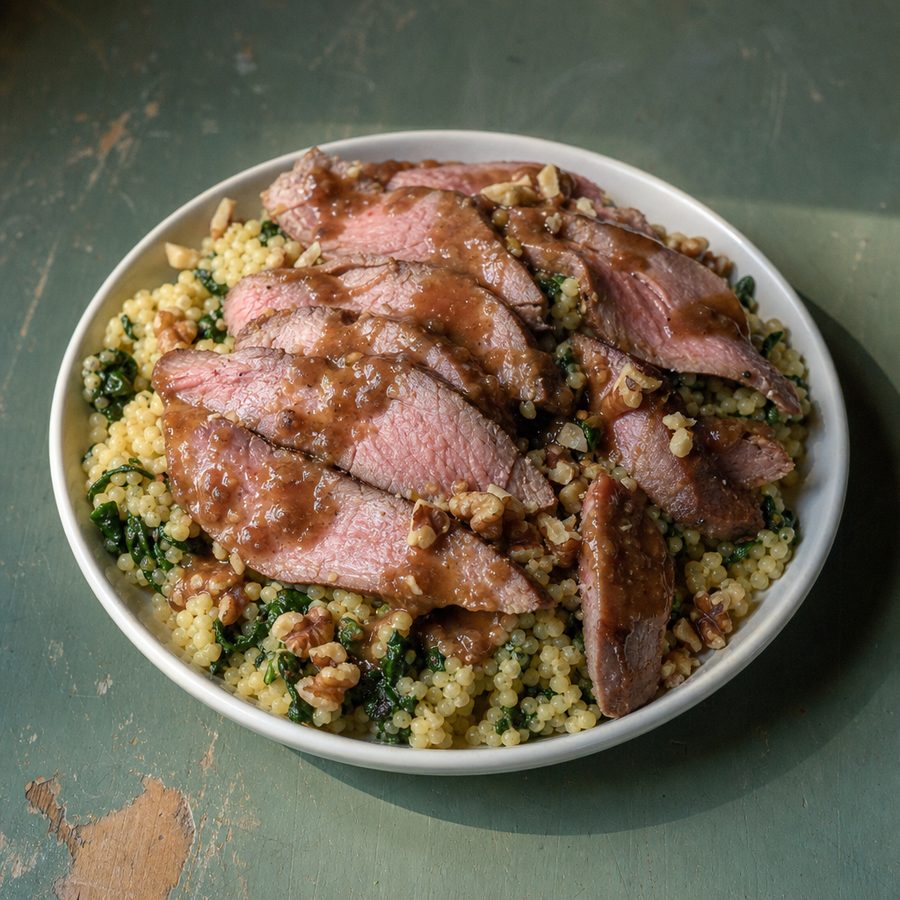
Sirloin seared in a hot skillet and rested, then sliced over warm millet folded with olive oil and lemon, with peppery watercress and a mustard pan sauce.
Why You'll Love This Recipe
Steak for breakfast sounds like a restaurant order until you have done it once on a weekday morning and realized it takes twelve minutes. This is the version I make when I have a long day in front of me, or on a morning when someone in my house needs feeding properly. Cooking one whole steak and slicing it across four plates goes further than you expect, and the warm millet underneath catches the juice that runs out of it while it rests. If you cook a pot of millet on a Sunday, this becomes a genuinely fast breakfast rather than a project.
The steak wants a very hot, very dry pan and almost no interference. Dry the surface with paper towel, salt it, and put it into a skillet that is just beginning to smoke, then leave it for four minutes before you look. What you are after is a dark crust across the whole face rather than a gray band around a pink middle, and that only happens if the meat is dry and the pan is hot. Pull it at 130°F (54°C) for medium rare and let it rest a full eight minutes, because sirloin is close-grained enough that cutting it early sends the juice onto the board rather than into the millet.
The millet is doing more work than it looks like. Warmed through with garlic-infused olive oil, lemon, and salt, it turns from a plain grain into something that tastes seasoned all the way down, and it stays loose and slightly sandy in texture, so it takes the pan sauce without going gluey. The watercress gets folded into it hot, off the heat, so it half wilts and keeps its pepper. Then the pan sauce, which is broth and dijon boiled down hard and finished with cold butter, goes over the sliced steak. Toasted walnuts on top give you something to bite against everything else that is soft.
Ingredients
- 1 1/2 lb sirloin steak, about 1 1/4 inches thick, left out for 30 minutes
- 3 cups cooked millet
- 4 packed cups watercress, thick stems trimmed
- 2 tbsp garlic-infused olive oil, divided
- 1 tbsp cold butter, cut into two pieces
- 1/2 cup beef broth
- 2 tsp dijon mustard
- 1 tsp finely chopped fresh rosemary
- 1 tbsp fresh lemon juice
- 1/3 cup walnuts, roughly chopped
- 1 1/4 tsp fine sea salt, divided
- 1 tsp freshly ground black pepper
Instructions
- Toast the walnuts: Put the chopped walnuts in a dry skillet over medium heat and shake the pan every 30 seconds for 3 to 4 minutes, until they smell toasted and darken a shade. Tip them onto a plate right away, since they keep cooking in a hot pan and turn bitter quickly.
- Sear the steak: Pat the steak dry and season both faces with 3/4 teaspoon of the salt and all the black pepper. Heat 1 tablespoon of the garlic-infused olive oil in a heavy skillet over high until it is just beginning to smoke. Lay the steak in and cook 4 minutes without moving it, until a dark crust has formed, then flip and cook 3 to 5 minutes more, to 130°F (54°C) at the center.
- Rest it: Move the steak to a cutting board with a groove around it and let it rest 8 minutes, uncovered. Do not skip this and do not cut in early. Everything that leaves the meat in the first few minutes off the heat is juice you wanted in the middle of each slice.
- Make the pan sauce: Set the skillet back over medium heat, add the rosemary, and pour in the beef broth. Scrape the browned bits off the bottom with a wooden spoon and let it bubble hard for 3 to 4 minutes, until it has reduced by half. Whisk in the dijon, take the pan off the heat, and swirl in the cold butter a piece at a time until the sauce turns glossy.
- Warm and dress the millet: Spread the cooked millet in a wide bowl and break up any clumps with a fork. Warm it through, covered, for about a minute in the microwave or in a dry skillet over low heat with a spoonful of water. Fork through the remaining 1 tablespoon garlic-infused olive oil, the lemon juice, and the remaining 1/2 teaspoon salt, then fold in the watercress so it half wilts in the heat.
- Slice and serve: Slice the rested steak against the grain into pieces about 1/4 inch thick, holding the knife at a slight angle. Divide the millet among four plates, lay the slices over the top, spoon the pan sauce over the meat along with any juice from the board, and scatter the toasted walnuts.
Variations
- Peppercorn version: Press coarsely cracked black pepper onto both faces of the steak before searing, and stir a spoonful of coconut milk into the sauce.
- Add a green: Fold two handfuls of baby spinach into the hot millet along with the watercress and let it collapse.
- Tomato on the side: Blister halved cherry tomatoes in the skillet for 2 minutes before the steak goes in and spoon them over at the end.
- Cheese finish: Shave parmesan over the millet while it is still hot for something saltier and richer.
- Herb swap: Use thyme in the pan sauce and finish with chopped parsley for a lighter, less resinous plate.
Storage & Leftovers
Leftovers keep in a sealed container in the refrigerator for 3 days. Store the sliced steak and the millet in the same box but the sauce in a small separate one, since sauce sitting on cooked beef overnight softens the crust you worked for and dulls the edges of the slices.
Reheat the millet on its own, covered, with a spoonful of water, then lay the cold sliced steak on top for the last 30 seconds so it only just warms. Beef reheated hard goes gray and tight. Honestly, this is also very good eaten cold, straight from the container with a squeeze of lemon.
Cooked millet freezes well for 2 months in a flat sealed bag, which makes it worth cooking in a double batch while the stove is already on. Cooked steak does not freeze well and comes back dry and stringy, so keep the meat to the refrigerator and freeze only the grain.
Notes & Tips
- One thick steak, not four thin ones: A single inch-and-a-quarter steak sliced across four plates gives you a crust and a rosy middle. Four thin steaks give you four well-done ones.
- Rest longer than feels reasonable: Eight minutes is not a suggestion. The juice redistributes through the muscle in that time, and cutting at three minutes puts most of it on the board.
- Slice against the grain: Find the direction the muscle fibers run and cut across them at an angle. The same steak eats twice as tender sliced the right way.
- Dress the millet while it is warm: Warm grain drinks up oil and lemon. Cold grain lets the dressing slide to the bottom of the bowl, which is why the millet gets warmed before anything goes on it.
- Why garlic-infused olive oil works: The flavor of garlic dissolves into fat, while the part that upsets a sensitive gut does not. Garlic steeped in oil hands over its taste and leaves the rest behind, so you get the savory backbone in the pan without what usually comes with it.
- Cold butter, off the heat: Swirl the butter into the sauce with the pan off the burner. Butter added to a boiling sauce splits and goes oily rather than glossy.
Nutrition & Mindful Eating
- Sirloin, millet, and watercress each do a different job on this plate. The steak brings the protein and the juice, the millet gives it substance and soaks up the sauce, and the watercress goes in raw so there is something sharp against the meat.
- Sirloin is a close-grained cut that stays tender when it is cooked fast and sliced thin, and beef is where the iron and B12 here come from, both in the forms the body takes up most readily.
- Millet cooks into small pale grains that stay separate and taste faintly of corn, and it carries magnesium and fiber along with its starch. Warmed with oil and lemon rather than served plain, it takes on the flavor of everything that lands on top of it.
- Watercress is one of the peppery greens, hot at the back of the throat when it is raw, and it is unusually rich in vitamin K for a leaf this delicate. Folding it into hot millet softens it just enough while keeping the bite.
- The dark crust on the steak, the cold butter whisked into the mustard sauce, and the toasted walnuts scattered over the top are what make a plate this plain feel finished. Protein this dense holds you well past the middle of the morning.
- As you eat, look at how much of the resting juice the millet has taken up, and notice the pepper of the watercress arriving after the beef, then take the plate to a table rather than the cutting board.
Frequently Asked Questions
Can I use a different cut or a different grain?
Yes to both. Flank, flat iron, and strip steak all sear and slice the same way, and any of them wants the same rest. Quinoa, buckwheat, and brown rice all stand in at the same cooked volume, though millet stays the loosest and takes the oil and lemon best while it is warm.
My steak came out gray on the outside with no crust.
The pan was not hot enough, or the meat was wet, or both. Dry the surface thoroughly, wait until the oil shimmers and just begins to smoke, and give the first side a full four minutes without touching it. Crowding a pan with two steaks does the same thing, so cook them one at a time.
Can I get ahead on this?
Cook the millet up to 5 days ahead and keep it plain in the refrigerator, and toast the walnuts whenever a pan is already going. The steak is worth cooking fresh, since it takes twelve minutes and reheated beef is never as good as beef straight off the board.
Does this fit a low-FODMAP breakfast?
It does. The savory depth comes from the browned crust on the steak, the fond in the pan, rosemary, dijon, and garlic-infused olive oil rather than from garlic or onion. Read the broth label carefully, since almost every carton on the shelf carries onion and garlic, and choose one that does not.