
Shaved Kohlrabi and Pear Breakfast Slaw with White Beans and Dijon
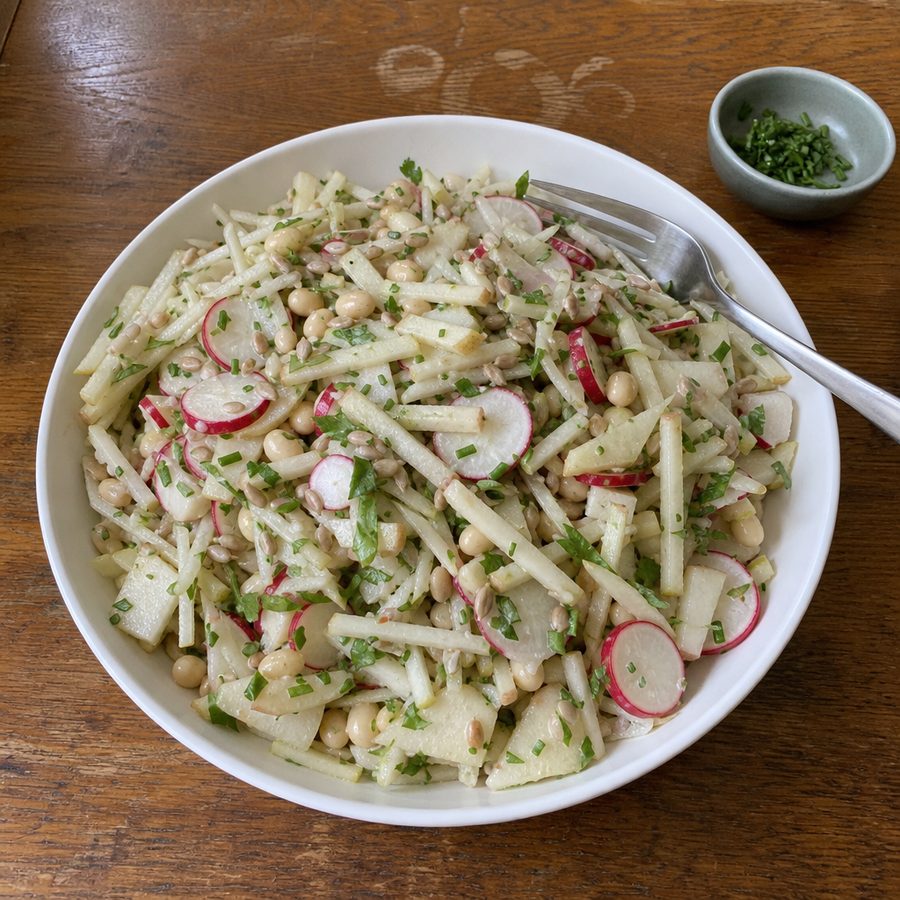
Kohlrabi and firm pear shaved thin with radishes and navy beans, tossed in a dijon yogurt dressing with cider vinegar, chives, and parsley, and scattered with sunflower seeds.
Why You'll Love This Recipe
This is what I make when I want breakfast to be cold and loud and take twenty minutes. There is no pan, no oven, and nothing to wait for. The whole thing is a knife, a peeler, and a bowl. I started making it in late summer when the idea of turning on a burner before nine in the morning was unbearable, and then found I wanted it in January too, because a bowl of something this crisp is a genuine relief in the middle of a week of hot food.
Cut everything the same way and the salad works; cut it carelessly and it does not. Kohlrabi and pear both go into matchsticks about the thickness of a wooden match, so they tangle together and you get both in every forkful. The radishes go paper thin so they read as heat rather than as chunks. The beans are the only soft thing in the bowl, and they are there on purpose, because a salad with nothing yielding in it gets tiring after five minutes of chewing.
The dressing is dijon, cider vinegar, yogurt, and olive oil, and it is sharper than it sounds. It has to be, against the sweetness of the pear. Made the night before and dressed in the morning, this is a genuinely good thing to carry in a jar, and it holds its crunch for two days, which almost nothing else in my kitchen does. I eat it out of the container standing at the counter more often than I sit down with it, and it is just as good that way.
Ingredients
- 2 medium kohlrabi (about 15 oz trimmed), peeled and cut into thin matchsticks
- 1 1/4 cups canned navy beans, drained and rinsed
- 1 firm Bosc pear, cored and cut into thin matchsticks
- 6 radishes, sliced paper thin
- 2/3 cup plain Greek yogurt
- 1 tbsp dijon mustard
- 1 1/2 tbsp apple cider vinegar
- 1 1/2 tbsp olive oil
- 1/3 cup raw hulled sunflower seeds
- 1/3 cup chopped fresh flat-leaf parsley
- 2 tbsp finely snipped chives
- 1/2 tsp cracked black pepper
- 1 pinch fine sea salt
Instructions
- Whisk the dressing first: In the bottom of a large bowl, whisk the yogurt, dijon, cider vinegar, olive oil, salt, and cracked pepper until completely smooth. It should be thick enough to coat a spoon but loose enough to pour. Taste it now, on its own. It will seem too sharp, and that is correct, because the pear and the kohlrabi will pull it back.
- Cut the kohlrabi: Trim the stems and peel the kohlrabi deeply, taking off the fibrous layer just under the skin as well as the skin itself. Slice into thin planks, stack the planks, and cut them into matchsticks until you have a pile about the thickness of wooden matches. A mandoline makes short work of the planks if you have one.
- Cut the pear and radishes: Cut the pear into matchsticks the same size as the kohlrabi and add it to the dressing right away so the cut surfaces do not brown. Slice the radishes as thin as you can manage, until light comes through them, and add those too. Toss everything to coat.
- Fold in the beans and herbs: Add the drained navy beans, parsley, and chives and fold gently with a spatula rather than tossing hard, so the beans stay whole instead of smashing against the side of the bowl. Everything should be lightly and evenly coated, with no puddle of dressing at the bottom.
- Rest, then finish: Let the bowl sit ten minutes so the kohlrabi softens just slightly and takes on the mustard. Taste and add more vinegar if it has gone flat, which it will if your pear was very ripe. Scatter the sunflower seeds over the top just before serving so they stay dry and crunchy.
Variations
- Apple and caraway: Swap the pear for a crisp apple and add a teaspoon of toasted caraway seeds for something closer to a northern European slaw.
- Fennel and orange: Use shaved fennel in place of half the kohlrabi and orange segments in place of the pear for a sweeter, more perfumed bowl.
- With smoked fish: Flake smoked trout over each portion and skip the beans for a heavier plate on a morning when you want more.
- Herb-forward: Double the parsley and add a handful of torn dill, which turns the dressing green and pushes the whole bowl in a fresher direction.
Storage & Leftovers
Dressed, this keeps two days in a sealed container in the refrigerator and stays surprisingly crisp, since kohlrabi has far less water in it than cucumber or lettuce. The radishes lose their color into the dressing and turn it faintly pink by day two, which bothers no one. Add the sunflower seeds fresh each time.
For a make-ahead version, cut the kohlrabi and radishes up to three days in advance and keep them in a sealed container with a damp paper towel on top. Whisk the dressing and store it separately. In the morning, cut the pear, combine everything, and you are eating in five minutes.
This does not freeze, and there is no version of it that does. Everything in the bowl is here for its crunch, and freezing collapses the cell walls that provide it. If you have more than you can eat in two days, the leftovers are very good folded into a pan of scrambled eggs, which is a different dish but not a waste.
Notes & Tips
- Dress the pear immediately: Cut pear browns within minutes. Getting it into the acidic dressing as soon as it leaves the board keeps the matchsticks pale and clean-looking.
- Peel deeper than you think: The fibrous layer under kohlrabi skin never softens. Take it all off with a paring knife and the raw texture goes from stringy to crisp.
- Match the cuts: Kohlrabi and pear in the same size matchsticks tangle together and give you both in one bite. Different sizes and they separate into layers in the bowl.
- Fold the beans, do not toss them: Navy beans are soft enough to break under a hard toss, and broken beans make the dressing chalky. A spatula and a gentle lift keeps them whole.
- Seeds at the last second: Sunflower seeds sitting in a wet bowl go soft in about fifteen minutes. Store them apart and scatter them as the bowls go on the table.
- Taste again after ten minutes: Salt and acid both fade as the vegetables release water. What tasted sharp when you mixed it will need another splash of vinegar by the time you eat.
Nutrition & Mindful Eating
- Kohlrabi, navy beans, and sunflower seeds carry this bowl between them. The kohlrabi gives the crunch and the bulk, the beans bring the soft texture and the plant protein, and the seeds add the last bit of snap along with most of the fat that makes a cold breakfast satisfying.
- Kohlrabi belongs to the cabbage family, which is where that faint mustardy edge comes from, and it holds a striking amount of vitamin C for something so mild. Eaten raw it keeps all of it, and the crispness is the whole reason to buy it.
- Navy beans are small, soft, and slightly sweet, and they are the only yielding thing in a bowl otherwise full of crunch. They carry both fiber and plant protein, and the soluble fiber in them is part of why this eats more substantially than a salad usually does.
- Sunflower seeds bring vitamin E and magnesium along with their snap, and scattered on at the last moment rather than tossed through, they stay dry and give every forkful something to break against.
- Dijon, cider vinegar, and a hard hand with the black pepper are what keep the pear from taking over. Mustard is an emulsifier as much as a flavor, which is why the dressing clings to shaved vegetables rather than sliding off them into the bottom of the bowl.
- As you eat, notice how loud the first few forkfuls are and how the kohlrabi quietens as it sits in the dressing, and let the sound of it be a reason to slow down and chew properly.
Frequently Asked Questions
What does kohlrabi actually taste like?
Mild and faintly sweet, with the crispness of a good apple and a distant cabbage flavor in the background. Raw is where it is best. Buy the smaller bulbs, about the size of a tennis ball, since the large ones turn woody in the middle no matter how well you peel them.
Which pear should I use?
A firm one. Bosc holds its shape and cuts into clean matchsticks, while a ripe Bartlett turns to mush under the knife and sweetens the whole bowl too much. Slightly underripe is better than ripe here, and a crisp apple works just as well if the pears look sad.
Can I make it without yogurt?
Yes. Double the olive oil, add another teaspoon of dijon, and treat it as a vinaigrette. The dressing will not cling the same way, so toss it a second time right before serving to pick up what has run to the bottom of the bowl.
Do I have to peel the kohlrabi that deeply?
You do. There is a tough fibrous layer just under the skin that stays stringy no matter how thin you slice it, and a vegetable peeler often only takes the skin. Use a paring knife and take off enough that the surface looks glassy and pale.