
Sheet-Pan Bacon with Roasted Parsnip and Crisped Collard Greens
Thick-cut bacon roasted on a sheet pan with parsnip batons that cook in the rendered fat, collard greens added late so the edges crisp, finished with balsamic and thyme.
Why You'll Love This Recipe
Most mornings I do not want to stand at the stove, and this is what I make on those days. Everything goes onto one sheet pan, the oven does the work, and I get twenty five minutes back. It is also the rare breakfast that improves if you make double, because roasted parsnip reheats better than almost anything else you can put in a container. I cook it on a Sunday and eat it Monday and Tuesday with whatever else is in the refrigerator. The whole thing needs about ten minutes of knife work, and after that you are only turning a pan twice. Four portions, one pan, one bowl to wash.
Nothing here matters as much as the order things go on the pan. The bacon goes on first, on its own, for about eight minutes, long enough to give up a real pool of fat. Then the parsnips go into that fat and roast while the bacon finishes crisping on top of them. Parsnip has enough sugar in it to caramelize properly, and a cut face pressed against a hot pan in bacon fat goes brown and almost sweet in a way that boiling or steaming will never give you. Garlic-infused olive oil goes on with the parsnips and carries a savory note through the whole tray.
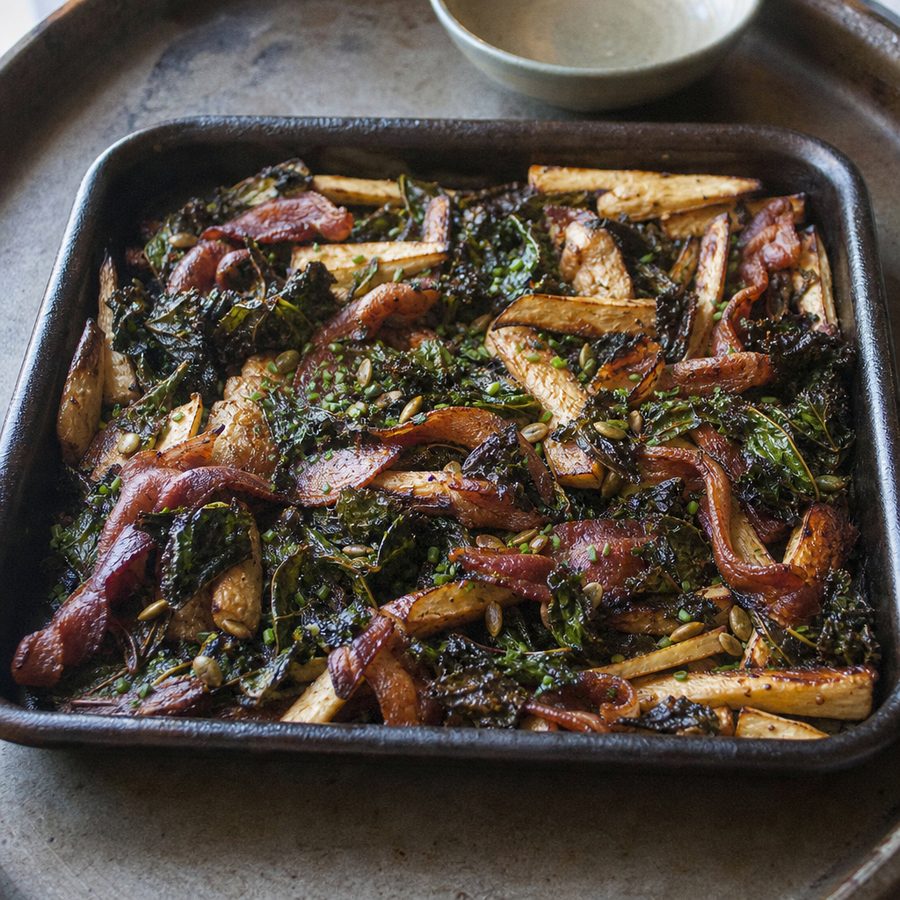
The collard greens are the last thing onto the pan and they only need seven minutes. Stripped off their ribs, torn into big pieces, and turned through the fat, the thin edges go crisp and shattery while the thicker parts stay tender, which gives you two textures out of one leaf. Then a spoonful of balsamic goes over the whole tray while it is still hot, so it hisses and clings rather than pooling in the corners. Toasted pumpkin seeds and chives finish it. What you end up with is smoke, sweetness, and something sour and green, and it eats like a proper breakfast rather than a side dish.
Ingredients
- 12 slices thick-cut bacon (about 1 lb)
- 1 lb parsnips (about 4 medium), peeled and cut into 3/4-inch batons
- 1 bunch collard greens (about 7 oz), ribs stripped and leaves torn into big pieces
- 1 tbsp garlic-infused olive oil
- 1 tbsp fresh thyme leaves
- 1 tbsp balsamic vinegar
- 1/4 cup raw pumpkin seeds
- 2 tbsp thinly sliced chives
- 1 tsp freshly ground black pepper
- 1/2 tsp fine sea salt
Instructions
- Toast the pumpkin seeds: Put the pumpkin seeds in a dry skillet over medium heat and shake the pan every 30 seconds for 3 to 4 minutes, until they puff, begin to pop, and smell toasted. Tip them onto a plate right away so they stop cooking, and set them aside for the end.
- Render the bacon: Heat the oven to 425°F (220°C). Lay the bacon slices in a single layer on a large rimmed sheet pan and roast 8 to 10 minutes, until the fat has run out and the strips are limp and pale gold but not yet crisp. Lift them onto a plate and leave every bit of the fat on the pan.
- Roast the parsnips: Add the parsnip batons to the hot pan along with the garlic-infused olive oil, the thyme, the salt, and half the black pepper. Toss them through the bacon fat with a spatula and spread them in one layer with a little space between them. Roast 20 minutes without touching them.
- Turn and return the bacon: Turn the parsnips with the spatula so a second cut face meets the pan, then lay the bacon back over the top. Roast 8 minutes more, until the parsnips are deep brown at the edges and give easily to a fork and the bacon has gone crisp.
- Crisp the collard greens: Move the bacon to one end of the pan and add the torn collard greens, turning them through the fat at the bottom until every piece is coated. Spread them out and roast 6 to 8 minutes, until the thin edges are dark and brittle and the rest is tender. Watch them closely, since they go from crisp to burnt in about a minute.
- Dress and serve: Take the pan out and pour the balsamic over everything while it is still hot, scraping the bottom so it picks up the browned bits. Add the remaining black pepper, scatter the toasted pumpkin seeds and chives across the tray, and serve straight from the pan.
Variations
- Squash version: Swap half the parsnip for cubed delicata or acorn squash, which roasts in the same time and goes sweeter.
- Herb change: Use rosemary in place of the thyme for something more resinous, and cut the amount in half since it is stronger.
- With a grain: Spoon the tray over warm cooked quinoa or brown rice when you want a bigger plate, and let the balsamic run into it.
- Cheese on top: Shave parmesan over the hot tray so it melts into the parsnips, or crumble feta over it once it has cooled a little.
- Some heat: Add a pinch of chipotle powder or cayenne with the black pepper for a smokier, hotter tray.
Storage & Leftovers
The whole tray keeps in a sealed container in the refrigerator for 4 days, and roasted parsnip is one of the better things to find waiting there. The greens soften overnight and lose their crackle, which is worth knowing before you are disappointed by them on day two. The flavor holds up completely.
Reheat it spread on a small tray in a 400°F (200°C) oven for about 8 minutes, which brings the parsnips back to crisp at the edges and the bacon close to where it started. A microwave heats it in 90 seconds and turns everything soft, so use that only when you are short of time.
Freezing is not worth it here. Parsnip goes watery and grainy after thawing and the greens collapse entirely. If you want a head start, peel and cut the parsnips up to 2 days ahead and keep them covered in the refrigerator, then the tray goes into the oven in about four minutes.
Notes & Tips
- Render the bacon before anything else goes on: The fat is the point. Eight minutes on its own gives you enough to coat a pound of parsnips, and roasting the bacon alongside raw vegetables from the start leaves you with neither crisp bacon nor browned parsnip.
- Give the parsnips room: Space between the pieces is what lets steam escape so the cut faces can brown. Crowd them and you get pale, soft parsnip every time, no matter how long you leave it in.
- Go easy on the salt: Bacon brings a good deal of its own, and it seasons the fat that everything else cooks in. Half a teaspoon across the vegetables is enough, and you can always add more at the table.
- Why garlic-infused olive oil works: The flavor of garlic dissolves into fat, and the part of it that troubles a sensitive gut does not. Garlic left to steep in oil hands over its taste and leaves the rest behind, so a spoonful gives the tray a savory backbone without what usually comes with it.
- Strip the ribs out of the collards: The center rib is thick enough that it is still tough when the leaf has crisped. Fold each leaf in half and run a knife down the side of the stem, then tear the rest into pieces.
- Balsamic onto a hot pan: Pour it over while everything is still hot so it hisses, reduces slightly, and clings to the parsnips. Added once the tray has cooled it just sits in the bottom.
Nutrition & Mindful Eating
- Bacon, parsnip, and collard greens make a full tray between them. The bacon brings salt, smoke, and the fat everything else cooks in, the parsnip brings sweetness and body, and the greens go on last so there is something crisp and dark against both.
- Parsnips are sweeter than they look raw, and roasting concentrates that sugar until the cut faces go toffee brown and almost candied. They carry fiber and vitamin C, and cut into thick batons they hold their shape through half an hour in a hot oven.
- Collard greens are sturdy enough to crisp at the edges while the rest of the leaf stays tender, which gives you two textures in one bite. They carry calcium in a form the body absorbs well, along with a good deal of vitamin K.
- Bacon does more here than sit at the side of the plate. Rendered first and on its own, it leaves behind fat with real smoke in it, and that fat is what the parsnips brown in, so the whole tray tastes of it rather than only the strips.
- Toasted pumpkin seeds and a spoonful of balsamic land at the very end, one for crunch and the magnesium and zinc that seeds carry, the other for the sourness that keeps something this rich from going flat. A plate of this holds you into the middle of the day.
- As you eat, notice how sweet the parsnip has gone where it touched the pan and how the greens shatter at the edges, and give the tray a few unhurried minutes at a table before the day starts.
Frequently Asked Questions
Can I use a different root vegetable?
Carrot, rutabaga, turnip, and celeriac all roast well in bacon fat and all want the same 3/4-inch batons. Carrot and rutabaga are closest to parsnip in sweetness. Turnip and celeriac are more savory, so add a little more balsamic at the end to balance them.
My parsnips steamed and never browned.
The pan was too crowded. Roasting needs air around each piece, and a sheet pan packed edge to edge traps steam that keeps the surface too wet to brown. Use the largest pan you own, or split everything across two, and do not turn them before the first twenty minutes are up.
Can I make it ahead for the week?
Yes, and it is one of the better candidates for it. Roast the full tray, divide it into four containers once cool, and refrigerate for up to 4 days. Reheat in a hot oven rather than a microwave, and add the pumpkin seeds and chives fresh so they keep their crunch and color.
Does this fit a low-FODMAP breakfast?
It does. The savory depth comes from rendered bacon fat, browned parsnip, thyme, and garlic-infused olive oil rather than from garlic or onion, so nothing gets stripped out of the recipe on its way to you. Parsnip and collard greens at roughly a cup of each per plate sit in the comfortable range.