
Sheet-Pan Carrots and Green Beans with Green Goddess Tahini
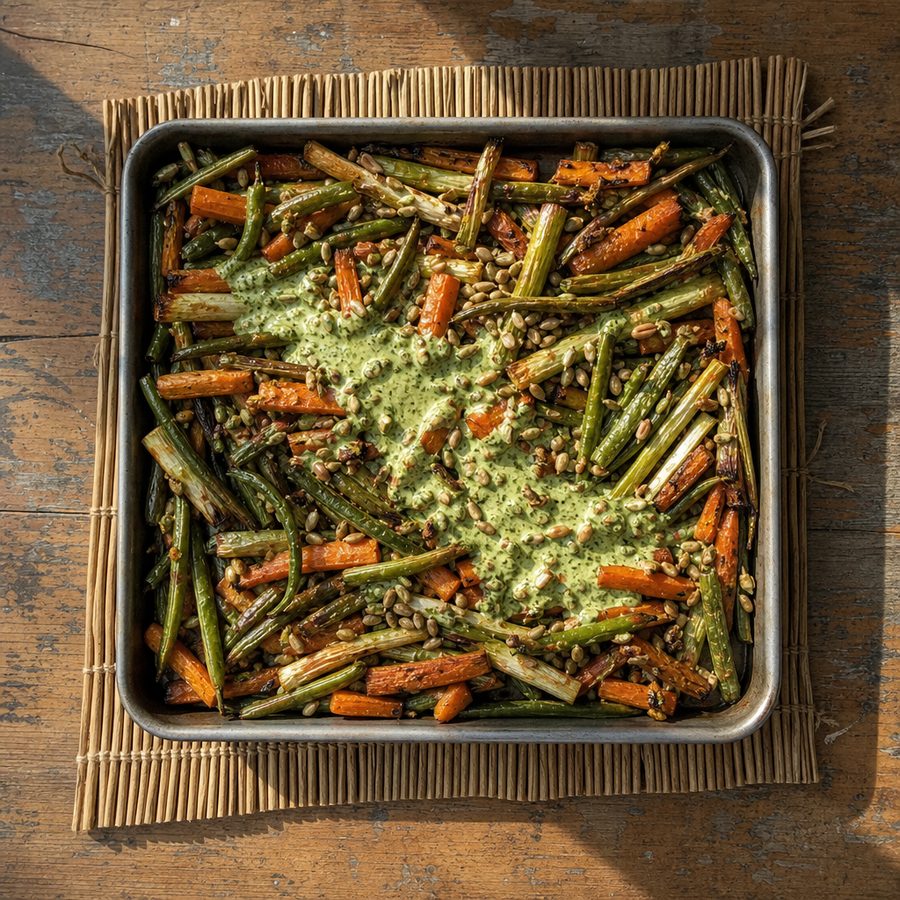
Carrot batons and green beans roasted at high heat with whole scallions until blistered and sweet, poured over with a lemony green goddess sauce of parsley, basil, chives, and tahini, and finished with toasted sunflower seeds.
Why You'll Love This Recipe
Green goddess is a San Francisco invention and it has been a dressing for salads for most of a century, but the version I make most is thickened with tahini rather than dairy and poured over hot vegetables. Sesame gives it a savory backbone that stands up to roasting, and the herbs stay green and loud. This lunch came out of wanting something I could put together from what is always in the crisper drawer, and carrots and green beans are the two vegetables that survive a long week in my refrigerator without complaint.
The pleasure of it is the sweetness. Carrots roasted hard at 450°F (230°C) lose water and concentrate, and the thin ends go dark and chewy while the thick parts stay tender. Green beans wrinkle and blister and taste faintly of the grill. The scallions are the surprise, going almost jammy and losing all their sharpness. Then the sauce, cold and lemony and thick enough to coat, runs through the hot pan and pulls everything together, and the sunflower seeds give you something to bite against all that softness.
I make this for lunch on days when I have been eating out of containers and want something green and sharp, and it takes one pan and one blender jar. It is just as good at room temperature an hour later, which makes it a decent thing to carry to work or to set out on a table where people are grazing. The sauce keeps for the better part of a week, so I usually make a double batch and spoon the rest over whatever vegetable I roast next.
Ingredients
- 1 lb carrots, halved lengthwise and cut into 3-inch batons
- 1 lb green beans, stem ends snapped off
- 1 bunch scallions (about 8), left whole with the roots trimmed
- 3 tbsp olive oil, divided
- 1/3 cup tahini, stirred smooth from the bottom of the jar
- 3 tbsp lemon juice, from about 1 1/2 lemons
- 1 packed cup flat-leaf parsley leaves and thin stems
- 1/2 packed cup basil leaves
- 2 tbsp chopped chives
- 2 cloves garlic
- 3 tbsp hulled sunflower seeds
- 1/2 tsp fine sea salt
- 1/2 tsp coarsely ground black pepper
Instructions
- Heat the oven and the pan: Set a heavy rimmed sheet pan on the middle rack and heat the oven to 450°F. The pan needs to be genuinely hot when the carrots hit it, because that first contact is where the browning starts and it is what keeps the vegetables from stewing in their own steam.
- Cut the carrots evenly: Halve the carrots lengthwise and cut them into batons about three inches long, quartering the thick shoulder ends so every piece is roughly the same thickness. Toss them with 1 tbsp of the oil, half the salt, and the black pepper. Uneven pieces are the main reason a tray of carrots comes out both burnt and underdone.
- Roast in two stages: Pull out the hot pan, spread the carrots on it cut side down, and roast for ten minutes. Meanwhile toss the green beans and whole scallions with another tablespoon of oil and the rest of the salt. Add them to the pan, shake it once to settle everything into a single layer, and roast for another ten minutes, until the beans are blistered and wrinkled and the carrots have dark, sticky tips.
- Blend the green goddess: While the pan is in the oven, put the parsley, basil, chives, garlic, lemon juice, tahini, the last tablespoon of oil, and 5 tbsp of cold water into a blender. Run it for a full minute until it is smooth and pale green. Tahini seizes and thickens the moment it meets acid, so add another tablespoon of water at a time until it pours in a slow ribbon.
- Toast the seeds and plate: Put the sunflower seeds in a small dry skillet over medium heat for two to three minutes, shaking often, until they smell nutty and have gone one shade darker. Pile the vegetables onto a platter, pour the sauce over the middle while they are still hot, and scatter the seeds across the top with a final grind of pepper.
Variations
- Charred lemon: Add two lemon halves cut side down to the pan for the last eight minutes and squeeze the hot juice over everything before the sauce goes on.
- Chile heat: Blend a seeded jalapeno into the sauce, or scatter chile flakes over the finished plate for a sharper edge against the sweet carrots.
- White beans: Add a drained cup of white beans to the pan for the last five minutes so they warm through and pick up a little color.
- Yogurt version: Swap half the tahini for plain Greek yogurt, which makes a paler, tangier sauce and a slightly lighter plate.
- Dill and cucumber: Trade the basil for dill and add sliced cucumber to the platter after the vegetables come out, for a cooler and more summery version.
Storage & Leftovers
The vegetables keep for four days in a sealed container in the refrigerator and are honestly good cold, straight from the box with the sauce spooned over. Keep the sauce in a separate jar, where it holds for five days and thickens as it sits, and hold the sunflower seeds back so they stay crisp.
Reheat the vegetables on a sheet pan at 425°F for five or six minutes rather than in the microwave. Dry heat brings back the blistered edges, while the microwave leaves the green beans limp. Add the sauce after they come out, since the herbs dull and go olive-colored when they are heated.
This does not freeze well. Carrots and green beans both go watery and soft after thawing, and the herb sauce loses its color. The sauce alone will hold for a month in the freezer if you want to stash some, though it needs a hard whisk and a splash of water to come back together.
Notes & Tips
- Preheat the sheet pan: Vegetables that land on cold metal spend the first five minutes releasing water rather than browning. A hot pan gives you color on the underside before the moisture has a chance to pool.
- Give the carrots a head start: Carrots are dense and green beans are not. Ten minutes of separation is what gets both of them right on one pan.
- Stir the tahini jar properly: The oil separates and sits on top, so a spoonful from the surface behaves completely differently from one from the bottom. Stir it all the way down before you measure.
- Use cold water in the sauce: Cold water keeps the herbs bright green in the blender. Hot water and long blending both dull the color toward olive.
- Toast the seeds separately: Sunflower seeds on the sheet pan burn before the carrots are done. Two minutes in a dry skillet at the end gives you far better control.
- Sauce the platter, not the pan: Pour the sauce over the vegetables once they are plated. Poured onto the hot sheet pan it splits and the herbs go dark.
Nutrition & Mindful Eating
- Carrots, green beans, tahini, and sunflower seeds work as a set here. The carrots bring sweetness and color, the beans bring bulk and a snap, the tahini brings the fat that makes the sauce cling, and the seeds give the plate the crunch that makes a bowl of vegetables feel finished.
- Carrots are one of the best sources of beta-carotene on the produce shelf, which is the pigment behind their color and what your body turns into vitamin A. Roasting them hard concentrates their sugars, so a pan of them tastes closer to dessert than a vegetable usually does.
- Tahini is ground sesame and very little else, and it carries a surprising amount of calcium along with the unsaturated fat that gives the sauce its body. It is also what keeps a herb sauce from tasting thin.
- Green beans hold their shape and their bite through high heat, and they bring fiber along with vitamin K. The wrinkled, blistered ones taste the most concentrated, so do not pull the pan while they still look smooth and glossy.
- Parsley, basil, chives, and lemon are the reason this plate tastes alive. Fresh herbs blended cold keep their oils and their color, and the acid from three tablespoons of lemon juice is what keeps a sesame sauce from sitting heavy.
- As you eat, notice how much sweeter a roasted carrot is than one from the bag, and let the herb sauce and the crack of the seeds keep you eating slowly enough to feel the plate settle.
Frequently Asked Questions
My sauce turned into a paste. What went wrong?
Tahini does that. The moment lemon juice hits it, it seizes and stiffens, which looks alarming and is completely normal. Keep adding cold water a tablespoon at a time with the blender running and it loosens back into something smooth and pourable. Warm water makes it happen faster.
Can I use dried herbs?
Not for this one. The whole character of the sauce is fresh parsley and basil blended until they are still bright green, and dried herbs make it muddy and dusty. If you are short on basil, use all parsley and add a few mint leaves, but keep everything fresh.
Do the green beans need to be trimmed at both ends?
Only the stem end, which is woody. The tapered tail is tender and looks better on the plate. Snapping rather than cutting is faster for a pound of beans and tells you where the tough part ends.
What else works on this pan?
Broccoli, cauliflower, asparagus, and wedges of fennel all take the same treatment, though asparagus wants only six or seven minutes. Match the timing to the density of the vegetable and give anything thick a head start the way the carrots get one here.