
Sheet-Pan Maple-Dijon Pork Tenderloin with Broccoli and Potatoes
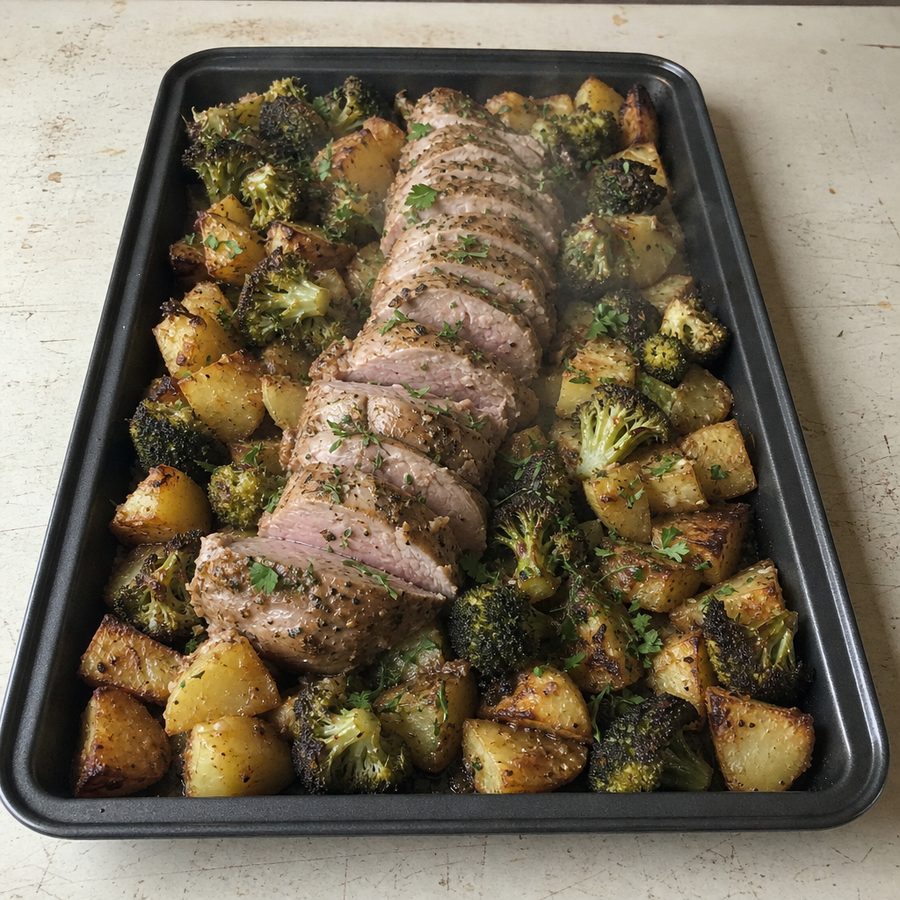
Pork tenderloin roasted whole on a tray of Yukon gold potatoes, brushed with maple and dijon, with broccoli florets added late so the tips char and the stems stay firm.
Why You'll Love This Recipe
On a Sunday the oven can do all of the work and still have you eating within the hour. One tray, one pork tenderloin, and a pile of potatoes that go in first so they get a head start. It eats like a proper plate of food rather than something you balance on a napkin, and it is what I hand people who tell me they are hungry again forty minutes after they eat breakfast. If your mornings are too rushed for this, roast it the night before and let the tray carry you through the week, which is what happens in my kitchen more often than not.
The staging is the whole recipe. Potatoes are cut small and given twenty minutes alone at 425°F (220°C) so their cut faces have time to stick and brown, and then the pork goes down the middle of the tray with the broccoli scattered around it for the last stretch. Pork tenderloin cooks fast and dries out faster, so it comes out at 145°F (63°C) and rests on a board while you spoon up the pan. The maple and dijon are brushed on for the final ten minutes only, because maple over direct heat for half an hour turns bitter and black, and ten minutes is exactly long enough for it to go sticky.
What makes this taste like more than roasted vegetables is what collects at the bottom of the pan. The mustard, the maple, and the pork juices run together into something you can drag a potato through, and the garlic-infused olive oil the potatoes were tossed in carries its own savory smell up through all of it. Broccoli tips that touch the hot metal go dark and almost nutty, which is my favorite part of the tray. Thyme roasts along with everything and turns gentle, parsley and lemon go on raw at the very end, and between the pork and the potatoes a plate of this holds me well into the afternoon.
Ingredients
- 1 1/4 lb pork tenderloin, silverskin trimmed off
- 1 1/2 lb Yukon gold potatoes, cut into 3/4-inch pieces
- 4 cups broccoli florets, cut with only a short stub of stem
- 3 tbsp garlic-infused olive oil, divided
- 2 tbsp dijon mustard
- 2 tbsp pure maple syrup
- 2 tbsp chopped fresh thyme leaves, divided
- 1 tsp smoked paprika
- 1 tbsp fresh lemon juice
- 1/4 cup chopped flat-leaf parsley
- 1 1/2 tsp fine sea salt, divided
- 1 tsp freshly ground black pepper, divided
Instructions
- Heat the oven and start the potatoes: Heat the oven to 425°F (220°C) with a rack in the upper third. Toss the potato pieces on a large rimmed sheet pan with 2 tablespoons of the garlic-infused olive oil, 3/4 teaspoon of the salt, the smoked paprika, and half the black pepper. Spread them into a single layer and turn each piece so that a flat cut face sits against the metal, since that contact is where the crust comes from.
- Give them a head start: Roast the potatoes alone for 20 minutes, until the undersides are browned and release from the pan when you push them with a spatula. If they stick, give them 3 more minutes and try again. A potato lets go by itself once its crust has formed.
- Season the pork and load the tray: While the potatoes roast, pat the tenderloin dry and rub it with the remaining tablespoon of oil, 1/2 teaspoon of the salt, the rest of the black pepper, and 1 tablespoon of the thyme. Push the potatoes to the edges of the hot pan and lay the pork down the center, because the edges of a tray run hotter and potatoes can take that heat where a tenderloin cannot, then scatter the broccoli around it with the remaining salt.
- Roast, then glaze: Roast for 12 minutes before the glaze goes anywhere near it, since maple syrup would be black long before the pork was done. Stir the maple syrup and dijon together, brush it thickly over the top and sides, and return the pan for 8 to 10 minutes, until an instant-read thermometer in the thickest part reads 145°F (63°C) and the glaze has gone sticky and dark at the edges.
- Rest the meat off the pan: Move the tenderloin to a board and let it rest for 10 minutes. It will climb a few degrees as it sits and the juices will settle back through the meat. If the broccoli wants more color while you wait, slide the pan back into the oven for 3 minutes.
- Slice and finish: Cut the pork into 1/2-inch medallions across the grain, since cutting with the grain leaves long fibers that eat tough, and lay them back on the pan so that they pick up the glaze and the juices. Scatter the remaining thyme and the parsley over the tray, squeeze the lemon juice over everything, and serve it straight from the pan.
Variations
- Salmon on the same tray: Lay four salmon fillets over the potatoes for the last 12 minutes and brush them with the maple and dijon for the final 5.
- Warm and spiced: Add 1 teaspoon of cumin and 1/2 teaspoon of chipotle powder to the potatoes, and finish the tray with lime rather than lemon.
- Greens at the end: Throw 4 cups of chopped kale over the pan for the final 5 minutes so the thin edges crisp and the rest wilts into the juices.
- Rutabaga or turnip: Swap half the potatoes for cubed rutabaga or turnip, both of which brown darker and taste sweeter after a long roast.
- Cheese over the vegetables: Grate parmesan over the potatoes and broccoli the moment the tray comes out so it melts against the heat.
Storage & Leftovers
Cooled and sealed, the tray keeps in the refrigerator for 4 days. Store the sliced pork with any pan juices poured over it, in a separate container from the vegetables, since potatoes go soft sitting under liquid. The broccoli holds its color better if you spread it out to cool before it goes into the box.
Reheat the potatoes and broccoli in a hot dry skillet or a 400°F (200°C) oven for 6 to 8 minutes so they crisp again rather than steam. The pork wants the opposite handling: 60 to 90 seconds in a covered pan over low heat with a spoonful of its juices, only long enough to take the chill off.
Freezing suits the pork on its own. Wrap the medallions tightly in a single layer, freeze for up to 2 months, and thaw overnight in the refrigerator before warming them gently. Roasted potatoes and broccoli come out of the freezer watery, so I would rather you ate those within the week.
Notes & Tips
- Why garlic-infused olive oil works: The flavor of garlic dissolves into fat and the part that troubles a sensitive gut does not, so the oil carries the taste and leaves the trouble behind in the bottle. Toss the potatoes in it at the start and it perfumes the whole tray.
- Stagger the tray: Potatoes need about twice as long as pork tenderloin does. Give them 20 minutes alone and everything finishes at the same moment.
- Use a thermometer, not the clock: Pork tenderloin goes from juicy to dry in about four minutes. Pull it at 145°F (63°C) at the thickest point and let the carryover heat do the rest while it rests.
- Glaze late: Maple brushed on at the start will be black by the end. Ten minutes is long enough for it to turn sticky and still taste of maple.
- Florets, not stalks: Cut the broccoli so each floret keeps only a short stub of stem. The tips char in that heat, and thick stalks would still be tough when the pork is ready.
- Rest it on a board, not the pan: The pan is hot enough to keep cooking the meat from underneath. Move the tenderloin off to rest and slice it only when you are ready to eat.
Nutrition & Mindful Eating
- Pork, potatoes, and broccoli split the work on this tray. The pork gives the plate its substance, the potatoes brown into something starchy and sweet underneath it, and the broccoli tips go dark and almost nutty against both.
- Pork tenderloin is close-grained and mild, and roasted whole it slices into medallions that stay juicy in the middle. It carries thiamin, one of the B vitamins the body uses to pull energy out of the food around it, along with the protein doing most of the work on this plate.
- Yukon gold potatoes have enough waxiness to hold their shape and enough starch to crisp at the cut faces. Cooked and then cooled, which is how you meet them when you eat this from the refrigerator, some of that starch turns into resistant starch, the kind that feeds the bacteria living in your gut.
- Broccoli florets roasted at high heat lose their raw green smell and turn sweet and slightly charred at the tips. They bring vitamin C and vitamin K, and the short stub of stem left on each floret keeps a little bite against all that soft potato.
- Dijon, maple, thyme, and lemon are what keep a roasted tray from tasting flat. The mustard brings the sharpness, the maple only enough sweetness to catch on the meat, and the lemon goes on raw at the end. A plate this size holds you a long stretch, and the protein in the pork is doing most of that.
- As you eat, notice the difference between the potato faces that touched the hot pan and the ones that did not, and give yourself long enough at the table to feel the meal land rather than finishing it standing over the tray.
Frequently Asked Questions
Can I use pork chops or another cut?
Boneless chops work if they are at least an inch thick. Start them with the potatoes rather than after, and pull them at 145°F (63°C). Chicken breast fits the timing almost exactly as written. Pork tenderloin's advantage is only that it roasts as one piece and slices into neat medallions.
My potatoes stuck to the pan and tore. What went wrong?
They were moved too early. A cut potato grips hard until its crust forms and then lets go on its own, so leave them alone for the full 20 minutes and test with a thin metal spatula. A dark heavy pan and an uncrowded single layer both help.
Can I get this on the table on a weekday?
Cut the potatoes and trim the pork the night before and keep them covered in the refrigerator, and the morning is only the roasting. The whole tray also reheats well enough that I usually roast it on Sunday and eat it again on Tuesday and Thursday.
Does this fit a low-FODMAP breakfast?
It does. Pork, potatoes, and thyme are all comfortable here, and broccoli sits in the gentle range as long as you use the florets rather than the thick stalks. The savory depth comes from garlic-infused olive oil, dijon, and the browned pan rather than from garlic cloves or onion, so nothing gets stripped out of the recipe.