
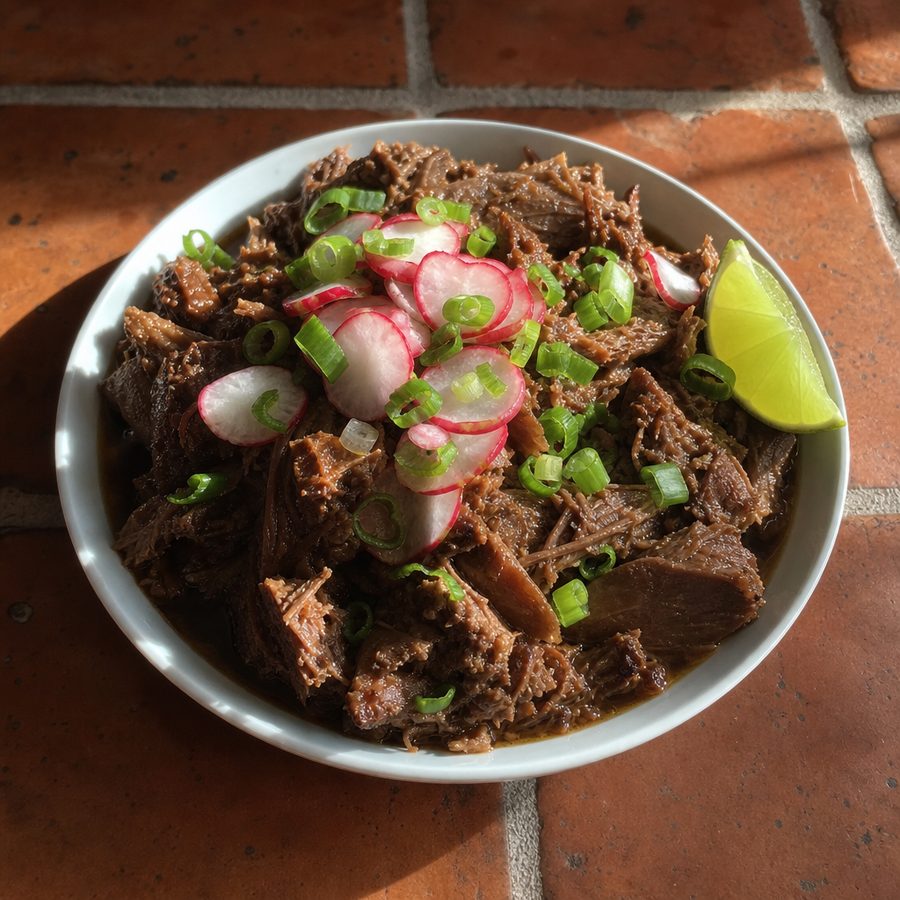
Shredded Beef Chuck with Pickled Radish and Lime
Beef chuck braised low with onion, garlic, and bay until it shreds, then eaten barely warmed under sharp cider-pickled radishes, scallions, and lime.
Why You'll Love This Recipe
This is a Sunday job that feeds most of a week, and it is what I hand people who tell me they cannot face cooking anything in the morning. Two pounds of chuck goes into a low oven with broth, onion, and bay, and then it is left completely alone for three hours while you do something else with your afternoon. The radishes get sliced and covered in cider vinegar somewhere in that same hour. On Monday morning breakfast is a bowl of shredded beef warmed for two minutes with a fistful of hot pink radish over the top, and finding a fork takes longer than making it.
Sear the meat properly before any liquid goes near it. Two inches of space between the pieces, a genuinely hot pan, and about four minutes a side is what gives you the browned crust the whole braise ends up tasting of, and crowded gray meat gives you a pale and watery pot. After that the oven does all the work. Three hours at 300°F (150°C) is where the connective tissue in the shoulder turns to gelatin, which is the difference between meat you pull apart with two forks and meat you have to saw at. The pickled radishes ask for vinegar, salt, a teaspoon of honey, and an hour in the refrigerator, though they are better the next day.
What makes this a breakfast rather than a dinner is the radish. Chuck cooked this long is genuinely rich, and rich meat at seven in the morning is hard going with nothing sharp beside it. Sliced thin and left in cider vinegar, radishes go bright at the rims, stay crisp all week, and taste hot and sour at the same time, which is exactly what cuts through fat. Lime and scallion go on last. The beef itself carries a real amount of protein and it holds you well into the afternoon, which is the honest reason to spend a Sunday on it.
Ingredients
- 2 lb boneless beef chuck roast, cut into 2-inch pieces
- 2 bunches radishes (about 10 oz), trimmed and sliced paper thin
- 1/2 cup apple cider vinegar
- 2 cups beef bone broth
- 1 large yellow onion, quartered
- 5 cloves garlic, smashed
- 2 bay leaves
- 2 tbsp fresh lime juice, plus wedges to serve
- 4 scallions, thinly sliced
- 1 tsp honey
- 1 tbsp olive oil
- 1 1/4 tsp fine sea salt, divided
Instructions
- Season and sear the beef: Pat the chuck pieces very dry and season them with 3/4 teaspoon of the salt. Heat the olive oil in a Dutch oven over medium-high until it shimmers, then sear the pieces in two batches, about 4 minutes a side, until each one has a dark brown crust. Move them to a plate, since the pot needs the browned layer they leave behind and nothing else in this braise is deep enough to replace it.
- Build the braise: Add the onion and garlic to the pot and cook for 3 minutes, scraping up the browned bits as they soften. Pour in the bone broth, add the bay leaves, and bring it to a simmer. Return the beef and any juices, then cover the pot.
- Braise it low: Slide the covered pot into a 300°F (150°C) oven for 3 hours. It is ready when a fork twists in the thickest piece with no resistance at all. If it still holds together, give it another 30 minutes, since undercooked chuck only ever gets tender with more time.
- Pickle the radishes: While the beef cooks, put the sliced radishes in a jar with the cider vinegar, the honey, 1/4 teaspoon of the salt, and 2 tablespoons of water. Press them under the liquid, close the jar, and refrigerate for at least 1 hour, because that is how long the vinegar needs to take the raw heat out of a radish and turn it pink the whole way through. They keep for up to 2 weeks.
- Shred and reduce: Lift the beef out and pull it apart with two forks. Fish out the bay leaves, then simmer the liquid on the stovetop for 8 to 10 minutes, until it reduces to about a cup and looks glossy, since three hours of braising leaves you with far more liquid than the meat can carry. Return the meat, add the remaining salt, and turn it through the liquid.
- Cool now, eat in the morning: Cool the beef uncovered for 30 minutes before it goes into the refrigerator, because a warm covered container steams itself and the meat sits in water by morning. In the morning warm a portion in a skillet for 2 to 3 minutes, add the lime juice off the heat, and pile the drained pickled radishes and scallions over the top.
Variations
- Orange and bay: Swap the lime for the juice and zest of an orange, which gives the beef a rounder, sweeter finish.
- Turnip pickle: Use thin-sliced turnip or kohlrabi in the jar in place of radish for something milder and sweeter against the meat.
- Avocado bowl: Add half a sliced avocado to each bowl in the morning for a softer, richer plate under the pickles.
- Broth bowl: Spoon the beef into a mug of hot bone broth with the scallions for something you can drink at the counter.
- Herb finish: Stir a handful of chopped parsley or chives into the shredded meat while it is still warm for a greener, fresher bowl.
Storage & Leftovers
The shredded beef keeps in its liquid in a sealed container in the refrigerator for up to 4 days and genuinely improves after the first night, once the gelatin sets and the salt has worked all the way through. Store it in its braising liquid rather than drained, since that liquid is what keeps it from drying out.
Reheat a portion in a skillet over medium for 2 to 3 minutes with a spoonful of its own liquid, or eat it cold straight from the container, which is how I usually do it on a weekday. The pickled radishes hold their crunch in the jar for 2 weeks and get pinker and milder as they sit.
The beef freezes well for up to 3 months. Portion it into bags with enough liquid to cover, freeze it flat, and thaw it overnight in the refrigerator. Do not freeze the radishes, since they go limp and hollow on thawing and the whole point of them is the crunch.
Notes & Tips
- This is a Sunday job: Three hours in the oven feeds four breakfasts, so make it on an afternoon you are home anyway. Nobody should be searing chuck on a weekday morning.
- Sear in two batches: Crowding drops the pan temperature and the meat steams in its own juice. Two batches costs 8 minutes and is the whole flavor of the pot.
- Cut the pieces big: Two-inch chunks hold their moisture over three hours. Smaller pieces dry out and shred into threads with nothing to bite.
- Use a mandoline for the radishes: Paper thin is what makes them pickle in an hour and stay crisp. A knife works, but you have to be patient with it.
- Do not skip the reduction: That cup of glossy liquid is what coats the shredded meat and keeps it good on day four. Braising liquid left thin just pools in the container.
- Make it the day before you want it: Chuck tastes better after a night in the refrigerator, and the fat rises and sets so you can lift off as much or as little as you like.
Nutrition & Mindful Eating
- Beef, broth, and pickled radish are the three parts of this bowl and each one needs the others. The meat brings richness and substance, the broth turns silky as it reduces, and the sharp radishes on top are what keep something this rich from wearing you out by the third bite.
- Chuck is the cut that makes this what it is. Its connective tissue melts into gelatin over the long cook, which is where the glossy texture comes from, and the meat carries iron in the form the body absorbs most readily along with zinc and B12.
- Radishes are peppery and wet and stay crisp even after days in vinegar, and they bring vitamin C to a bowl built on meat. That mustardy bite is what wakes up a bowl of long-cooked beef.
- Bone broth simmered from bones carries the collagen that gives the finished liquid its body, and reducing it concentrates that until it coats the shredded meat rather than pooling underneath it.
- Cider vinegar, lime, and raw scallion are the whole finish, and they all go on cold. Acid against warm fatty beef is what makes it taste clearly of beef, and it is the reason you reach for the salt shaker less than you would expect.
- As you eat, try one bite of the beef on its own and the next with a pile of pickled radish on it, and notice how differently the same meat lands when something sharp arrives alongside it.
Frequently Asked Questions
Can I use a slow cooker or a pressure cooker?
Both work. Sear the meat in a skillet first either way, since that browning is most of the flavor. Then give it 8 hours on low in a slow cooker or 45 minutes at high pressure with a natural release, and reduce the liquid on the stovetop afterward.
My beef was still tough after three hours. What happened?
Tough chuck almost always means undercooked chuck rather than overcooked. Check that the lid sits tight, since a loose one lets the steam out and the pot runs dry, and give it another 30 to 45 minutes. The fork should twist with no resistance at all.
Do the radishes have to sit overnight?
An hour is enough to make them sharp and pink at the edges, and overnight makes them rounder and less aggressive. Slice them paper thin either way, since thick coins stay raw-tasting in the middle no matter how long they sit in the jar.
Does this fit an AIP elimination phase?
It does. There are no grains, legumes, dairy, eggs, nuts, seeds, or nightshades in it, and the seasoning is onion, garlic, bay, vinegar, and lime. Check the bone broth carton, though, since many of them carry black pepper or paprika that will not show up in the name.