
Sicilian Caponata with Chickpeas over Farro
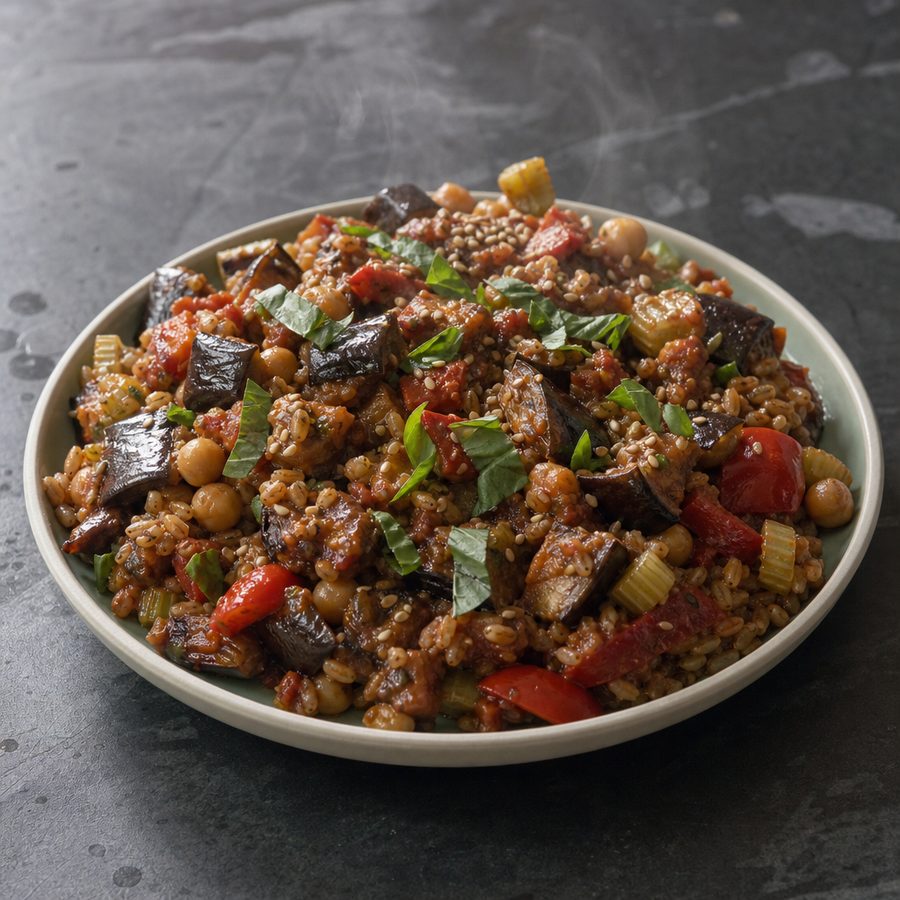
Eggplant browned hard, then simmered down with peppers, celery, and tomato into a sweet and sour tangle with balsamic and maple syrup, spooned over farro with chickpeas, basil, and toasted sesame.
Why You'll Love This Recipe
Caponata is one of those dishes that repays you for standing at the stove. The eggplant has to brown properly first, in a hot pan with room around each cube, and that stage cannot be hurried or crowded. After that it is mostly waiting: the vegetables cook down, the tomato reduces, and somewhere around the twenty five minute mark the whole thing stops being a pile of chopped vegetables and becomes one thing. The vinegar and the touch of sweetness at the end are what make it Sicilian rather than just a stew, and that sweet and sour finish is the flavor people cannot place and keep going back for.
Warm or at room temperature, it eats soft and dense and a little jammy, with the celery holding on to just enough bite to remind you it is there. The farro underneath is the opposite: nutty, chewy, each grain separate. Chickpeas go in whole so they stay firm and give you something to bite through, and the toasted sesame on top is a Sicilian habit worth keeping, since almost every loaf of bread on the island wears a coat of it. Basil torn over at the last second is the smell that hits before the first forkful.
Caponata is one of the few things that is genuinely better on day three than on day one, which is why I make it on purpose when I know the week ahead is busy. Cook it Sunday, keep the farro separate, and you have four lunches that need nothing but a warm pan or not even that. It also travels: packed cold in a jar with the basil added when you eat it, it holds up better than any salad I know.
Ingredients
- 2 medium eggplants (about 1 1/2 lb total), cut into 3/4-inch cubes
- 1 large red bell pepper, seeded and cut into 1/2-inch dice
- 2 celery stalks, sliced 1/4 inch thick on an angle
- 1 large yellow onion, halved and sliced thin
- 1 1/4 cups no-salt-added crushed tomatoes
- 1 1/2 cups no-salt-added chickpeas, drained and rinsed well
- 2 cups cooked farro (from about 3/4 cup dry, simmered in unsalted water)
- 3 1/2 tbsp extra-virgin olive oil, divided
- 1 1/2 tbsp balsamic or red wine vinegar
- 1 tsp maple syrup
- 3 garlic cloves, minced
- 1 1/2 tsp dried oregano
- 2 tbsp sesame seeds
- 1/2 cup torn fresh basil leaves
- 1/2 tsp coarsely ground black pepper
Instructions
- Brown the eggplant hard: Heat 2 tbsp of the oil in a wide skillet over medium-high until it shimmers. Add half the eggplant in a single layer and leave it for 3 minutes without touching it, until the undersides are deep brown, then toss and cook 3 minutes more. Move it to a bowl and repeat with another tablespoon of oil and the rest. Crowding the pan here is the one mistake that cannot be undone later.
- Soften the aromatics: Lower the heat to medium, add the last of the oil, and cook the onion, pepper, and celery together for 8 minutes, stirring occasionally, until the onion is translucent and the celery has lost its squeak but still has a little resistance. Stir in the garlic and oregano and cook 1 minute more, until they smell sweet.
- Bring it together with tomato: Return the eggplant to the pan with the crushed tomatoes and the black pepper. Bring it to a slow bubble, then turn the heat to low and cook uncovered for 25 minutes, stirring every five, until the eggplant has collapsed, the tomato has darkened, and the mixture holds its shape when you push a spoon through it.
- The sweet and sour finish: Stir in the vinegar and the maple syrup and cook for 3 to 4 minutes, until the sharp smell of the vinegar has cooked off and the pan looks glossy. Taste it now and adjust: it should land sweet first and sour just behind, with neither one winning. Add a splash more vinegar if it tastes flat.
- Toast the sesame: While the caponata finishes, toast the sesame seeds in a small dry pan over medium heat for 2 to 3 minutes, shaking constantly, until they are straw colored and popping. Tip them onto a cold plate right away so they stop cooking.
- Build the bowls: Warm the farro through, either in the microwave or in a dry pan with a splash of water, and divide it between four bowls. Fold the chickpeas into the caponata off the heat so they warm without breaking up, spoon it over the farro, and finish each bowl with the toasted sesame and a good handful of torn basil.
Variations
- With white beans: Use cannellini beans in place of the chickpeas for a softer, creamier bite that melts into the eggplant.
- Extra herb: Stir a tablespoon of chopped mint in with the basil, which is common in the eastern half of Sicily and makes the whole bowl taste cooler.
- On bread: Skip the farro and pile the caponata onto thick griddled bread rubbed with garlic, which is how it usually turns up as an appetizer.
- Fennel and orange: Add a diced fennel bulb with the celery and a strip of orange peel with the tomato for a brighter, more perfumed version.
Storage & Leftovers
Caponata keeps five days in a sealed container in the refrigerator and genuinely improves for the first three. The vinegar and the maple syrup work their way into the eggplant, the tomato settles, and the sharp edges round off. Store it separately from the farro so the grain does not go soft, and hold the basil back until you serve it.
It is meant to be eaten at room temperature as often as warm, so take a portion out twenty minutes before you want it and you may not need a pan at all. If you do want it hot, three or four minutes in a skillet over medium is plenty. Add the sesame and basil after reheating, since both go dull under heat.
It freezes for three months and comes back remarkably well, better than most vegetable dishes, because the eggplant is already fully collapsed and has nothing left to lose. Freeze it flat in sealed portions, thaw overnight in the refrigerator, and refresh it with a small splash of vinegar when you reheat, which wakes the sweet and sour back up.
Notes & Tips
- Brown the eggplant in two batches: A crowded pan traps steam and you get gray, squeaky cubes that never develop flavor. Two batches costs six extra minutes and is the difference between good caponata and forgettable caponata.
- Cut the cubes big: Three-quarter-inch pieces survive both the browning and the long simmer. Anything smaller disappears entirely, and you want some cubes still recognizable in the finished pan.
- Add the vinegar at the end: Poured in early, it cooks away and leaves only a vague sweetness. Added in the last few minutes, it stays sharp enough to cut the richness, which is the entire point of the dish.
- Let it sit before you judge it: Caponata tastes unbalanced straight off the heat, usually too sour. Give it fifteen minutes off the burner before you decide it needs anything, and taste it again.
- Rinse the chickpeas properly: Drain them, then run cold water over them in a sieve for a good thirty seconds and shake them dry. It rinses away the starchy canning liquid that would otherwise cloud the pan.
Nutrition & Mindful Eating
- Eggplant, peppers, and celery are the body of this dish, with the chickpeas and farro underneath giving it structure. It is a bowl that is mostly vegetable by weight, and the grain and the legume are what make it sit like a proper lunch rather than a side.
- Eggplant has a spongy flesh that collapses into creaminess once it is browned and simmered, and it carries a soft fiber along with the purple-skin pigments called anthocyanins, which is where its color comes from.
- Chickpeas go in whole and stay whole, which is why they give the bowl something to bite through. They bring plant protein and a fiber that ferments slowly in the gut, and folate along with it.
- Farro is an ancient wheat with a husk that keeps the grain separate and chewy no matter how long it sits under a sauce, and its whole-grain fiber is a large part of why this bowl holds you through an afternoon.
- The balsamic and the spoonful of sweetness are the finish that makes this Sicilian. Sweet and sour together do something neither does alone, and they are the reason a pan of soft vegetables tastes vivid instead of muted.
- As you eat, notice the sour arriving a beat after the sweet, and let the chew of the farro slow you down enough to finish the bowl at the pace it was cooked.
Frequently Asked Questions
Do I need to salt and drain the eggplant?
Not for bitterness, which modern varieties have mostly been bred out of. It does firm the flesh and reduce how much oil the cubes take up, so if you have an extra half hour it is not wasted. Toss the cubes with a teaspoon of salt, leave them in a colander for 30 minutes, then rinse and press them dry in a towel.
Can I use a different grain?
Barley is the closest match and behaves exactly the same way. Bulgur is faster and softer, brown rice works if that is what is cooked, and if you want it lighter, skip the grain and pile the caponata onto griddled bread instead. Farro is my preference because it stays separate and chewy under something this soft.
Mine came out watery. What went wrong?
Either the eggplant was steamed instead of browned, or the last simmer was too short. Both are fixed the same way: keep it on low, uncovered, for another ten minutes and stir now and then. It is ready when a spoon dragged across the bottom leaves a track that closes slowly.
How sweet should it actually taste?
Sweet enough to notice, sour enough that you reach for another bite. A teaspoon of maple syrup against a tablespoon and a half of vinegar is where I land, but tomatoes vary a lot. Taste at the end and move whichever direction it needs, a half teaspoon at a time.