
Sicilian Smothered Cabbage with White Beans and Farro
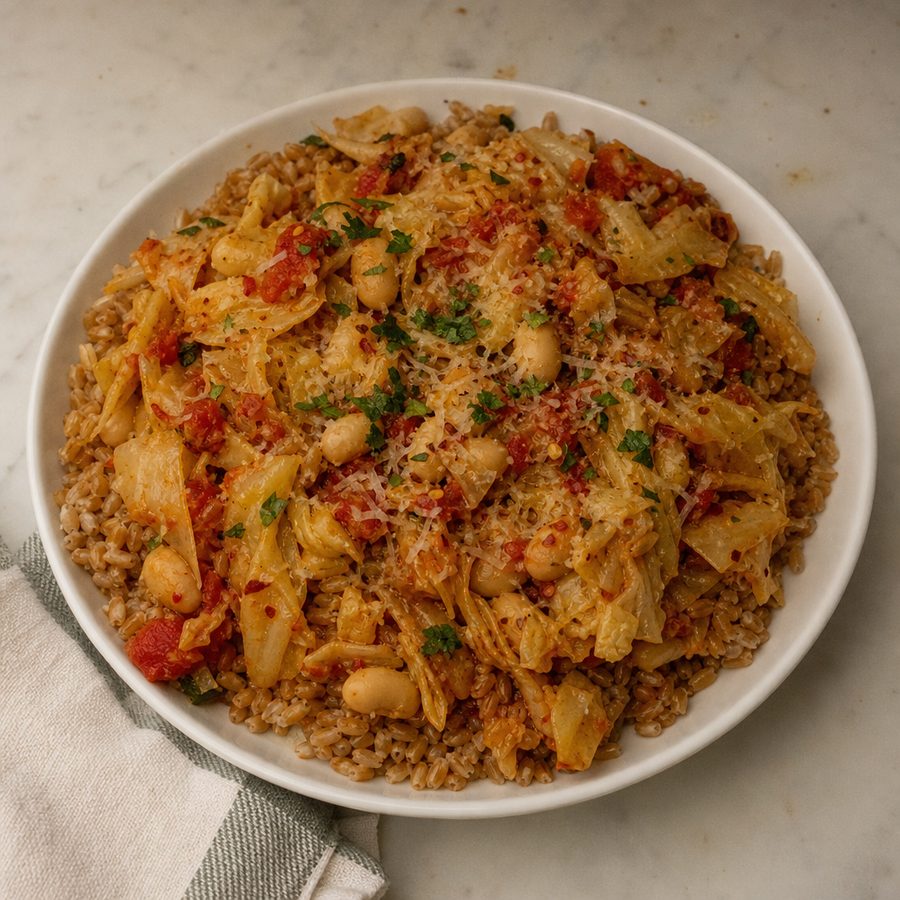
A whole head of cabbage cooked down slowly with onion, garlic, crushed tomato, and chile until it turns sweet and silky, folded with white beans and spooned over farro with grated parmesan.
Why You'll Love This Recipe
Cabbage has a reputation it does not deserve, and I blame boiling. Cooked slowly in olive oil with the lid on, in the Sicilian way they call affogato, it does something else entirely: the sulfur smell never appears, the sugars come forward, and by forty minutes in you have a pan of soft golden ribbons that taste sweet and savory at once. It costs almost nothing, it makes a lot, and it is the dish I make when the refrigerator is empty except for a cabbage that has been sitting there since last week.
The technique is worth learning because it works on almost any hardy vegetable. You cook the onion until it is properly sweet, add sliced garlic and chile, then pile the cabbage in with a splash of water and put the lid on. It looks like far too much for the pan and then in ten minutes it is half the volume. After that the lid comes off, the tomato goes in, and the moisture cooks away while the ribbons on the bottom brown a little. Those browned bits are what make people go back for a second bowl.
White beans and farro turn a side dish into lunch. The beans go in near the end, just long enough to warm through and soften at the edges without breaking apart, and the farro underneath stays chewy and separate. Parmesan and a spoonful of cider vinegar are the last two things, and they pull in opposite directions in a way the dish needs. Leftovers reheat beautifully, which is more than I can say for most vegetables, and I have eaten this cold standing at the counter more than once.
Ingredients
- 1 medium head green cabbage (about 2 lb), cored and cut into 1-inch ribbons
- 2 cups cooked farro, warm
- 1 large yellow onion, halved and thinly sliced
- 3/4 cup no-salt-added crushed tomatoes
- 1 cup no-salt-added cannellini beans, drained and rinsed well
- 3 1/4 tbsp extra-virgin olive oil, divided
- 1/3 cup finely grated parmesan
- 5 garlic cloves, thinly sliced
- 1/4 cup chopped flat-leaf parsley
- 1 tbsp cider vinegar
- 1 1/2 tsp dried oregano
- 1/2 tsp freshly ground black pepper
- 1/8 tsp fine sea salt
- 1/4 tsp cayenne, or more to taste
Instructions
- Cut the cabbage: Quarter the head through the core, cut the core out of each quarter, and slice the leaves crosswise into ribbons about an inch wide. You want ribbons rather than shreds, since anything finer disappears into the sauce. Do not worry about the pieces that fall apart.
- Sweeten the onion: Warm 2 1/2 tbsp of the olive oil in a large Dutch oven over medium heat, add the onion and the salt, and cook for eight minutes, stirring now and then, until the slices are limp and beginning to color. Add the garlic, oregano, cayenne, and black pepper and cook one minute more, until the garlic smells sweet.
- Get the cabbage in and covered: Add the cabbage in two or three additions, stirring each one down before the next goes in, along with 1/3 cup water. Cover the pot and cook for twelve to fifteen minutes over medium-low, stirring twice, until the volume has dropped by half and the ribbons are floppy.
- Add the tomato and cook it down: Stir in the crushed tomatoes, take the lid off, and cook for twenty minutes over medium-low, stirring every few minutes. The liquid should cook away and the cabbage should start to stick and brown in patches on the bottom of the pot, which you scrape up and stir back in. That is where the flavor is.
- Fold in the beans: Add the cannellini beans and cook five minutes more, stirring gently so they warm through and pick up the sauce without breaking. Taste and add more cayenne if you want it hotter. Take the pot off the heat and stir in the cider vinegar and the remaining olive oil.
- Serve it over the farro: Spoon the warm farro into four wide bowls and pile the cabbage over the top with all the sauce. Grate the parmesan over while everything is still hot enough to melt it, scatter the parsley, and serve.
Variations
- With fennel seed: Add a teaspoon of fennel seed with the garlic for a rounder, more anise-scented version that suits colder weather.
- Chickpeas rather than white beans: Swap in chickpeas for a firmer bite that holds its shape completely against the soft cabbage.
- With ricotta: Leave out the parmesan and put a spoonful of whole milk ricotta on each bowl, letting the heat of the cabbage soften it.
- Tossed with pasta: Skip the farro and fold the finished cabbage through a pound of cooked whole wheat pasta with a splash of the cooking water.
Storage & Leftovers
The cabbage keeps five days in a sealed container in the refrigerator and improves for the first two or three of them, the way most slow-cooked vegetable dishes do. Keep the farro in its own container so it stays chewy, and grate the parmesan fresh each time rather than storing it on top.
Reheat the cabbage in a skillet over medium heat for four or five minutes, spread out and left alone for the first two so the edges catch again. A splash of water loosens it if it has tightened up. The microwave works and is faster, though you lose the browned edges that make it worth eating.
It freezes well for up to three months, which is unusual for a cabbage dish and comes down to how thoroughly it is cooked in the first place. Freeze it without the farro or the cheese, thaw overnight in the refrigerator, and finish with fresh vinegar and parmesan.
Notes & Tips
- Cut ribbons, not shreds: Inch-wide ribbons keep their identity through forty-five minutes of cooking. Finely shredded cabbage turns to a puree and you lose the texture that makes the dish.
- Let it stick a little: The brown patches on the bottom of the pot after the lid comes off are flavor, not a mistake. Scrape them up with a wooden spoon and stir them through every few minutes.
- Add the beans last: Five minutes is all they need. Any longer and they break down into the sauce, and you lose the creamy whole beans that give each spoonful something to bite.
- Grate the cheese over hot food: Parmesan grated onto the cabbage straight from the pot melts into the sauce. Added once the bowl has cooled it sits on top in dry threads.
- Use the widest pot you own: Two pounds of cabbage is bulky at the start and the pieces on top will steam rather than cook if the pot is narrow. A wide Dutch oven gets everything down to size faster.
Nutrition & Mindful Eating
- Cabbage, white beans, and farro make this a full bowl. The cabbage cooks down to a soft, sweet base, the cannellini beans bring creaminess and plant protein, and the chewy farro underneath gives the whole thing enough substance to sit like a real lunch.
- Cabbage is a member of the brassica family, and long slow cooking turns its sulfur compounds gentle and its sugars forward. It carries vitamin C and vitamin K along with a fiber that softens completely here, which is often easier on people who find crisp vegetables uncomfortable.
- Cannellini beans have a thin skin and a floury inside, so they turn creamy at the edges once they warm in the sauce, and they bring folate, plant protein, and the kind of fiber that ferments slowly in the gut.
- Farro is an ancient wheat with a chew that holds up under a wet sauce, and it carries magnesium and B vitamins along with a nutty flavor that gets stronger the longer the grain sits in the pan juices.
- Garlic, oregano, cayenne, and a spoonful of cider vinegar at the end are what keep something this sweet from tasting one-note, and the parmesan grated over the top while it is hot brings a savory depth you can taste in every bite.
- As you eat, notice how little this tastes like the cabbage you put in the pot, and let the first few forkfuls go slowly enough that you catch the sweetness underneath the chile and the cheese.
Frequently Asked Questions
Will my kitchen smell like boiled cabbage?
No, and that is the point of cooking it this way. The smell people dislike comes from sulfur compounds released by hard boiling in a lot of water. A covered pot with olive oil and very little liquid, cooked slowly, gives you a sweet and savory smell instead.
Can I use savoy or red cabbage?
Savoy is excellent here and cooks about five minutes faster since the leaves are more crinkled and tender. Red cabbage works too, though it stains everything in the pot purple and takes closer to an hour to reach the same softness.
Do I have to use farro?
No. Barley, brown rice, or a short whole wheat pasta all work underneath it, and in Sicily this would often be tossed straight through pasta with the cheese. Choose whichever you already have cooked.
It tastes flat. What is missing?
Almost always the vinegar or the heat. A long-cooked sweet vegetable needs something sharp at the end to give it definition, so add another teaspoon of vinegar off the heat, then more cayenne, tasting between each.