
Silken Steamed Eggs with Melted Butter
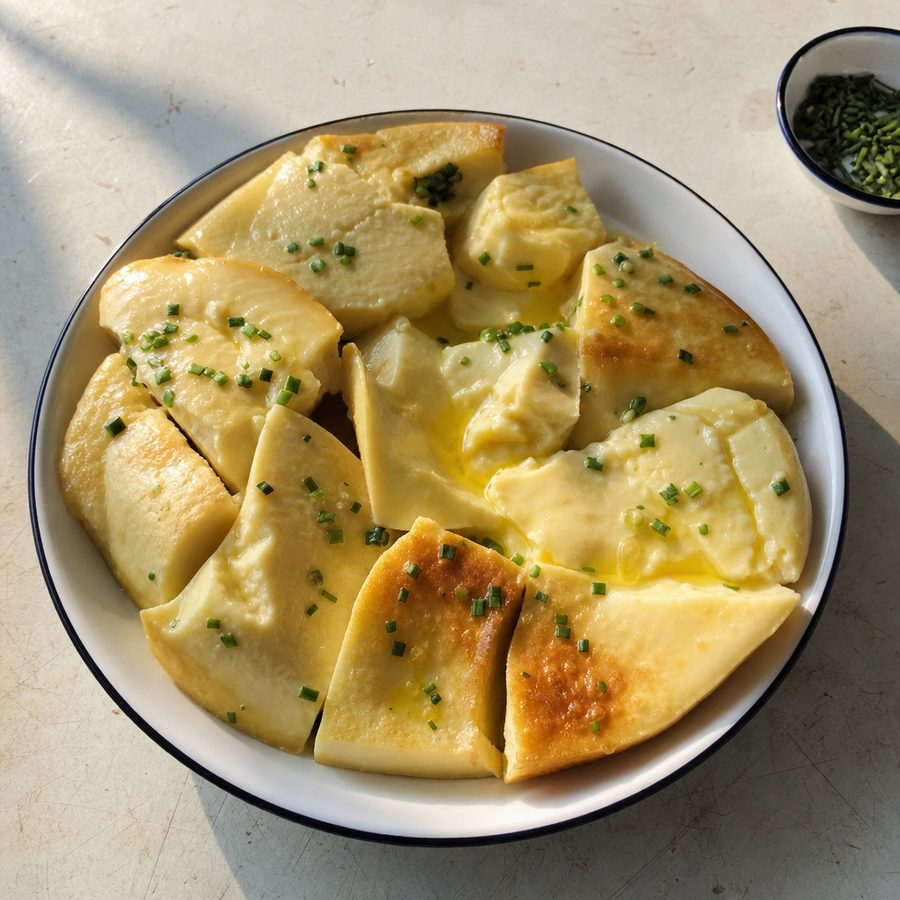
Eggs beaten with warm milk, strained twice, and steamed over the gentlest heat into a trembling savory custard, finished with butter poured over the surface.
Why You'll Love This Recipe
Every other way I cook eggs in the morning is loud and fast. This one is neither, and it has become the breakfast I make when I want something warm and quiet before the day starts. Eggs beaten with warm milk and cooked in steam rather than in a pan set into a savory custard, somewhere between a soft-boiled yolk and a panna cotta. There is no browning and no crust, which sounds like a loss and is not; what you get instead is one uniform, silky texture and a very clean taste of egg and warm dairy that nothing is competing with.
The technique is entirely about restraint. Beat the eggs flat rather than whipping air into them, strain the mixture so no ropy bits of white survive, cover the bowls so condensation cannot drip and pit the surface, and above all keep the water at a lazy shiver rather than a boil. Steam that is too violent drives bubbles through the custard and leaves it pocked like a honeycomb, still edible but grainy. Kept gentle, it sets into something you could see your reflection in, and that mirror surface is a matter of pride once you have managed it twice.
It suits a slow morning, and it is the breakfast I make for anyone who is not feeling well, since it goes down easily and still carries a real amount of food. It also works for a crowd better than a skillet does, because four bowls steam at exactly the same rate and are all ready at the same moment, which no pan of scrambled eggs has ever managed. You can strain the mixture the night before and keep it covered in the refrigerator, so the morning is nothing but pouring, covering, and waiting. If you have never cooked eggs this way, give it two attempts before you judge it. The first one teaches you what your burner does at its lowest setting, and the second one comes out with a surface like glass.
Ingredients
- 10 large eggs
- 2 cups whole milk, warmed to just above body temperature
- 2 tbsp butter, melted, for pouring over
- 1/2 tsp fine sea salt
Instructions
- Warm the milk and beat the eggs: Heat the milk until it is just warm to a fingertip, around 100°F, and no hotter. Crack the eggs into a bowl with the salt and beat them with a fork or a whisk held flat against the bottom, working the yolks and whites together without lifting the whisk clear. You want them uniform and pale, not foamy, since air is what turns a custard bubbly.
- Combine and strain twice: Pour the warm milk into the eggs in a slow stream while beating gently, then pass the whole mixture through a fine mesh sieve into a jug. Do it a second time. What stays behind in the sieve is the ropy chalaza and any stubborn strands of white, and it has to come out because that is the difference between a silky custard and a lumpy one. Skim off any foam on top with a spoon until the surface is clear.
- Fill and cover the bowls: Divide the mixture among four shallow heatproof bowls or ramekins, filling each about three quarters full. Cover each one tightly with foil or a small plate. This is not optional. The condensation collecting on the lid of the pan will otherwise rain onto the custard and leave the top pitted and wet.
- Steam very gently: Set the bowls in a wide pan or steamer over an inch of water, bring the water to a bare simmer, then turn the heat to low so it is barely shivering. Cover the pan and steam for twelve to fourteen minutes. Do not let the water reach a rolling boil at any point, because hard steam blows bubbles through the custard and honeycombs it.
- Check the tremble and finish: Uncover one bowl and nudge it. The custard should move as a single mass with a slight wobble at the middle, and a knife slipped in at the edge comes out clean. If the center is still liquid, cover it and give it two more minutes, since a custard pulled early slumps as soon as you put a spoon through it. Pour a spoonful of melted butter over each bowl and serve while the surface is still hot enough to spread it.
Variations
- Crab or shrimp underneath: Drop a spoonful of picked crab or chopped cooked shrimp into each bowl before you pour, so it sits suspended in the finished custard.
- Cheese on top: Grate a little hard cheese over the hot surface as it comes out of the steamer and let the residual heat melt it in.
- Browned butter: Cook the butter until the solids turn golden and it smells nutty before pouring it over, which gives a plain custard a deep toasted edge.
- Cream for a firmer set: Replace half a cup of the milk with heavy cream for a richer, denser custard that holds a spoon mark.
- Crisped bacon: Scatter crumbled crisp bacon over the top just before serving so it stays crunchy against the soft custard.
Storage & Leftovers
Steamed eggs keep three days covered in the refrigerator and set firmer as they chill, closer to a sliceable custard than the trembling thing that came out of the steamer. Some watery liquid may weep out around the edge overnight, which is normal, and you can simply tip it off.
Reheat in the steamer over low heat for four or five minutes, covered, which returns almost all of the original softness. A microwave will work in twenty-second bursts at half power, but it is unforgiving here, and one burst too many turns a silky custard into a rubbery puck.
Do not freeze this. Egg custard separates into curds and water on thawing and there is no bringing it back. It is quick enough to make fresh that I have never wanted to, and the mixture itself can be strained and refrigerated overnight so the morning is nothing but pouring and steaming.
Notes & Tips
- Beat flat, never whip: Keep the whisk on the bottom of the bowl and do not lift it. Every bubble you beat in now is a bubble in the finished surface.
- Strain twice, not once: The second pass through the sieve is what catches the last of the stringy white. It takes ten seconds and it is the single biggest upgrade to the texture.
- Warm the milk first: Cold milk lengthens the steaming time and makes the outside set well before the middle. Just warm to the touch is exactly right, and hotter than that will start cooking the eggs in the jug.
- Cover every bowl: Foil or a small plate over each one keeps condensation off the surface. Skip it and the tops come out pocked and watery no matter how well you steamed.
- Keep the water shivering: If you can hear it rolling, it is too hot. A quiet pan with a thin thread of steam escaping is what you are aiming for.
- Pull it slightly underdone: The custard carries on setting from its own heat for a minute or two after it leaves the steamer, so a center that still wobbles is finished rather than underdone.
Nutrition & Mindful Eating
- Eggs, milk, and butter make one smooth thing here rather than three separate ones. The eggs give the custard its structure, the milk softens that structure into something silky, and the butter poured over at the end carries the flavor across the surface.
- Eggs set this custard entirely on their own, since their proteins unwind and link together at a low temperature and trap the liquid around them. The yolks are also where the choline sits, along with the vitamins A and D that give the finished bowl its pale gold color.
- Whole milk is what keeps this soft. Diluting the eggs raises the temperature at which they set and slows the whole process down, which is why the texture ends up closer to a custard than a scramble, and the milk brings a real amount of calcium with it.
- Butter goes on last and stays on the surface rather than cooking into the dish. It melts into the warm custard as you eat, and the butterfat carries vitamin A and the smell that makes a plain bowl of eggs feel like something made on purpose.
- A bowl of this holds you through the morning more solidly than its softness suggests, with the protein from the eggs and the milk together doing that work. The salt goes in with the eggs at the start, where it seasons the whole custard evenly instead of sitting on top.
- As you eat, notice how little resistance the spoon meets and how the butter finds the low spots on the surface, and let a breakfast this soft slow you down before the rest of the morning starts.
Frequently Asked Questions
My custard came out full of holes. What happened?
The heat was too high. Water at a rolling boil sends steam through the mixture hard enough to blow bubbles into it before it sets, and those bubbles stay as a honeycomb. Bring the water up, then turn the burner down until it is barely shivering, and keep it there the whole time.
What is the right ratio of egg to milk?
Roughly one part beaten egg to one part liquid by volume gives the classic silky set. More egg makes it firmer and more like a baked custard, more milk makes it softer and closer to a sauce, and past about one to one and a half it will not set at all. Measure by volume rather than counting eggs, since eggs vary.
Can I make it in one large dish?
You can, and it is easier for a crowd. Use a wide shallow dish rather than a deep one so the heat reaches the center, cover it the same way, and expect eighteen to twenty-two minutes. Test the middle rather than the edge, since the center is always the last part to set.
The list is only four things. Is that intended?
It is. Eggs, milk, butter, and salt, with the heat controlled carefully, is the whole dish, and the texture is what you are making rather than a flavor. If you are keeping your meals to animal foods, it is built that way as written.