
Skillet-Crisped Brown Rice Cake with Crab, Chives, and Lemon
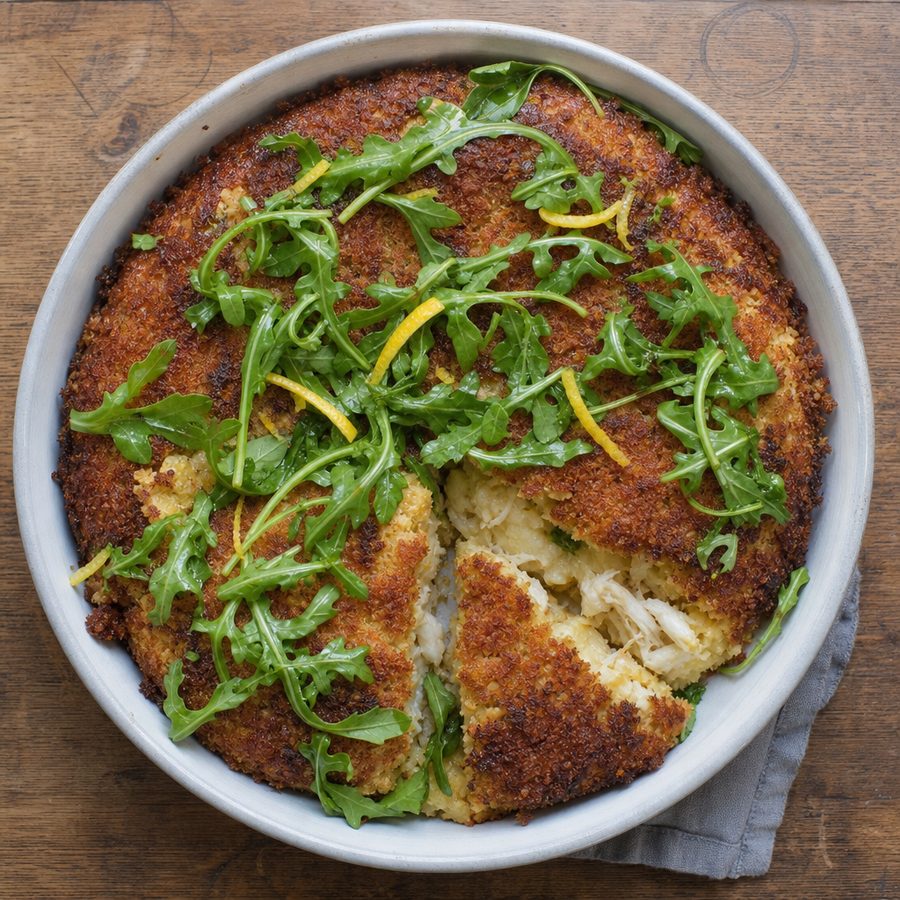
Cold cooked brown rice pressed into a hot skillet with crab, parmesan, dill, and chives, crisped on both faces until it holds as one cake, and cut into wedges under dressed arugula.
Why You'll Love This Recipe
This began as a way to use the last of a container of rice, and it has turned into what I make when someone has stayed over and I want breakfast to look like I tried. Cold rice, crab, parmesan, and herbs get pressed into a hot skillet and left alone until the bottom sets into a solid golden sheet. You turn it once, crisp the second face, and cut it into four wedges at the table. There is no batter and no clever binder anywhere in it. The starch in cold rice and a patient pan are the entire method, and the crab stays sweet because it barely gets cooked at all.
Cold rice is a requirement rather than a suggestion, and it is worth knowing why. Rice straight from the pot is wet and soft, so it steams in the skillet and slumps. Rice that has spent a night in the refrigerator has firmed up and dried at the surface, so the grains keep their shape under the spatula and the cut faces brown rather than stick. Short-grain brown rice is my first choice because it clings to itself, though any cooked rice will work if you press hard enough. The grated parmesan does real structural work as it melts, gluing the layer together from the inside while the outside browns.
What makes this breakfast rather than a side dish is the crab. It never meets direct heat on its own, folded through cold rice so it only warms through and never turns stringy or dry. Dijon and lemon sharpen it, dill and chives keep it from tasting heavy, and the cayenne sits underneath where you notice it a beat later. The dressed arugula on top is not a garnish either. Hot crisp rice wants something cold and peppery against it, and the lemon on the leaves runs down into the cut faces of the wedges. Bring the whole pan to the table and cut it there.
Ingredients
- 3 cups cold cooked short-grain brown rice
- 12 oz cooked lump crab meat, picked over
- 1/2 cup finely grated parmesan
- 1/4 cup thinly sliced chives
- 2 tbsp chopped fresh dill
- 1 tbsp dijon mustard
- 2 tbsp fresh lemon juice, divided
- 1/4 tsp cayenne
- 1 tsp freshly ground black pepper
- 3/4 tsp fine sea salt
- 2 tbsp butter, divided
- 2 tbsp garlic-infused olive oil, divided
- 3 cups arugula
Instructions
- Mix the cake: Break the cold rice up with your fingers in a large bowl so no clumps are left. Add the crab, parmesan, chives, dill, dijon, 1 tablespoon of the lemon juice, the cayenne, black pepper, and salt. Fold and then squeeze the mixture with your hands until the rice starts to cling to itself and the crab has broken into shreds.
- Get the pan properly hot: Heat a 10-inch cast iron or heavy nonstick skillet over medium heat. Add 1 tablespoon of the butter and 1 tablespoon of the garlic-infused olive oil and swirl until the butter foam dies down. The fat should shimmer and move quickly across the pan before the rice goes in.
- Press it in hard: Tip in the rice mixture and spread it to the edges, then press it down firmly and evenly with a stiff spatula. Keep pressing every minute or so for the first 3 minutes. Compression is what makes this one cake rather than a pan of fried rice, so use real force.
- Crisp the first face: Cook undisturbed for 10 to 12 minutes over medium heat. Do not stir it and do not lift it early. When it is ready the edge looks dry and pulls slightly from the pan, and a knife slid under the middle shows a deep golden brown crust that holds together in a sheet.
- Turn it in one piece: Slide the cake out onto a large plate, cover it with a second plate, and flip the pair over. Add the remaining butter and 2 teaspoons of the oil to the pan, slide the cake back in raw side down, press it flat again, and cook 8 to 10 minutes more until the second face is brown and firm.
- Rest, dress, and cut: Slide the cake onto a board and let it sit 2 minutes so the crust sets. Toss the arugula with the remaining lemon juice and oil. Cut the cake into 4 wedges, pile the dressed leaves over the top, and take it to the table while the crust is still loud under the knife.
Variations
- Shrimp version: Use 12 oz of cooked shrimp, chopped into rough pieces, in place of the crab and add an extra tablespoon of dill.
- Cheddar and jalapeno: Swap the parmesan for grated cheddar and work a finely chopped seeded jalapeno through the rice for a sharper, hotter cake.
- Tuna and lemon: Two drained cans of tuna in water stand in for the crab and make this a pantry breakfast rather than a shopping trip.
- Four small cakes: Divide the mixture into four and cook them as individual cakes for 6 minutes a side, which is easier to turn and gives you more crust per serving.
- Tomato and basil: Skip the dill, fold in 1/2 cup of halved cherry tomatoes, and finish the wedges with torn basil.
Storage & Leftovers
Leftover wedges keep in a sealed container in the refrigerator for 2 days, and I would not push crab further than that. The crust softens overnight in the cold, which is normal, so plan on bringing it back in a pan rather than eating a wedge straight from the refrigerator.
Reheat wedges in a dry skillet over medium heat, 3 to 4 minutes a side, until the outside is crisp again and the middle is hot. A 375°F (190°C) oven or toaster oven does the same job in about 8 minutes. Dress fresh arugula each time, since leaves that have already been dressed go limp and watery in storage.
The cake itself does not freeze well, because crab turns fibrous and the rice weeps as it thaws. What does freeze is the rice. Keep cooked brown rice in flat 3 cup portions for up to 3 months, thaw it overnight in the refrigerator, and you are 25 minutes from this breakfast on any morning.
Notes & Tips
- Cold rice only: This is the one rule that decides everything. Rice from the refrigerator has dried and firmed at the surface, so it crisps, while fresh warm rice steams and slumps into a mound.
- Press it like you mean it: Put your weight behind the spatula. A loosely laid cake is just fried rice, and the difference between the two is about thirty seconds of real pressure in the first few minutes.
- Why garlic-infused olive oil works: The flavor of garlic dissolves into fat while the part that upsets a sensitive gut does not, so the oil carries the taste and leaves the trouble behind in the bottle. Half of it goes in the pan and the rest goes on the greens.
- Parmesan is the glue: It melts between the grains and sets as it cools, which is what holds the wedges together. Grate it finely so it disappears into the rice rather than sitting in strands.
- Go light with the salt: Crab and parmesan both arrive salty. Three quarters of a teaspoon is enough for the whole cake, and you can always finish a wedge at the plate.
- The two plate flip: Slide the cake onto a plate, cap it with another, and turn the pair over. A spatula will crack it in half every time and a wrist flip will land it on the floor.
Nutrition & Mindful Eating
- Rice, crab, and parmesan work together here. The rice gives the cake its body and its crust, the crab makes it a breakfast rather than a side, and the parmesan melts through the middle and holds the two together.
- Crab is sweet and delicate and needs almost nothing done to it, which is why it goes in cold and comes out barely warmed. It brings protein along with vitamin B12, selenium, and zinc, all in meat soft enough to shred between your fingers.
- Brown rice keeps a nutty chew even after a night in the refrigerator, and the bran still on each grain is where its fiber and magnesium sit. Cold rice also crisps in a way that fresh rice cannot, so the texture and the grain are the same choice.
- Dill, chives, lemon, and a quarter teaspoon of cayenne are what keep a rich cake tasting bright. The herbs go in raw and the lemon arrives twice, once inside the mixture and once over the leaves at the end.
- Arugula goes on cold and completely raw, so it stays peppery and crisp against the hot crust, and it brings folate and vitamin K to a plate that is otherwise soft and rich.
- As you eat, take the first wedge while the crust is still loud under the knife, notice how the lemon comes through the leaves before the crab does, and slow down enough to taste more than the crunch.
Frequently Asked Questions
Can I use a different rice or a different shellfish?
Yes to both. Cooked white rice crisps even more readily than brown, and leftover jasmine works well. Chopped cooked shrimp is the easiest swap for the crab and holds up better to reheating, and flaked cooked salmon is good too, though it makes a richer cake that wants extra lemon.
My cake broke apart when I flipped it. What happened?
It came out of the pan early. The crust has to be continuous before the cake can travel, which takes the full 10 to 12 minutes, and lifting an edge to check every two minutes tears the sheet you are trying to build. Press harder at the start, wait longer, and use the two plate flip rather than a spatula.
Can I get any of this ready the night before?
You can mix the whole thing the night before and keep it covered in the refrigerator, which actually helps because the rice dries a little further. Bring the bowl out while the pan heats. Do not add the arugula or the last of the lemon until the cake is cut.
Does this fit a low-FODMAP breakfast?
It does. Crab, rice, and parmesan are all comfortable here, and hard cheeses like parmesan carry very little lactose. The savory side comes from dijon, chives, dill, and garlic-infused olive oil rather than garlic cloves or onion, so nothing gets stripped out of the recipe on its way to you.