
Skillet Red Cabbage with Apple, Smoked Paprika, and White Beans
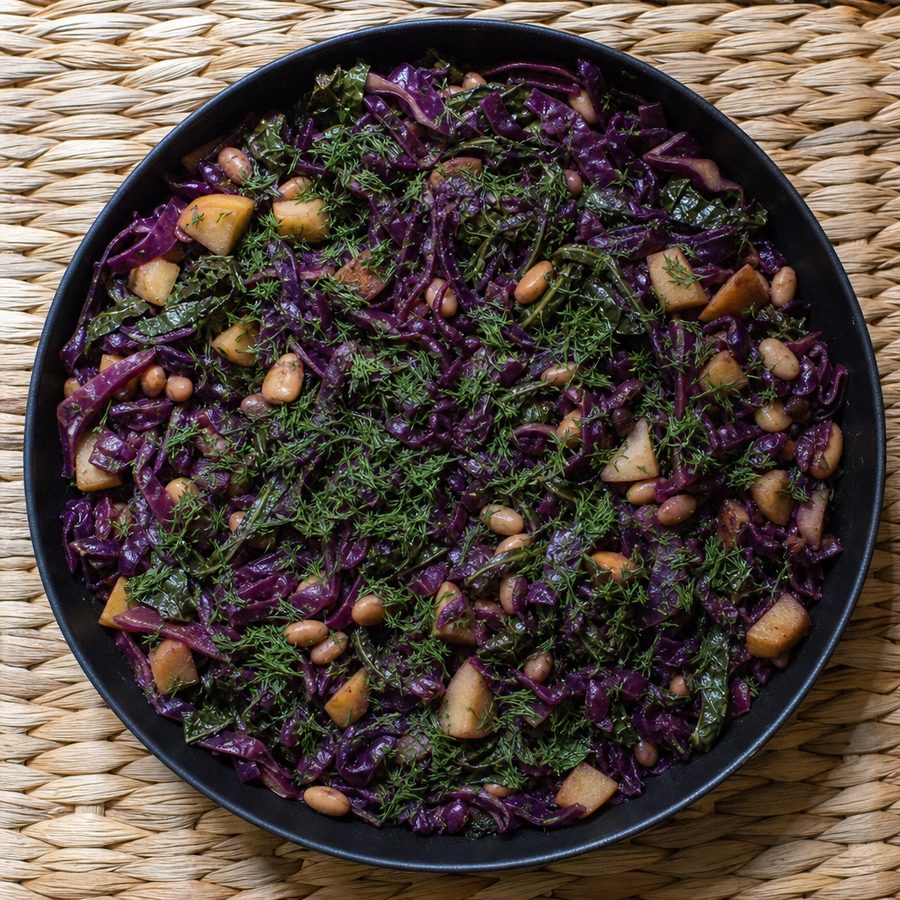
Thin ribbons of red cabbage cooked down with diced apple, smoked paprika, and sliced garlic, finished with cider vinegar, white beans, and a great deal of fresh dill.
Why You'll Love This Recipe
A heavy head of cabbage on the bottom shelf, and no plan at all. A cabbage that size looks like a project, and it is not one: quartered and sliced thin it cooks down in about twelve minutes, and the pile that seemed impossible when you started fits comfortably in one pan by the end. The apple is not a garnish here. It breaks down into the cabbage and takes the sharp sulfur edge off it, which is the single thing that turns cabbage from a vegetable people tolerate into one they ask for again.
What you get is sweet and sour and smoky all at once, with three different textures in the same forkful. The cabbage keeps a little chew at its center, the apple has gone soft and jammy, and the white beans are creamy against both of them. Collard ribbons go in late and stay dark and slightly firm. The smoked paprika sits underneath everything and reads almost like something cured, which is what makes a pan of vegetables taste as substantial as it does. The dill goes on off the heat, in a quantity that feels excessive right up until you taste it.
This belongs in the middle of a cold week, on a night when you want to cook once and eat well. It is one pan and thirty minutes, most of that hands off while the cabbage does its work, and it holds beautifully for lunch the next day. I also bring it to potlucks in autumn, where it sits happily at room temperature next to whatever else is on the table. If you are feeding people who claim not to like cabbage, serve it without saying what it is and wait.
Ingredients
- 1 small head red cabbage, about 1 1/2 lb, quartered, cored, and sliced into thin ribbons
- 1 large firm apple such as Honeycrisp or Braeburn, cored and cut into 1/2-inch dice
- 1 medium yellow onion, halved and sliced thin
- 1 can (15 oz) cannellini beans, drained and rinsed well
- 6 oz collard greens, thick stems stripped out and leaves rolled and sliced into thin ribbons
- 3 cloves garlic, sliced thin
- 2 tbsp olive oil
- 2 tbsp apple cider vinegar
- 2 tsp smoked paprika
- 3 tbsp chopped fresh dill
- 1/4 cup chopped flat-leaf parsley
- 1/2 tsp coarsely ground black pepper
- 1/2 tsp fine sea salt
Instructions
- Slice the cabbage thin: Quarter the cabbage through the stem and cut the hard white core out of each quarter at an angle. Lay each piece flat side down and slice across into ribbons no thicker than a quarter inch. Thin is the whole game here, since it is what lets a pound and a half of cabbage cook through in the time you have.
- Start the onion and garlic: Heat the olive oil in a twelve-inch skillet over medium-high until it shimmers. Add the onion with the salt and cook for three minutes, stirring once or twice, until the edges are translucent and starting to go gold. Add the garlic and the smoked paprika and stir for thirty seconds, just until the paprika smells toasted and the pan turns rust colored.
- Cook the cabbage down: Add the cabbage in two additions, pressing the first down and letting it wilt for a minute before the rest goes in. Cook for eight to ten minutes, stirring every couple of minutes and pressing it flat between stirs. It is ready when the volume has halved, the ribbons look glossy rather than dry, and some of the shreds against the metal have gone dark at the tips.
- Add the apple and the beans: Stir in the diced apple, the beans, and the black pepper. Cook for three to four minutes, long enough for the apple to soften at the corners while still holding its shape and for the beans to heat through. Fold gently once the beans are in so they stay whole rather than breaking into the cabbage.
- Wilt the collards and finish with vinegar: Scatter the collard ribbons over the top, cover the pan, and cook for two minutes until they have gone bright and limp. Take the skillet off the burner, pour in the cider vinegar, and stir once. The color will jump from muddy to violet as the acid hits. Fold in the dill and parsley and taste before it goes to the table.
Variations
- Caraway and juniper: Add a teaspoon of caraway seed and four crushed juniper berries with the paprika for a pan that tastes distinctly of a German kitchen.
- Mustard finish: Whisk a tablespoon of grainy mustard into the vinegar before it goes in, which gives the whole skillet a sharper, more savory edge.
- Potato underneath: Spoon it over crushed boiled potatoes so the vinegary juices soak in, which turns it into a heavier plate for a cold night.
- Pear and thyme: Swap the apple for a firm pear and the dill for fresh thyme, a rounder and more autumnal version of the same pan.
Storage & Leftovers
This keeps five days in a sealed container in the refrigerator and is one of the few vegetable dishes I think improves overnight. The cabbage relaxes further, the apple disappears into it, and the smoked paprika spreads through the whole bowl rather than sitting in pockets. Add a small splash of vinegar when you serve it cold, since the acid softens as it sits.
Reheat it in a dry skillet over medium heat for three or four minutes, spread flat and stirred only once, which brings back some of the browning. The microwave works and takes ninety seconds, though everything softens uniformly and you lose the contrast between the cabbage and the collards. Either way, fresh dill on top at the end wakes it up.
It freezes for up to three months in flat sealed portions, and it thaws better than most cooked vegetables because the cabbage was already cooked past crisp. Thaw overnight in the refrigerator and reheat in a pan rather than from frozen so the water that separates has somewhere to go. The beans go a little softer after freezing, which is fine here.
Notes & Tips
- Core the cabbage properly: The white core is dense and never softens in the time the leaves take. Cut it out on an angle from each quarter and you will not find a hard chip in anybody's bowl.
- Bloom the paprika in oil: Thirty seconds in hot oil before the cabbage goes in changes smoked paprika from dusty to fragrant. Any longer than a minute and it scorches and turns bitter, so have the cabbage ready beside the stove.
- Press the cabbage flat: Contact with hot metal is where the browning comes from. Press the pile down with the back of a spatula, leave it for two minutes, then stir, and repeat. That rhythm gives you dark tips rather than uniform steam.
- Rinse the beans well: Tip the can into a sieve and run cold water over the beans until it stops foaming. The liquid they sit in is cloudy and tastes of the tin, and it will dull a pan that is otherwise bright.
- Add the vinegar off the heat: Acid poured into a hot pan mostly evaporates. Pull the skillet off the burner first, pour it around the edge, and stir once, and you keep both the sharpness and the color.
Nutrition & Mindful Eating
- Cabbage, apple, beans, and collards each do a separate job in this pan. The cabbage gives it bulk and a little sweetness once it is cooked down, the apple rounds off the sharp edges, the beans bring fiber and enough plant protein to make it a meal, and the collards add a firm, mineral-tasting green that keeps everything from reading as soft.
- Red cabbage is a member of the same family as broccoli and mustard greens, and it carries vitamin C and vitamin K along with the pigments that make it purple. Cooking it hot and fast in ribbons keeps that color intense and pushes the flavor toward sweet.
- Collard greens have sturdy leaves that hold their shape after two minutes under a lid, and they are one of the better plant sources of calcium, which is a good reason to give them a real presence rather than a garnish role.
- Cannellini beans are creamy enough to feel like a sauce where they break against the cabbage, and their soluble fiber is the kind that slows a meal down and makes it sit well.
- Smoked paprika, sliced garlic, and cider vinegar are what make this taste like more than a pan of vegetables. The paprika brings the smoke, the garlic goes sweet in the oil, and the acid at the end lifts the whole skillet so the last bite tastes as bright as the first.
- As you eat, notice how the color changed the moment the vinegar went in, and let the sweet and sour swing of it slow you down enough to finish the bowl at the table rather than standing over the stove.
Frequently Asked Questions
Can I use green cabbage?
Yes, and it cooks in about the same time. Green cabbage is a little milder and it will not give you the violet color, so the vinegar moment at the end is less dramatic. Savoy works too and goes silkier, though its crinkled leaves hold more water, so give the pan an extra two minutes.
My cabbage steamed and never browned. What went wrong?
Either the pan was too small or the heat was too low. A pound and a half of shreds needs a twelve-inch skillet and medium-high heat, and it needs to be pressed flat and then left alone between stirs. Stirring constantly keeps the cabbage from ever sitting still long enough against the metal to color.
Which apple should I buy?
A firm, tart one. Honeycrisp, Braeburn, Pink Lady, and Granny Smith all hold their shape for the four minutes they spend in the pan. A soft apple such as McIntosh turns to sauce almost immediately, which tastes fine but leaves you with no texture from the fruit at all.
Is this a whole dinner or a side?
I serve it as dinner in a shallow bowl, and the beans and collards are what make that work. If you would rather run it as a side, it goes with almost anything roasted, and you can leave the beans out entirely and it will still be a good pan of cabbage.