
Slow Cooker Cinnamon Applesauce
Apples cooked down with cinnamon and lemon into a thick unsweetened applesauce, skins left on.
Why You'll Love This Recipe
Applesauce does not need sugar and it never did. Four pounds of apples under a lid for four hours give up enough of their own sweetness to make anything you add redundant, and the reason store bought sauce usually has some is that it is made from apples chosen for price rather than flavor. October is the month to do it, when the good apples are cheap and a bag of them is more than anyone gets through raw.
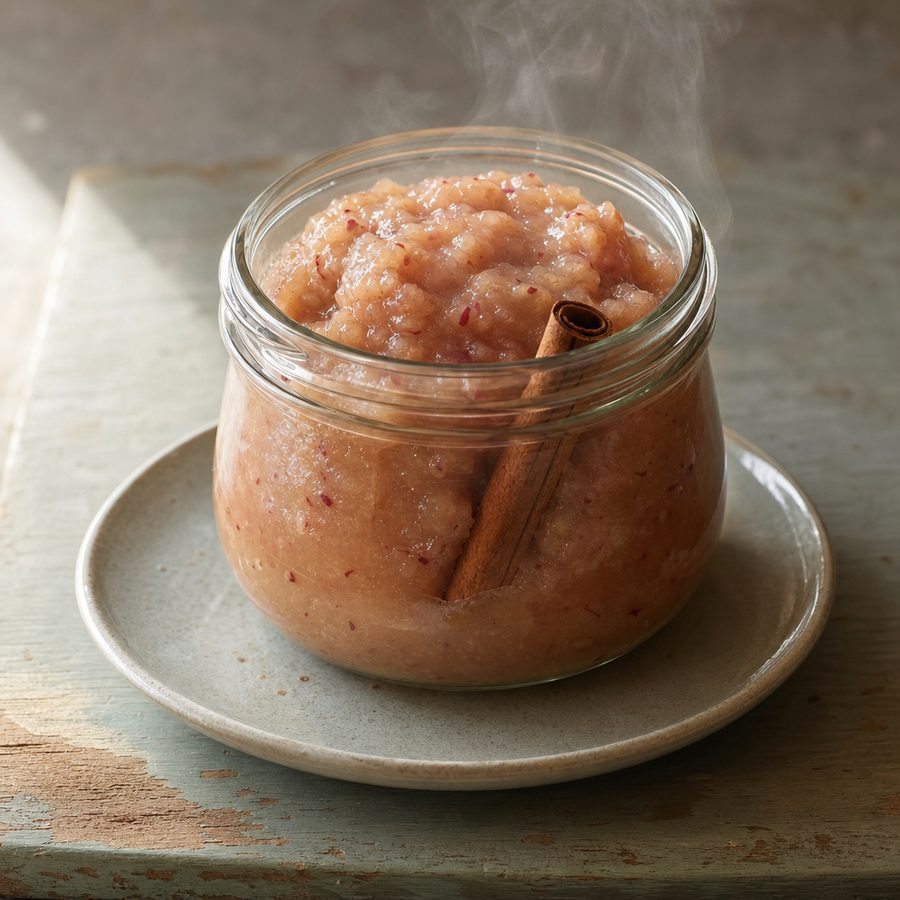
The skins stay on here, which is the one thing that makes this different from most recipes. They carry a good share of the fiber and nearly all of the pectin that makes the sauce set thick, and they turn the whole batch a soft rosy pink if you use red apples. An immersion blender takes them down to nothing you would notice. It does mean washing the apples properly, since whatever is on the skin is going into the jar with everything else.
This is the only thing on this site I make in a slow cooker purely because it is easier to ignore. On a stove, applesauce needs stirring and scorches the moment you wander off, since the sugar in the fruit catches on a hot pan bottom. In a crock the heat is too gentle for that to happen, so four hours later the kitchen smells like a bakery and nothing has asked anything of you. It also makes eight servings at once, which is the difference between a nice thing to have made and a jar you actually eat from all week.
Ingredients
- 4 lb apples, cored and cut into chunks
- 2 tbsp fresh lemon juice
- 1 1/4 tsp ground cinnamon
- 1/8 tsp ground cloves
Instructions
- Choose a mix of apples: Use at least two varieties if you can, one sweet and one tart. A single variety makes a flat sauce, and the mix is what gives it depth without anything added. If you are buying for this rather than using what is around, something like a sweet Gala or Fuji against a sharp Granny Smith covers both ends.
- Core and chop, skins on: Core the apples and cut them into rough two-inch chunks, which is about 10 minutes of work for four pounds. Leave the skins on. The pieces do not need to be even, since everything collapses anyway, and chasing uniformity here buys you nothing at all.
- Load the crock and stir the spices through: Put the apple chunks in a 6-quart slow cooker with the lemon juice, the cinnamon, and the cloves, then stir until the spices are distributed through the whole pot rather than sitting in a layer on top. Ground spice that starts on the surface tends to stay there, and you end up with a strong first spoonful and four hours of plain apple underneath it.
- Cook on low for 4 hours, with no water: Cover and cook on low for 4 hours. Add no water at any point. The apples release far more liquid than you expect, and any water added at the start gives you a thin sauce that then has to be cooked back down, which undoes the whole point of leaving it alone.
- Blend it smooth or mash it chunky: Blend with an immersion blender until the skins have disappeared into flecks and the sauce is smooth, about 30 seconds, or mash with a potato masher for a chunkier one. Blending is what takes the skins down to nothing you would notice; a masher leaves them as recognizable strips, which some people like and some do not.
- Thicken it uncovered if it needs it: If it is thinner than you want, cook it uncovered on low for another 30 minutes, stirring once or twice, until it holds a mound on a spoon. Bear in mind it also thickens noticeably as it cools, so stop a little short of the texture you are aiming for rather than reducing it to a paste.
Variations
- Instant Pot: Cook on high pressure for 5 minutes with a natural release of 10, then blend. It is quicker but the flavor is slightly less developed.
- Chunky style: Skip the blender and mash half the batch with a potato masher, then stir it back into the rest. You keep real pieces of apple in every spoonful.
- With pear: Swap a pound of the apples for ripe pears. The sauce comes out softer and floral and needs the lemon juice more than the all apple version does.
- Spiced deeper: Add a half teaspoon of ground ginger and a whole star anise at the start, and pull the star anise out before blending.
- Apple butter: Cook it uncovered on low for a further 3 hours after blending, stirring occasionally. It darkens, thickens and concentrates into something closer to a spread.
Storage & Leftovers
Cooled applesauce keeps in the refrigerator for 10 days in a sealed jar, which is far longer than most things on this site. The lemon juice is doing that work along with the acidity of the apples themselves.
It does not need reheating and I would not bother, though it is very good warm over yogurt or oatmeal. If you do warm it, do it gently and add nothing, since it thins as it heats.
It freezes for up to 6 months and comes back almost identical. Freeze in half cup portions, leave headspace since it expands, and thaw in the refrigerator overnight.
Notes & Tips
- Use two varieties: One sweet, one tart. A single apple makes a one note sauce and the mix is the entire reason this needs no sugar.
- Skins on: They carry fiber and the pectin that sets the sauce. Blended, you get flecks rather than strips and nothing unpleasant to chew.
- Add no water: Apples are mostly water already. Anything you add has to be cooked back out and you end up with thin sauce for no reason.
- Lemon is not optional: It keeps the sauce from browning, sharpens the flavor of tired apples and is a good part of why it keeps for ten days.
- Blend hot, judge cold: Warm applesauce always looks thinner than it will be. Let a spoonful cool before deciding whether it needs more time.
- Leave headspace to freeze: It expands. Fill jars to about an inch below the rim or you will find cracked glass in the freezer.
Nutrition & Mindful Eating
- There is no added sugar in this at all, and it still tastes sweet, because every bit of that sugar is the fruit's own. That is what four pounds of apples tastes like, and it is why applesauce sits differently than an apple does.
- Leaving the skins on is most of where the fiber comes from. Peeled applesauce has roughly half as much, which is a meaningful difference for something you eat often.
- The fiber in apple skin and flesh is largely pectin, a soluble fiber that thickens the sauce as it cools and slows how quickly the sugars in it reach your bloodstream.
- Because this is blended, the sugars are more available than they would be in a whole apple. Eating it alongside something with protein or fat, like yogurt or nut butter, evens that out considerably.
- Cinnamon is doing real flavor work here in a recipe with four ingredients, and it is the reason a bowl of this tastes sweetened when nothing has been added to it.
- As you eat, notice how much sweeter this is than a whole apple even though nothing was added, and let a smaller bowl be enough.
Frequently Asked Questions
Which apples should I use?
A mix is best. Honeycrisp, Gala or Fuji for sweetness with Granny Smith or Braeburn for tartness. Red skinned apples turn the sauce pink, which is worth knowing before you start.
Do I have to leave the skins on?
No, but you lose fiber and pectin if you peel them. Peeled applesauce is paler, smoother and thinner, and you will want the extra 30 minutes uncovered at the end to make up for it.
Can I add sweetener?
You can, though I would taste it first. If your apples were tart or out of season, a tablespoon of maple syrup stirred in at the end is plenty for the whole batch.
Can I can it for the pantry?
This recipe is written for the refrigerator and the freezer. Water bath canning needs its own tested procedure and acidity checks, and that is not what this page is.