
Slow Cooker Pork Loin with Apples and Red Cabbage
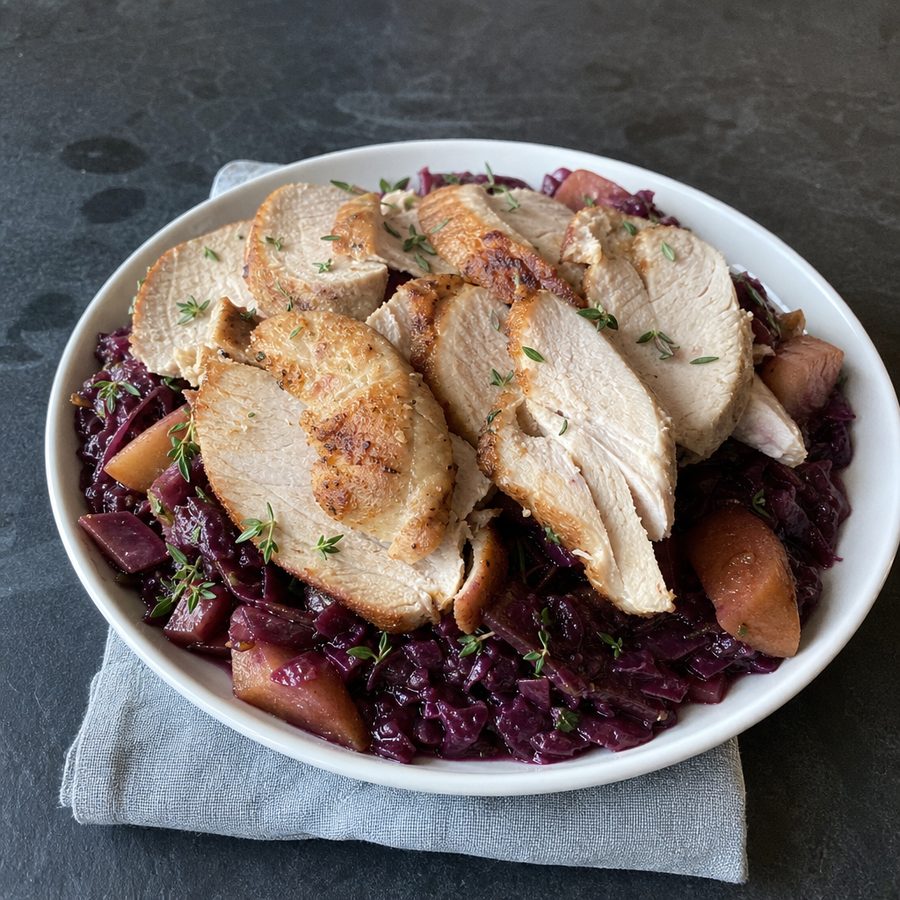
A pork loin roast cooked slowly over shredded red cabbage and sliced apples with cider vinegar and thyme.
Why You'll Love This Recipe
Pork loin is the cut people are most afraid of in a slow cooker, and they are right to be careful with it. It is a tender, close-grained muscle, so it does not behave like a shoulder that can sit under a lid all day and come out better for it. What it does have is enough size to cook gently for five hours over a wet bed of vegetables, and that is exactly how this is built.
The cabbage and apples are not a side dish here, they are the cooking method. Shredded red cabbage collapses into a soft purple tangle and gives off enough moisture to steam the roast from underneath, while the apples break down into something halfway between a sauce and a vegetable. Cider vinegar keeps the cabbage a deep magenta instead of the sad blue it turns without acid.
What I like most is how little it asks of you. Everything goes in raw, the lid goes on, and five hours later you slice the pork against the grain and spoon the cabbage over it. My kitchen smells like cinnamon and vinegar all afternoon, which in my house is the smell of nobody having to think about dinner. The slices are good cold the next day as well, so one afternoon of doing very little turns into lunch twice over.
Ingredients
- 2 1/2 lb boneless pork loin roast, trimmed
- 1 small head red cabbage, cored and shredded, about 8 cups
- 2 firm apples, cored and sliced 1/4 inch thick
- 1 large yellow onion, thinly sliced
- 4 garlic cloves, minced
- 3 tbsp apple cider vinegar
- 1 cup chicken broth
- 1 tbsp olive oil
- 2 tsp fresh thyme leaves
- 1 tsp chopped fresh sage
- 1/2 tsp ground cinnamon
- 2 bay leaves
- 1/2 tsp salt
- 3/4 tsp black pepper
- 1/4 cup chopped fresh parsley, for serving
Instructions
- Build the bed: Toss the shredded red cabbage, sliced onion, apples, and garlic together in the bottom of a 6-quart slow cooker until the garlic is worked all the way through the pile. Spread it into an even layer so the roast has something level to sit on.
- Season the pork: Pat the pork loin dry with paper towels and rub it all over with the olive oil, then the salt, black pepper, and half of the thyme, until the surface is evenly coated. A dry surface is what lets the seasoning stick instead of sliding off into the pot.
- Set it in place: Lay the roast fat side up on top of the cabbage. Keeping it on top rather than buried means it steams gently instead of boiling, which is the difference between sliceable and stringy.
- Add the liquid and aromatics: Whisk the chicken broth and cider vinegar together and pour it around the edges of the pot, not over the roast. Tuck in the bay leaves and sprinkle the cinnamon and sage over the cabbage.
- Cook it low and check early: Cover and cook on low for 5 hours, checking at 4. The loin is done when the center reaches 145°F (63°C) and the cabbage is completely soft. Pulling it at the right moment matters more here than it would with a fatty cut, because there is no fat in a loin to cover for overcooking.
- Rest and serve: Move the roast to a board and let it rest for 10 minutes before slicing against the grain. Stir the remaining thyme into the cabbage, fish out the bay leaves, and serve the slices over the cabbage with the juices spooned on top.
Variations
- Instant Pot: Cook on high pressure for 25 minutes with a full natural release. Add the apples after the pressure drops and let them sit in the residual heat so they keep their shape.
- With caraway: A teaspoon of caraway seed added with the cinnamon takes this in a distinctly German direction and suits the cabbage beautifully.
- With sweet potato: Add 2 cups of cubed sweet potato to the vegetable bed. It cooks through in the same 5 hours and makes the pot a complete meal without a side.
- More tang: Stir an extra tablespoon of cider vinegar into the cabbage at the very end, off the heat. Vinegar added late tastes sharper and brighter than vinegar that has cooked for hours.
- With mustard: Rub the roast with a tablespoon of grainy mustard along with the oil before it goes in. It builds a savory crust that plays well against the sweetness of the apples.
Storage & Leftovers
Cooled leftovers keep in the refrigerator for 4 days. Store the sliced pork sitting in some of the cabbage juices rather than dry on a plate, because pork gives up moisture fast once it is cut and the juices are what put it back.
Reheat gently in a covered pan over medium-low heat with a splash of broth. High heat and a microwave on full power will both turn pork tough and chalky, which is the one way to ruin what you spent five hours making.
It freezes for up to 3 months. Freeze the pork and cabbage together in flat bags with plenty of liquid, thaw overnight in the refrigerator, and reheat covered. The cabbage comes back better than the pork does, so slice thicker if you know it is headed for the freezer.
Notes & Tips
- Slice against the grain: Pork loin is unforgiving about this. Find the direction the muscle fibers run and cut across them, and the same roast eats twice as tender.
- Rest before slicing: Ten minutes on the board lets the juices settle back through the meat. Slice it straight out of the pot and most of that moisture runs onto the cutting board instead.
- Check the temperature early: Every slow cooker runs a little differently and this roast has a narrow window. Start checking at 4 hours so you catch it at 145 rather than 20 minutes past it.
- Shred the cabbage thin: Thick wedges stay crunchy in spots and never fully collapse. A thin shred gives up its moisture evenly and turns silky, which is what steams the pork.
- Do not skip the vinegar: It is doing three jobs at once, holding the color, balancing the apples and keeping the pork from tasting flat. This is not the ingredient to leave out.
- Keep the roast on top: Buried in liquid it boils and goes stringy. Sitting on the vegetable bed it steams, and that is the whole trick to this recipe.
Nutrition & Mindful Eating
- Pork loin, red cabbage and apples make an unusually good pot together because each one supplies what the others do not. The pork brings substance, the cabbage brings bulk and color, and the apples bring the sweetness that keeps the vinegar from taking over.
- Red cabbage gets its deep purple from anthocyanins, the same pigment family as blueberries, and the cider vinegar in the pot is what keeps that color from washing out over five hours.
- A pork loin is one of the better sources of thiamin there is, and it carries a lot of protein in a dense, close-grained cut, which is why a modest slice eats as satisfying as it does.
- Cabbage and apples together give this bowl a real amount of fiber, and cooked cabbage is far gentler on most people than raw cabbage is while keeping most of what makes it worth eating.
- Thyme, sage, cinnamon and bay are carrying most of the seasoning load in a pot with only half a teaspoon of salt in it. Aromatics cooked long and slow give you depth that salt alone never does.
- As you eat, notice the way the sweetness of the apple and the sharpness of the vinegar trade places from one bite to the next, and slow down enough to catch both.
Frequently Asked Questions
Can I use pork shoulder instead?
You can, and it is more forgiving, but it needs 8 hours on low rather than 5 and it is a much fattier cut. The nutrition on this page is calculated for pork loin, so a shoulder version will read quite differently.
Why did my cabbage turn blue?
Red cabbage is a natural pH indicator and goes blue-gray in a neutral pot. The cider vinegar is what keeps it magenta, so do not cut it back, and add another splash at the end if the color looks dull.
What apples work best?
Firm ones that hold their shape, like Honeycrisp, Braeburn or Granny Smith. Softer apples such as McIntosh dissolve completely, which tastes fine but leaves you without the apple slices.
Can I cook it on high?
I would not. High heat drives moisture out of a loin roast quickly and you lose the gentle steam that keeps it tender. If you are short on time, a pork tenderloin on low for 3 hours is a better shortcut.