
Slow-Roasted Leg of Lamb over Lemon Potatoes with Mint and Olive Relish
Boneless leg of lamb rubbed with oregano and rosemary and roasted covered for hours over yukon golds, finished with a raw relish of mint, parsley, and olives.
Why You'll Love This Recipe
This is the roast I make when people are coming and I do not want to be cooking while they are here. It goes into the oven covered in the early afternoon and stays there, and the only thing left to do at the end is pull the foil off, turn the heat up, and chop some herbs. Boneless leg is easier to handle than a bone-in one and much easier to serve, since there is no carving around anything, and two pounds feeds four people properly with a plate of potatoes underneath. I have made it in February and in July and it suits both.
Three hours is longer than most people cook a leg of lamb, and that is deliberate. Roasted pink, leg is a knife-and-fork cut. Roasted covered and slow, it goes past pink into something that tears with a spoon, and the fat and sinew that make the cut chewy melt into the potatoes below. Nothing in the pan depends on onion or garlic. The seasoning is dried oregano, a lot of fresh rosemary, lemon, and salt, plus garlic-infused olive oil, which is worth understanding: garlic flavor dissolves into fat while the FODMAPs in garlic do not, so the oil carries the taste and leaves the trouble behind.
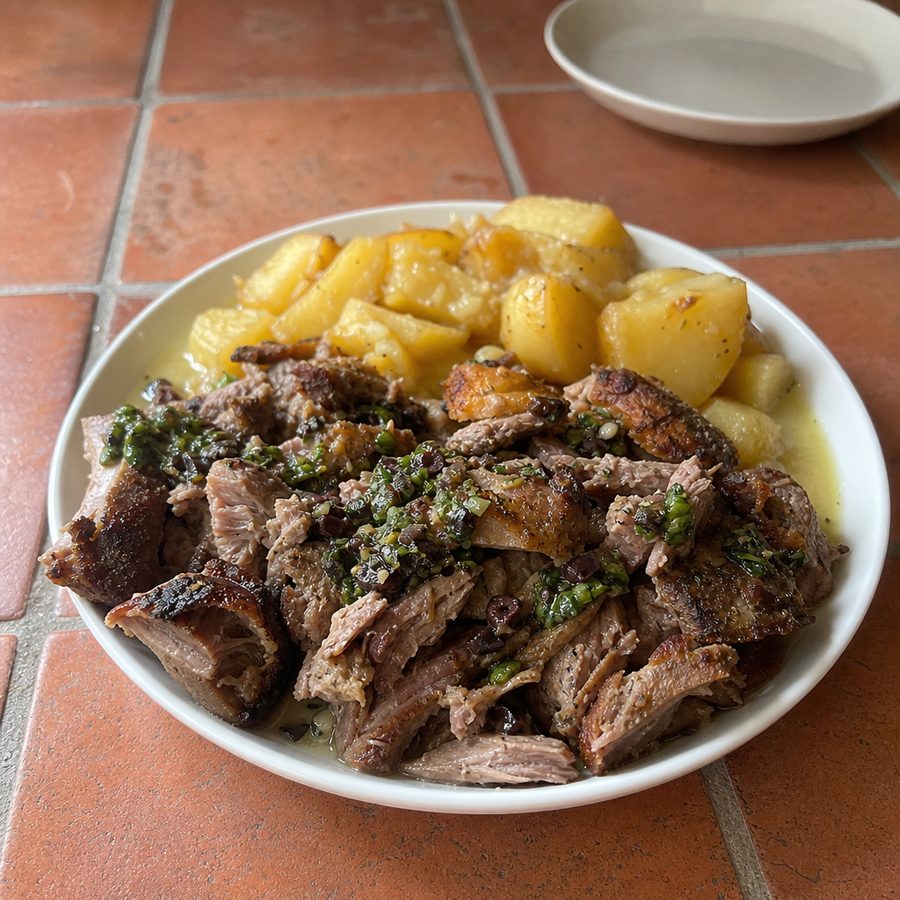
The potatoes are half the point. Yukon golds sit in lemon juice, broth, and bay in the bottom of the pan, and for three hours they take on lamb fat from above and citrus from below, so the pieces near the edge go crisp and the ones in the middle collapse a little. The relish is what stops the whole thing from being brown. Parsley, mint, olives, and lemon zest chopped together and spooned over at the table, raw and sharp against three hours of slow heat. Do not skip it. It is the difference between a good roast and a plate people remember.
Ingredients
- 2 lb boneless leg of lamb, opened out and tied
- 2 lb yukon gold potatoes, cut into 1 1/2-inch wedges
- 4 tbsp garlic-infused olive oil, divided
- Juice of 2 lemons (about 1/4 cup), plus the zest of 1
- 2 tsp dried oregano
- 2 tbsp chopped fresh rosemary
- 1 1/4 cups chicken broth
- 2 bay leaves
- 2 1/2 tsp fine sea salt, divided
- 1 1/2 tsp freshly ground black pepper
- 3/4 cup chopped fresh parsley
- 1/2 cup chopped fresh mint
- 1/2 cup pitted kalamata olives, roughly chopped
Instructions
- Season the lamb ahead: Pat the lamb dry and rub it all over with 2 teaspoons of the salt, the black pepper, the oregano, the rosemary, and 1 tablespoon of the garlic-infused olive oil, pressing the herbs into the surface and into the folds where it is tied. Leave it at room temperature for an hour, or in the refrigerator overnight and out for an hour before it goes in.
- Build the potato base: Heat the oven to 300°F (150°C). Toss the potato wedges in a roasting pan with 2 tablespoons of the oil, the remaining 1/2 teaspoon of salt, the lemon juice, the broth, and the bay leaves, and spread them into an even layer. The liquid should come about a third of the way up the potatoes.
- Roast it covered: Set the lamb on top of the potatoes, fat side up. Cover the pan tightly with foil, sealing it at the edges so no steam escapes, and roast for 2 1/2 hours. Do not open it to look. Underneath, the potatoes are cooking in broth and lamb fat and the meat is going slowly past the point where it would slice.
- Brown the top: Take off the foil and raise the oven to 425°F (220°C). Spoon a little of the pan liquid over the lamb, then roast uncovered for 25 to 30 minutes, until the top of the meat is deep brown and the potato wedges around the edge have crisped. If the pan looks dry at any point, add a splash of water to the corner rather than over the meat.
- Rest and make the relish: Move the lamb to a board and tent it loosely for 20 minutes. While it rests, chop the parsley, mint, and olives together on a board until they are coarse and combined, then stir in the lemon zest and the last tablespoon of oil. Keep it chunky, since a paste loses the point of it.
- Carve and serve: Cut off the strings and pull or slice the lamb into thick pieces, following the seams where it wants to come apart. Serve it over the potatoes with a few spoonfuls of the pan liquid, then spoon the relish over the meat at the table so it stays fresh and green.
Variations
- Lamb shoulder: Use 2 lb of boneless shoulder for a fattier, more forgiving roast, and add 30 minutes to the covered time.
- Root vegetables underneath: Replace half the potatoes with parsnip or rutabaga chunks for a base that is sweeter and less starchy.
- Greens at the end: Wilt a few big handfuls of spinach or swiss chard into the hot pan liquid while the lamb rests.
- Warmer rub: Add 1 teaspoon of ground cumin and 1/2 teaspoon of cinnamon to the herb rub for something closer to a North African roast.
- Relish with heat: Chop half a jalapeno into the parsley and mint if you want the green spoonful to bite as well as brighten.
Storage & Leftovers
Refrigerated in a sealed container, the lamb and potatoes keep for 4 days. Store them together with some pan liquid, since the potatoes hold moisture and pass it back to the meat. Keep the relish in its own small jar and it stays bright and usable for 3 days.
Reheat covered in a 325°F (163°C) oven for about 20 minutes with a few spoonfuls of the pan juices or water. The potatoes come back better than you expect. A skillet over medium heat is the faster route if you want the potato edges crisp again, and the meat can go in for the last 2 minutes.
The lamb freezes for up to 3 months in its juices, and the sliced pieces thaw better than a whole tied roast. Leave the potatoes out entirely, since yukon golds go grainy and watery on thawing. Thaw overnight in the refrigerator and make the relish fresh.
Notes & Tips
- Season it the night before if you can: Salt needs hours to work past the surface of a piece of meat this thick. An overnight rub is the single biggest improvement available here.
- Seal the foil properly: The covered stretch is a braise disguised as a roast. A loose seal lets the steam out, and the potatoes stay hard while the lamb dries at the edges.
- Why the infused oil is worth buying: Garlic flavor is fat-soluble and the FODMAPs in garlic are not, so an infused oil delivers the taste and leaves the part that causes trouble behind. It is the closest thing to a shortcut this way of eating has.
- Keep the relish coarse: Chop the herbs and olives by hand and stop while you can still see each one. A food processor turns it into a dull green paste in about four seconds.
- Rest it longer than feels necessary: Twenty minutes under loose foil lets the juices settle back through the meat. Cut it straight from the oven and most of that ends up on the board.
- How it keeps and comes back: It holds 4 days in the refrigerator and reheats covered at 325°F (163°C) in about 20 minutes. Store the meat with some pan liquid, since lamb dries faster than it looks like it will.
- For the rest of the table: Anyone not managing their gut can have crumbled feta over the potatoes and warm bread for the pan juices. Set both on the table rather than in the pan so the roast stays as it is.
Nutrition & Mindful Eating
- The lamb, the potatoes, and the herbs work as three layers here. The meat gives the plate its richness, the potatoes underneath take on the fat and the lemon as they soften, and the raw relish over the top keeps a long slow roast from tasting like one note.
- Leg of lamb is close-grained and firm, with enough fat marbled through it to hold up to three covered hours, and it carries iron in the form your body absorbs most readily along with zinc and B12.
- Yukon gold potatoes have a waxy, buttery flesh that holds its shape in liquid rather than falling apart, and the wedges nearest the edge crisp while the middle ones collapse into the lemon and broth. They bring potassium and a surprising amount of vitamin C.
- Mint and parsley chopped raw at the last minute are the loudest thing on the plate, both of them full of the volatile oils that heat drives off, which is exactly why the relish never goes near the oven.
- Kalamata olives bring salt and brine in short sharp bursts rather than seasoning everything evenly, and the fat they carry is mostly the monounsaturated kind.
- As you eat, notice how completely the lamb has given way and how the mint and lemon land on top of it, and let the meal take as long at the table as it needs rather than the time it took to cook.
Frequently Asked Questions
Can I use a bone-in leg?
Yes, and the flavor is better for it. Buy about 3 1/2 lb bone-in to get the same amount of meat, add 45 minutes to the covered time, and expect the meat around the bone to be the best of it. Everything else stays the same.
Can I roast it pink instead?
You can, but it is a different dish. Skip the foil, roast at 350°F (175°C) for about 75 minutes to an internal temperature of 135°F (57°C), and rest it 20 minutes before slicing thin against the grain. The potatoes will need their own pan, since they will not have time to cook through.
My potatoes were still firm at the end. Why?
Almost always the seal. If the foil is loose the steam escapes, the liquid boils away, and the potatoes sit in dry heat rather than cooking through. Crimp the foil hard against the rim, and cut the wedges to a size you can pierce easily with a knife tip.
Does this fit a low-FODMAP dinner?
It does. The seasoning is oregano, rosemary, lemon, olives, and salt rather than onion or garlic, so nothing is stripped out and nothing tastes hollow. Potatoes sit easily at this portion, olives are fine at a couple of tablespoons a person, and garlic-infused olive oil adds back that background note.