
Slow-Roasted Pork Shoulder with Cranberries and Delicata Squash
Pork shoulder salted a day ahead and roasted slowly until it pulls apart, finished in a hot oven with delicata squash and fresh cranberries that collapse into the pan juices.
Why You'll Love This Recipe
This is the roast I put in the oven on a Sunday afternoon when I want the house to smell like something for three hours and I want dinner handled long before anyone is hungry. Pork shoulder is one of the cheapest things at the meat counter and the cut that rewards this kind of cooking most, going from tight and grainy to meat that comes apart under the side of a fork. It feeds four with real leftovers, and it does not mind if you are twenty minutes late getting back to it. Salt it the night before if you remember, and the rest of the day it mostly looks after itself.
There is no onion and no garlic in this pan, so the savory side has to come from somewhere, and it comes from three places. The fat cap is scored and salted early, which dries the surface so it browns rather than steams. The garlic-infused olive oil goes underneath, and it is worth knowing why that works: the flavor compounds in garlic dissolve into fat, while the FODMAPs that cause the trouble do not, so the oil carries the taste out of the bulb and leaves the rest behind. Then cranberries and cider vinegar arrive at the end, and that sourness cuts through a rich cut in a way sweetness alone never could.
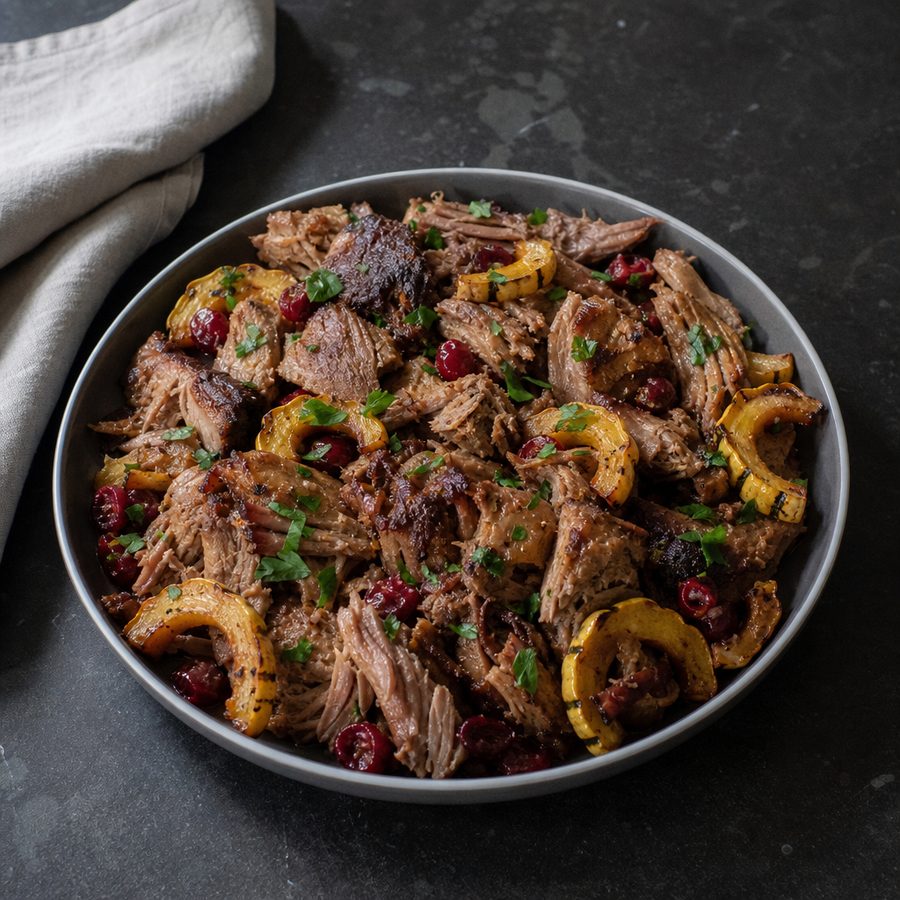
What makes this eat like a proper dinner rather than a plate of meat is the last forty minutes, when the squash and the berries go into the pan and the oven comes up hot. The delicata softens, its cut faces turn deep gold, and the cranberries split and collapse into the juices until they run dark red and sharp. You end up with three things on the plate that need each other: rich pork, sweet squash, sour fruit. Pull the meat into big pieces along its own seams rather than shredding it to threads, spoon the pan juices over all of it, and nobody at the table needs telling that it is a special sort of dinner.
Ingredients
- 2 1/2 lb boneless pork shoulder, fat cap scored in a crosshatch
- 2 1/2 tsp fine sea salt, divided
- 1 1/2 tsp freshly ground black pepper
- 1 1/2 tsp dried rubbed sage
- 1 tbsp chopped fresh rosemary
- 2 tbsp garlic-infused olive oil, divided
- 2 tbsp butter, melted
- 1 1/2 cups chicken broth
- 2 tbsp apple cider vinegar, plus more to finish
- 2 tbsp maple syrup
- 2 delicata squash (about 1 1/2 lb), halved, seeded, and cut into 3/4-inch half moons
- 1 1/2 cups fresh or frozen cranberries
- 1 orange, zest in wide strips and juice reserved
- 1/8 tsp ground cloves
- 3 tbsp chopped fresh parsley
Instructions
- Salt the pork early: Score the fat cap in a crosshatch about a quarter inch deep, cutting into the fat but not the meat. Mix 2 teaspoons of the salt with the black pepper and the dried sage and rub it over every surface, working it down into the cuts. Set the pork on a rack and leave it uncovered in the refrigerator for at least 4 hours and up to overnight.
- Start it low and covered: Heat the oven to 300°F (150°C). Rub 1 tablespoon of the garlic-infused olive oil over the pork and set it fat side up in a roasting pan or Dutch oven. Pour the broth and the cider vinegar around the meat rather than over it, so the seasoned surface stays dry, and add the rosemary. Cover tightly with a lid or foil and roast for 2 1/2 hours, until a fork twists easily in the thickest part.
- Cut the squash: Halve the delicata lengthwise, scoop out the seeds with a spoon, and cut each half into 3/4-inch half moons. The skin is thin enough to eat once roasted, so leave it on. Toss the pieces with the melted butter, the remaining tablespoon of oil, and the last 1/2 teaspoon of salt.
- Add the squash and cranberries: Uncover the pan and raise the oven to 400°F (200°C). Spoon some of the pan fat over the top of the pork. Scatter the squash around the meat in a single layer, add the cranberries, the strips of orange zest, the orange juice, the maple syrup, and the cloves, and roast uncovered for 35 to 40 minutes, until the squash is tender with browned edges, the cranberries have split, and the pork surface is crisp.
- Rest the meat: Move the pork to a board and tent it loosely for 20 minutes. Meanwhile, tilt the pan and spoon off the clear fat that pools at one end, then taste what is left. It should be sharp, sweet, and salty at once. Add a splash more cider vinegar or a pinch of salt if it is not.
- Pull and serve: Pull the pork into large pieces along the natural seams, using two forks and stopping well before it turns to threads. Return the pieces to the pan, turn them through the juices, and serve with the squash and cranberries spooned alongside. Scatter the parsley over everything at the table.
Variations
- Roots in place of the squash: Swap the delicata for 1 1/2 lb of parsnip and turnip in chunks, added at the same point, for a more savory and less sweet pan.
- Pan sauce: Mash half the cooked cranberries into the juices with a fork and reduce them on the stove for 5 minutes to get something closer to a sauce.
- Warmer spicing: Add 1/2 teaspoon of cinnamon and a pinch of cayenne with the cloves for a pan that tastes like late autumn.
- Country-style ribs: Use 3 lb of bone-in country-style pork ribs and cut the covered time to 1 3/4 hours, keeping the finish exactly the same.
- Greens on the side: Wilt a bunch of swiss chard in a little of the strained pan fat while the pork rests, for something green and slightly bitter next to the fruit.
Storage & Leftovers
Refrigerated in a sealed container with some of the pan juices spooned over the meat, the pork keeps for 4 days. Store the squash in its own container if you can, since it goes soft sitting in liquid. The cranberries hold their tartness and are honestly better on the second day than the first.
Reheat the meat covered, in a 325°F (163°C) oven with a few spoonfuls of juices or broth, for about 15 minutes. A microwave works at half power in short bursts with a lid on, but pork shoulder blasted hot goes stringy in under a minute, and there is no bringing it back once it does.
It freezes for up to 3 months, and the important part is freezing it in its juices, since meat frozen dry thaws dry. Leave the squash out, since it turns to water on thawing, and roast a fresh tray when you want it. Thaw overnight in the refrigerator before reheating.
Notes & Tips
- Salt it the night before: An overnight rub does two jobs, seasoning the meat all the way through and drying the surface. Four hours is the minimum worth bothering with.
- Score the fat, not the meat: Cut a crosshatch a quarter inch deep so the fat renders and the salt gets in. Go deeper and the juices run out through the cuts.
- Why the infused oil works: Garlic flavor is fat-soluble and the FODMAPs in garlic are not, so an infused oil carries the taste and leaves the part that upsets people behind in the bulb. This is the single most useful bottle in a low-FODMAP kitchen.
- Liquid around, never over: Pour the broth and vinegar into the pan beside the pork. Poured over the top it washes off the salt rub and the fat cap will never crisp.
- Pull, do not shred: Big pieces along the seams stay juicy and look like a roast. Shredded threads dry out on the plate within a few minutes.
- How it keeps and comes back: Store the meat under its juices and reheat it covered at 325°F (163°C) for about 15 minutes. Dry storage and high heat are the two things that turn good shoulder stringy.
- For the rest of the table: Anyone at the table who is not managing their gut can have a few onion wedges roasted in the pan alongside, or bread to mop the juices. Keep the onion at one end of the pan so it is easy to serve around.
Nutrition & Mindful Eating
- The pork, the squash, and the berries do this together. The meat brings the richness and the substance, the delicata brings sweetness and body underneath it, and the cranberries cut straight across both so nothing on the plate tastes the same by the third bite.
- Pork shoulder is a marbled, hard-working cut, and the fat and connective tissue running through it are exactly what let it cook for hours and come out yielding rather than dry. It is a real source of protein along with thiamin and B12.
- Delicata squash has skin thin enough to eat, so it goes into the pan in half moons and comes out with browned faces and a soft, almost custardy middle. The deep orange flesh is where the beta-carotene comes from.
- Fresh cranberries are far too sour to eat raw and exactly right cooked in pan juices, where they split, go jammy, and turn the drippings dark red. They carry vitamin C and the polyphenols behind that color.
- Sage, rosemary, and cider vinegar do the seasoning here, and the vinegar is the one that matters most, since it keeps something this rich from settling flat on the tongue. A plate of pork this dense holds you a long stretch, and the protein is doing most of that work.
- As you eat, notice how the pork comes apart along its own seams and how sharp the cranberries land against it, and let this be a plate you sit down to rather than one you finish standing at the stove.
Frequently Asked Questions
Can I use a different cut of pork?
Boston butt and picnic shoulder both work at the same weight and the same timing, and either is a better buy than what the label calls a roast. Pork loin is not a fair swap here. It has too little fat and connective tissue to survive three hours, and it comes out dry no matter how carefully you watch it.
The fat cap never crisped. What went wrong?
Almost always moisture. If you skipped the uncovered stretch in the refrigerator, the surface was still damp going in, and damp fat steams rather than crisps. Blot the top with a paper towel when you take the lid off, make sure the oven is fully up to 400°F (200°C), and give it the whole 40 minutes uncovered.
Can I make it in a slow cooker?
Yes for the meat, no for the finish. Cook the pork on low for 7 to 8 hours with the broth and vinegar, then move it to a roasting pan with the squash and cranberries and give it 40 minutes at 400°F (200°C). The high dry heat at the end is what browns the fat and concentrates the juices, and a slow cooker cannot do that.
Does this fit a low-FODMAP dinner?
It does. Nothing here leans on onion or garlic, so nothing important disappears when those get stripped out of a plan. The savoriness comes from the salted crust, the rendered fat, sage, rosemary, and cider vinegar. Keep the squash to about a cup a serving and the cranberries to roughly a third of a cup, and use garlic-infused olive oil for that background note.