
Slow-Roasted Salmon over Braised Leeks and Collard Greens
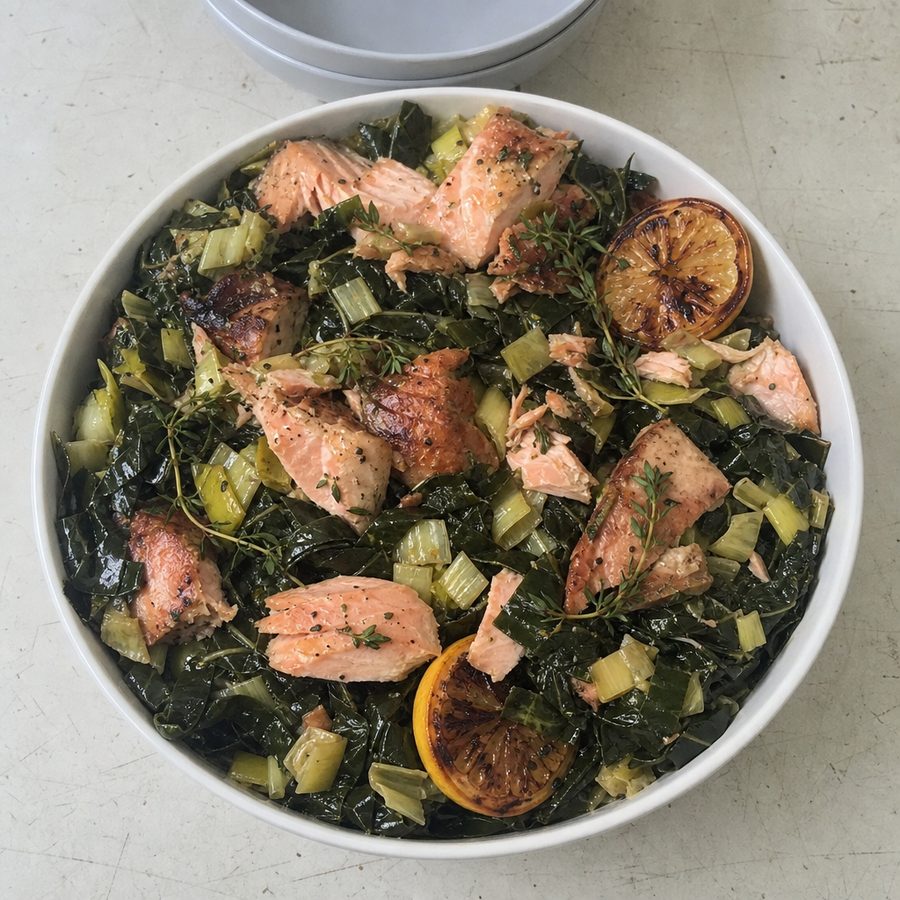
Leeks softened in olive oil with garlic and thyme, collard ribbons braised down until glossy, and salmon roasted slowly on top until it barely sets, finished with lemon and cider vinegar.
Why You'll Love This Recipe
I started roasting salmon at 275°F (135°C) after ruining one too many fillets at 425, and I have never gone back. Low heat gives you a fish that stays translucent and satiny in the middle no matter how distracted you get, and it releases almost none of that white albumin that streaks a hard-roasted piece. Setting it over a pan of braised greens means the fish drips into the collards while it cooks, so the greens end up tasting of it. The whole thing is one pan and about an hour, most of it unattended.
The eating is soft, sweet, and a little bitter in the best way. Leeks cooked slowly turn almost jammy and are the sweetness in the pan, collards braised past crisp go silky at the edges and keep a slight chew in the ribs, and the salmon sits on top in wide sheets you can pull apart with the side of a fork. Garlic sliced thin melts into the greens completely. Vinegar and lemon go in at the end, and that acid is what keeps a plate of long-cooked greens from tasting heavy or flat.
This is my Sunday dinner in the cold months, and the leftovers are the reason I make the full amount even when there are only two of us. It is also the dish I cook for people who say they do not like collards, because a long braise turns them into something entirely different from the tough leaf they remember. Serve it in shallow bowls so nobody loses the pan juices, which are the best part and the whole reason for the broth.
Ingredients
- 8 oz skinless salmon fillet, cut into 4 pieces
- 2 bunches collard greens (about 14 oz leaves), stems stripped and leaves rolled and cut into 1/2-inch ribbons
- 3 large leeks, white and pale green parts only, halved lengthwise and sliced into half moons
- 6 garlic cloves, thinly sliced
- 1 cup vegetable broth
- 2 1/2 tbsp olive oil, divided
- 1 lemon, half juiced and half cut into wedges
- 1 tbsp apple cider vinegar
- 6 sprigs fresh thyme
- 1/2 tsp coarsely ground black pepper
- 1/4 tsp fine sea salt
Instructions
- Soften the leeks: Heat 2 tbsp of the olive oil in a wide ovenproof braising pan or deep skillet over medium-low. Add the leeks with a pinch of the salt and cook for ten to twelve minutes, stirring every couple of minutes. You want them collapsed, pale gold, and sweet, with no browning at all. If they start to color, lower the heat and add a spoonful of water.
- Add the garlic and thyme: Stir in the sliced garlic and four of the thyme sprigs and cook for two minutes more, just until the garlic turns from white to barely gold and the pan smells sweet rather than sharp. Garlic browned at this stage will taste bitter for the whole braise.
- Braise the collards: Add the collard ribbons in two additions, letting the first wilt down before the second goes in. Pour in the broth, add the black pepper, cover, and cook over medium-low for twenty minutes, stirring twice. The greens are ready when they are glossy and dark and a ribbon collapses easily against the side of the pan but still has body in the thick part.
- Heat the oven low: While the collards braise, heat the oven to 275°F. A low oven is the whole method here. At this temperature salmon cooks evenly from edge to center rather than in a hard ring, which is what gives you the texture this dish is built on.
- Roast the salmon on the greens: Uncover the pan, taste the greens, and spread them into an even layer. Rub the salmon pieces with the last half tablespoon of oil and the rest of the salt, set them on top of the greens, and tuck the remaining thyme between them. Roast uncovered for eighteen to twenty two minutes, until the thickest part reads 120°F (49°C) and the flesh separates into wide flakes when you press it. A low oven holds salmon there for a long stretch without pushing past it, which is the whole reason for cooking it this slowly, and it is well under the 145°F (63°C) the FDA gives for seafood if that is the number you follow gently.
- Finish with acid: Take the pan out and let it sit for three minutes. Spoon the cider vinegar and the lemon juice over the greens around the fish, not over the salmon itself, and shake the pan once to distribute it. Serve in shallow bowls with the pan juices and a lemon wedge each.
Variations
- Mustard greens: Use mustard greens in place of half the collards for a sharper, more peppery braise that needs about five minutes less on the stove.
- Trout or arctic char: Both take the low oven beautifully and cook a few minutes faster, so start checking at fifteen minutes.
- Smoky: Add half a teaspoon of smoked paprika with the garlic for a deeper, redder pan that suits a winter night.
- Beans in the pan: Stir a cup of drained navy beans into the greens for the last five minutes of braising to make the pan heartier.
Storage & Leftovers
This keeps three days in a sealed container in the refrigerator and the greens improve overnight, since the pan juices and vinegar keep working their way into the ribbons. Store the salmon on top of the greens rather than separately so it stays moist.
Reheat gently in a covered pan over low heat with a splash of water, five or six minutes, and pull it off as soon as it steams. Salmon reheated hard turns dry and chalky, and this fish was cooked slowly on purpose. Cold salmon flaked over the warm greens is the better option most of the time.
The greens alone freeze well for three months and are worth cooking a double batch of, since they are useful under almost anything. Freeze them in flat portions, thaw overnight, and warm them in a pan with a little broth. I would not freeze the cooked salmon.
Notes & Tips
- Cook the leeks longer than feels necessary: Twelve minutes over low heat is what turns them sweet. Rushed leeks stay oniony and sharp, and there is nothing later in the recipe that will fix it.
- Keep the oven at 275°F: This is not a temperature to round up. The whole texture of the finished fish depends on the oven being slow enough that the outside never gets far ahead of the center.
- Set the fish on the greens, not in them: Salmon buried in the braise steams and goes firm. Sitting on top, it roasts in dry heat while the greens underneath catch everything that drips out of it.
- Acid at the end, and around the fish: Vinegar poured directly over hot salmon tightens the surface. Spooned into the greens it seasons the whole pan and comes up on the fork anyway.
- Use a wide pan: A twelve-inch braiser lets the collards sit in a shallow layer so they cook evenly and gives the salmon room to sit flat. Piled deep in a small pot, the greens on the bottom overcook before the top ones wilt.
Nutrition & Mindful Eating
- The collards, the leeks, and the salmon are three different kinds of substance in one pan. The greens give bulk, fiber, and a mineral depth that stands up to a long braise, the leeks bring the sweetness, and the salmon adds protein and fat that make the whole pan taste rich on a small amount of fish.
- Collard greens are the quiet giant of the calcium world among vegetables, and unlike some leafy greens they give theirs up in a form the body absorbs well. Braised long and slow, the ribbons go silky while keeping the vitamin K that makes them worth eating in quantity.
- Salmon carries the omega-3 fats that give it that soft, almost buttery texture, along with vitamin D, which very few foods supply at all. Roasted low and slow it stays moist enough that a modest piece eats like a generous one.
- Leeks cooked gently for twelve minutes turn sweet because their sugars have time to soften rather than scorch, and the inulin fiber they carry feeds the bacteria in your gut on the way through.
- Cider vinegar, lemon, thyme, and a great deal of sliced garlic are what season this. Acid added at the very end wakes up long-cooked greens, and it is the reason the last forkful of the pan tastes as bright as the first.
- As you eat, notice how easily the salmon separates into sheets and how much of its flavor has gone down into the greens beneath it, and take a moment between bites to check in on how full you actually are.
Frequently Asked Questions
How do I know when slow-roasted salmon is done?
By feel and by thermometer rather than by clock. At 120°F in the thickest part it is silky and just set, which is where I pull it. If you prefer fish fully opaque, take it to 130°F, but go past 140°F and the low oven has bought you nothing.
Can I use skin-on salmon?
You can, though skin does not crisp at 275°F, so set the pieces skin side down on the greens and lift the flesh off the skin when you serve. If crisp skin is what you want, sear the fillets skin down in a hot pan for three minutes first and then finish them on the greens.
Do I have to strip the collard stems?
Yes for this braise. The stems are far tougher than the leaves and need twice as long, so at twenty minutes you would have silky ribbons studded with something woody. Slice the stems thin and add them with the leeks if you would rather not waste them.
My leeks were full of grit. How do I clean them?
Cut them lengthwise first, then slice, then drop the half moons into a big bowl of cold water and swish hard. The sand sinks. Lift the leeks out with your hands rather than pouring the bowl through a colander, which just tips the grit back over them.