
Slow-Roasted Venison Shoulder with Butternut Squash
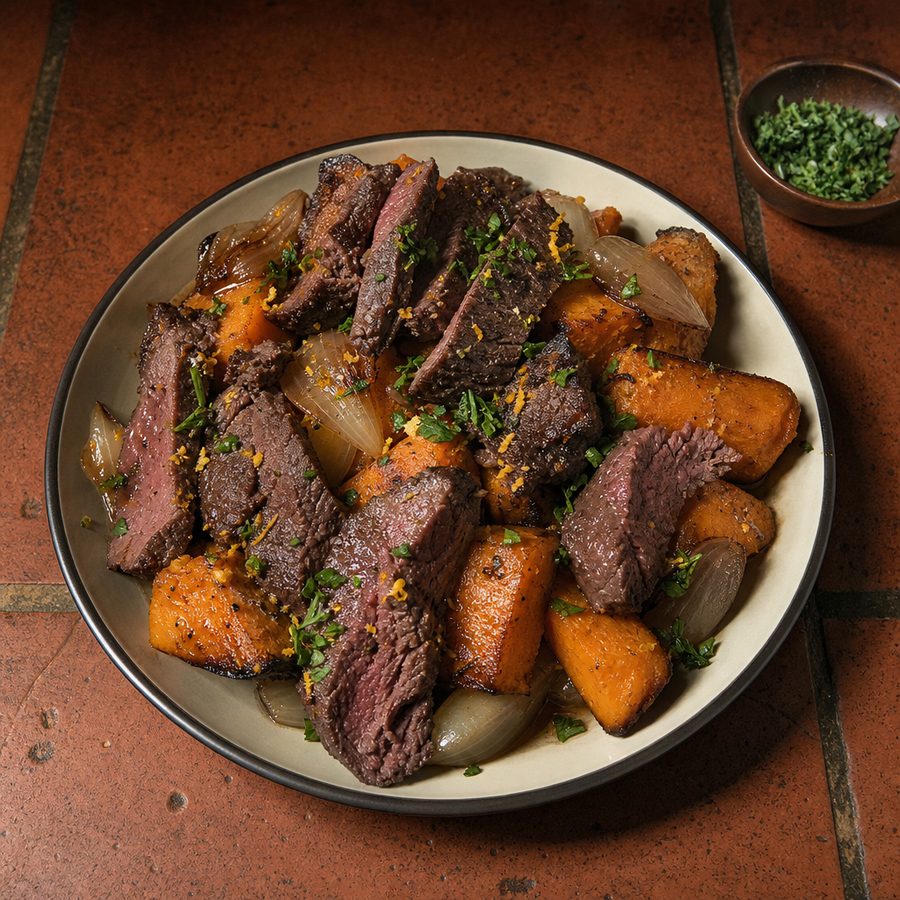
A venison shoulder rubbed with garlic and thyme and roasted low for three hours over onions, with butternut wedges added late, finished with lemon and parsley gremolata.
Why You'll Love This Recipe
This is a Sunday roast for a house that has venison in the freezer and has run out of ideas for it. A shoulder is the cut most people are unsure about, because venison is dark and close-grained and everyone has been warned about drying it out, so the instinct is to cook it fast and pink. A shoulder does not want that. It wants three hours at a low temperature under a lid, where the connective tissue has time to soften, and the reward is meat you can slice thickly without it going tight. My kitchen smells of thyme, garlic, and sweet onions from about the first hour on, which is its own argument for making it.
Two things make the difference. The first is browning the roast hard on every face before it goes in, because that dark crust is most of what ends up in the juices later. The second is the timing of the squash. Butternut cut into big wedges needs about an hour, so it goes in for the last stretch and comes out holding its shape, sweet at the edges where the pan juices have caught it, rather than dissolving into the broth over three hours. The gremolata at the end is not decoration. Raw garlic, parsley, and lemon zest over hot meat cut straight through an afternoon of slow cooking.
A plate of this is a real dinner and it eats like one. Venison is dense and full-flavored and carries a lot of protein for its size, and the squash brings a soft sweetness that suits the meat better than any sauce would. It slices best after a fifteen minute rest, and it is one of the few roasts I like as much cold, sliced thin the next day with more gremolata spooned over the top. If there are pan juices left, save them. They set to a soft jelly in the refrigerator and are worth reheating on their own for whatever you cook that week.
Ingredients
- 2 lb boneless venison shoulder roast, tied in one even piece
- 1 small butternut squash (about 1 1/2 lb), peeled, seeded, and cut into 2-inch wedges
- 2 large onions, cut into thick wedges through the root
- 9 cloves garlic, 8 peeled and left whole, 1 minced for the finish
- 1 1/2 cups beef bone broth
- 2 tbsp balsamic vinegar
- 3 tbsp olive oil, divided
- 6 sprigs fresh thyme
- 1 sprig fresh rosemary
- 2 bay leaves
- 1/2 cup chopped fresh parsley
- 1 lemon, for 2 tsp grated zest and 1 tbsp juice
- 1 1/4 tsp fine sea salt, divided
Instructions
- Season and heat the oven: Take the roast out of the refrigerator 30 minutes ahead, pat it very dry, and rub it with 1 teaspoon of the salt. Heat the oven to 275°F (135°C). Cut the onions into thick wedges through the root so they hold together, and leave the squash whole for now.
- Brown the venison hard: Heat 2 tablespoons of the olive oil in a Dutch oven over medium-high until it shimmers. Brown the roast on every face, about 3 minutes a side, until it is properly dark rather than gray. Move it to a plate. That crust is where most of the flavor in the finished pan comes from, so do not rush it.
- Build the pan: Lower the heat to medium and add the remaining tablespoon of oil, the onion wedges, and the whole garlic cloves. Cook for 5 minutes until they take on some color. Add the balsamic vinegar and let it bubble down for 30 seconds, scraping the browned bits off the bottom, then pour in the bone broth and add the thyme, rosemary, and bay leaves.
- Roast low and covered: Set the venison on the onions, cover with a tight lid, and roast at 275°F (135°C) for 2 hours, turning the roast once at the halfway mark. Peel the squash while it cooks, scrape out the seeds, and cut it into wedges about 2 inches thick so they will not fall apart.
- Add the squash and finish the roast: Tuck the squash wedges around the meat with the remaining salt, spooning some of the pan liquid over them. Cover and roast for another hour, until a fork slides into the middle of the venison with no resistance and the squash is tender all the way through but still in one piece.
- Rest, reduce, and serve: Move the roast to a board and tent it loosely with foil for 15 minutes. Lift the squash and onion into a warm bowl, pull out the herb stems and bay leaves, and simmer the juices for 5 to 8 minutes until they thicken slightly. Stir the parsley, minced garlic, lemon zest, and juice together, slice the meat against the grain, and spoon the juices around it with the gremolata over the top.
Variations
- Acorn squash: Use two acorn squash cut into thick crescents, skin on, which hold together even better than butternut.
- Orange gremolata: Use orange zest in place of the lemon for a rounder finish that suits venison particularly well.
- Mushroom pan: Add eight ounces of halved mushrooms with the onions for a darker, more savory set of juices.
- Apple in the pot: Tuck two quartered apples in with the squash for the last hour if you like a sweeter note against the meat.
- Shredded rather than sliced: Give it 30 minutes more and pull the meat apart with two forks for a version that suits bowls and leftovers.
Storage & Leftovers
Sliced venison keeps in the refrigerator for up to 4 days, and it wants to be stored sitting in its juices rather than dry in a container. The squash keeps just as long and goes on tasting sweeter, so if you have a choice about what to save, save the two together in one dish.
Reheat slices gently in a covered pan with a few spoonfuls of the juices over low heat, about 5 minutes. Venison tightens quickly in high heat, so a hot oven or a long spell in the microwave will make the slices firm and dry, and there is no undoing that once it has happened.
This freezes better than most roasts if you freeze it whole rather than sliced. Cool the meat in its juices, seal it in a container with the liquid, and freeze for up to 3 months. Thaw overnight in the refrigerator and warm it covered at 300°F (150°C). Cooked squash goes watery frozen, so make that part fresh.
Notes & Tips
- Dry the meat first: A wet surface steams rather than browns. Pat the roast dry with paper towels and salt it before it goes near the pan.
- Tie the roast: A shoulder is an awkward shape and cooks unevenly if it is loose. Three or four loops of kitchen twine solve it.
- Cut the squash big: Two-inch wedges survive an hour in liquid. Cubes turn to puree, which tastes fine but leaves you nothing to put beside the meat.
- Keep the oven low: At 275°F (135°C) the connective tissue melts before the meat dries. Above 325°F (163°C) you are racing the two, and the meat usually loses.
- Peel the squash with a Y peeler: Trim both ends, stand it up, and take the skin off in strips. Trying to cut a whole butternut with a knife is how people cut themselves.
- Rest before slicing: Fifteen minutes under loose foil lets the juices settle. Cutting straight away pushes them onto the board instead of leaving them in the meat.
Nutrition & Mindful Eating
- Venison, butternut squash, and the long slow cook work together here. The meat gives the plate its substance, the squash softens in the juices and turns sweet against it, and the parsley and lemon at the end keep something this deep from feeling heavy.
- Venison is dark, close-grained, and deeply savory, and it is a strong source of the heme iron and B12 that red meat carries, both of which come along with the protein that makes a plate of this hold you through an evening.
- Butternut squash turns silky and honeyed when it cooks in meat juices, and that deep orange color is beta-carotene, which your body turns into vitamin A. The fiber in it is part of why the sweetness lands gently rather than sharply.
- Garlic, thyme, rosemary, and bay do the seasoning across three hours, and cooked that long the garlic goes mellow and almost sweet. Raw garlic in the gremolata at the end is the sharper version of the same flavor, which is why both are here.
- Parsley and lemon zest are stirred together off the heat, so the vitamin C in them is not cooked away and the flavor stays green and sharp. That contrast is what makes a slow-cooked plate taste finished rather than uniformly soft.
- As you eat, notice how easily the venison gives way after three hours in a low oven and how the raw garlic in the gremolata cuts across it, and let a roast this slow be a reason to stay at the table a while.
Frequently Asked Questions
Can I use another cut or another meat?
Yes. Elk shoulder, beef chuck, and lamb shoulder all behave the same way at this temperature and need about the same time. A venison leg roast is a different animal, close-grained and much drier, so if that is what you have, roast it to medium-rare rather than cooking it for three hours.
My venison came out tough. Where did it go wrong?
Almost always it needed longer. A shoulder passes through a tough stage on the way to tender, so if a fork meets resistance at three hours, cover it again and give it another 30 to 45 minutes. Check that the lid actually seals, since a pan losing steam will dry the meat out before it softens.
Can I make it in a slow cooker?
You can. Brown the roast and the aromatics in a skillet first, then move everything to the cooker and cook on low for 7 to 8 hours, adding the squash for the last hour and a half. Reduce the liquid in a pan on the stovetop afterward, because a slow cooker will not concentrate it for you.
Does this suit an AIP elimination phase?
It does. There are no grains, dairy, nightshades, nuts, or seeds in it, and the seasoning is garlic, thyme, rosemary, bay, and lemon. Balsamic vinegar is generally allowed, though check the label for added sulfites or caramel color if you are being strict about it.