
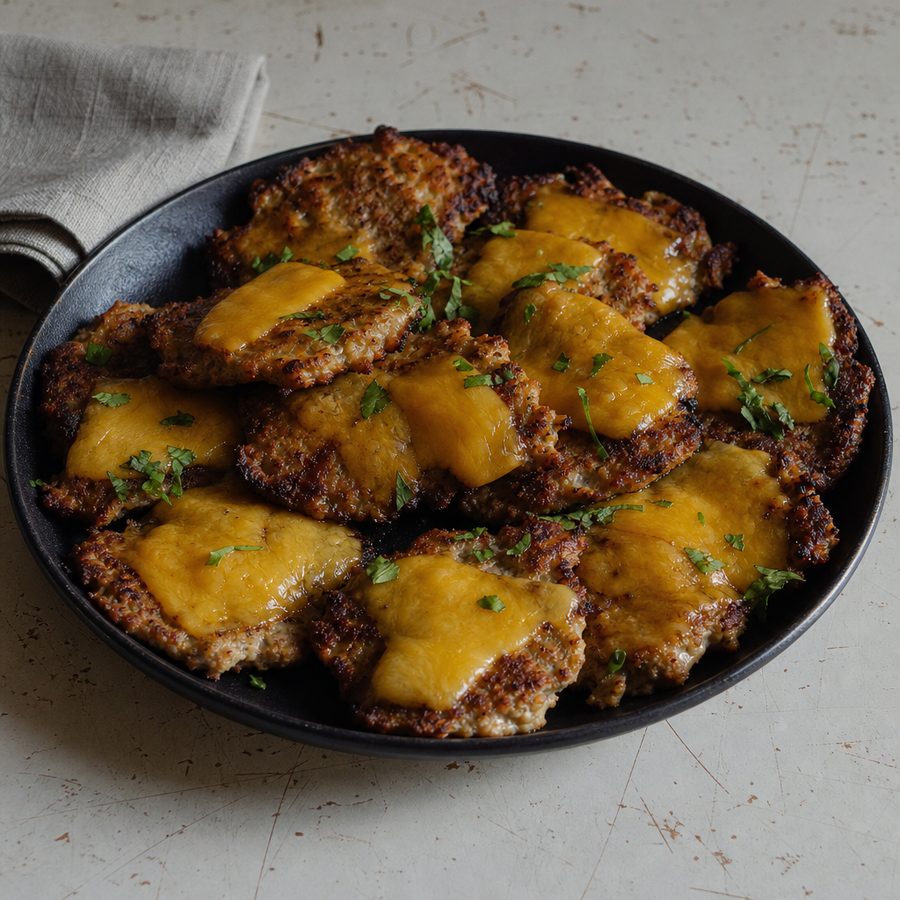
Smashed Turkey Patties with Melted Cheddar
Loose balls of ground turkey pressed thin against a screaming cast iron griddle so the edges go lacy and dark, then folded over melting cheddar.
Why You'll Love This Recipe
The smash is a technique, not a shortcut, and it is the one that makes ground turkey genuinely worth eating. Turkey is a mild, close-grained meat that goes dry and cottony if you cook it slowly, so the answer is to cook it in ninety seconds on a surface hot enough to build a crust before the middle has time to tighten. Pressing a loose ball flat against that surface forces every square inch of it into contact with the metal at once, and the thin ragged edges that squeeze out cook past crisp into something like a chip. That is where all the flavor is.
Timing matters more than anything else. The ball goes down, you press once and hard for about ten seconds, and then you leave it completely alone. Press again later and you are just squeezing juice onto the griddle. Two to three minutes on the first side is all it takes, and then the flip is a scrape rather than a lift, because you want the brown crust to come up with the patty instead of staying on the pan. Cheddar goes on immediately after the flip, and the residual heat does the melting.
I make these when there is nothing in the house and twenty minutes before somebody needs feeding. They cook faster than almost anything else I know, they eat well hot or at room temperature, and they turn out better in a well-seasoned cast iron pan than they ever would on a grill, where the ragged edges would drop straight through the grate. Two patties per person is a real dinner rather than a snack, and eight of them come off a twelve-inch skillet in two quick rounds. They also hold up in a lunch container the next day, which is more than most quick dinners manage, and the crust keeps enough of its flavor to be worth eating cold.
Ingredients
- 1 1/2 lb ground turkey, thigh meat if your store carries it, kept cold until the pan is hot
- 3/4 cup shredded cheddar, or 4 slices halved
- 1 tbsp ghee, for the griddle
- 1/2 tsp fine sea salt
Instructions
- Portion, do not shape: Divide the cold turkey into eight loose balls, roughly three ounces each, handling them as little as you can. Do not knead, compact, or flatten them now, since a ball worked in the hands is already tight before it reaches the pan. A tightly packed ball turns springy in the pan, while a loose one spreads under the spatula and gives you those ragged edges.
- Get the griddle properly hot: Set a large cast iron skillet or griddle over medium-high heat for four to five minutes, until a drop of water skitters across it and vanishes. Add the ghee and tilt to spread it into a thin film, which should shimmer immediately, because a pan that takes its time is a pan that will gray the meat rather than brown it. A pan that is not hot enough will gray the meat instead of browning it.
- Smash: Lay three or four balls on the griddle with room between them, then press each one flat with a stiff metal spatula, leaning your weight into it for a full ten seconds until the patty is about a quarter inch thick and the edges have spread out thin and ragged. Salt the tops, and salt them now rather than in the bowl, since salt worked into raw ground meat draws out its water and makes the patty springy. Then put the spatula down and do not touch them again.
- Cook, scrape, and flip: Give them two to three minutes. The edges will darken first and start to look lacy, and the top will turn from pink to pale and matte. Slide the spatula in at a low angle and scrape rather than lift, so the browned crust comes away with the patty, then turn it over.
- Cheese and finish: Scatter the cheddar over each patty the moment it is flipped and cook forty-five to ninety seconds more, until the cheese has slumped and gone glossy and the meat registers 165°F. Move them to a warm plate and cook the second batch, wiping the griddle between rounds if any bits have burned, because anything scorched from the first round will taste bitter on the second.
Variations
- Double stack: Make sixteen smaller patties and stack them in pairs with cheese between, so the cheese melts in the middle as well as on top.
- Bacon fat griddle: Render two slices of bacon first, smash the patties in the fat, and crumble the bacon over the cheese.
- Parmesan crust: Sprinkle grated parmesan directly onto the griddle beside each patty so it fries into a lacy wafer you can lift onto the top.
- Fried egg: Set a fried egg on each portion and break the yolk over the crust before serving.
- Ground turkey and pork: Mix half ground pork into the turkey for a richer patty that browns even faster and stays juicier.
Storage & Leftovers
Stacked in a sealed container with the cheese side up, these keep four days in the refrigerator. The crust softens overnight, which is unavoidable, but the flavor of it stays, and cold smashed patties are surprisingly good straight from the container.
Reheat them in a dry skillet over medium heat for about ninety seconds a side, which crisps the crust back up better than any other method. In a microwave they warm through in thirty seconds and come out soft all the way, so use short bursts and stop while they are barely hot.
They freeze well for up to three months. Cook them, cool them completely, then stack with a square of parchment between each one and freeze flat in a bag. Reheat from frozen in a covered skillet over medium-low for five or six minutes, then uncover for the last minute to dry the surface.
Notes & Tips
- Keep the meat cold: Cold turkey spreads cleanly under the spatula and holds together. Meat that has warmed on the counter smears and sticks.
- Use the heaviest pan you own: Cast iron holds its temperature when cold meat lands on it. A thin pan drops fifty degrees on contact and you get gray patties instead of brown ones.
- Ten seconds, then stop: That is long enough to set the shape and no longer. Everything after that is juice going onto the griddle instead of staying in the patty.
- Cook in batches: Four patties at most in a twelve-inch pan. Crowded meat steams, and steam is the enemy of the crust this whole method is built around.
- Salt on the griddle, not in the bowl: Salt mixed through ground meat ahead of time draws out protein and makes the texture springy and sausage-like. Salting the tops in the pan keeps it loose.
- Scrape, do not lift: The browned crust is fused to the pan for a second before it releases. A thin stiff spatula pushed flat along the metal brings all of it with the patty.
Nutrition & Mindful Eating
- The turkey, the cheddar, and the crust are doing three different jobs. The meat brings the substance, the cheese melts down into it and makes every bite richer, and the browned surface from the griddle is where nearly all the flavor of the dish comes from.
- Ground turkey is mild and close grained, and it carries a lot of protein for how quickly it cooks, along with the selenium and the B vitamins, niacin and B6 in particular, that poultry is a dependable source of. Thigh meat is darker and stays juicier under high heat.
- Cheddar melted straight onto the hot patty goes glossy rather than greasy, and it brings a salty, tangy edge that mild poultry genuinely needs. It is also where the calcium in this dinner sits, since aged cheese concentrates it.
- The crust is the reason for the whole technique. Pressing the meat flat against metal at high heat browns the proteins and the traces of sugar in them into hundreds of new aromatic compounds, which is why a thin patty tastes so much stronger than a thick one.
- Two patties eat like a full plate of food, and the protein across the turkey and the cheese is what makes that hold. The salt goes on in the pan rather than into the bowl, where it sharpens the meat without turning the texture springy.
- As you eat, start at the dark frilled edge where the crust is thickest and work in toward the softer middle, and notice how much difference a browned surface makes to something with so few things in it.
Frequently Asked Questions
My patties stuck to the pan and tore.
Two likely causes. The pan was not hot enough when the meat went down, so the crust never set and released, or you tried to lift too early. Give it the full two minutes, then go in with a thin stiff spatula at a low angle and scrape along the metal rather than lifting from underneath.
Can I use ground chicken or beef?
Yes to both. Ground chicken behaves almost identically. Ground beef renders more fat, so you can skip the ghee entirely and expect a slightly longer cook. Ground lamb works too and browns very fast, so watch it closely from ninety seconds on.
Why can I only press once?
The first press, made while the meat is still cold and loose, spreads it and puts it in contact with the pan. Ten seconds later the crust has started to set and the juices have begun to move, so any further pressing simply squeezes them out onto the griddle. One press, hard, then hands off.
There are four things in the list. Is that the whole recipe?
It is. The meat, the cheese, the fat for the pan, and salt, with a very hot surface doing the rest. If you are keeping your meals to animal foods, this is built that way as written, and the crust is what makes a short list taste like more.