
Smoked Salmon Plate with Quick-Pickled Kohlrabi, Radish, and Dill
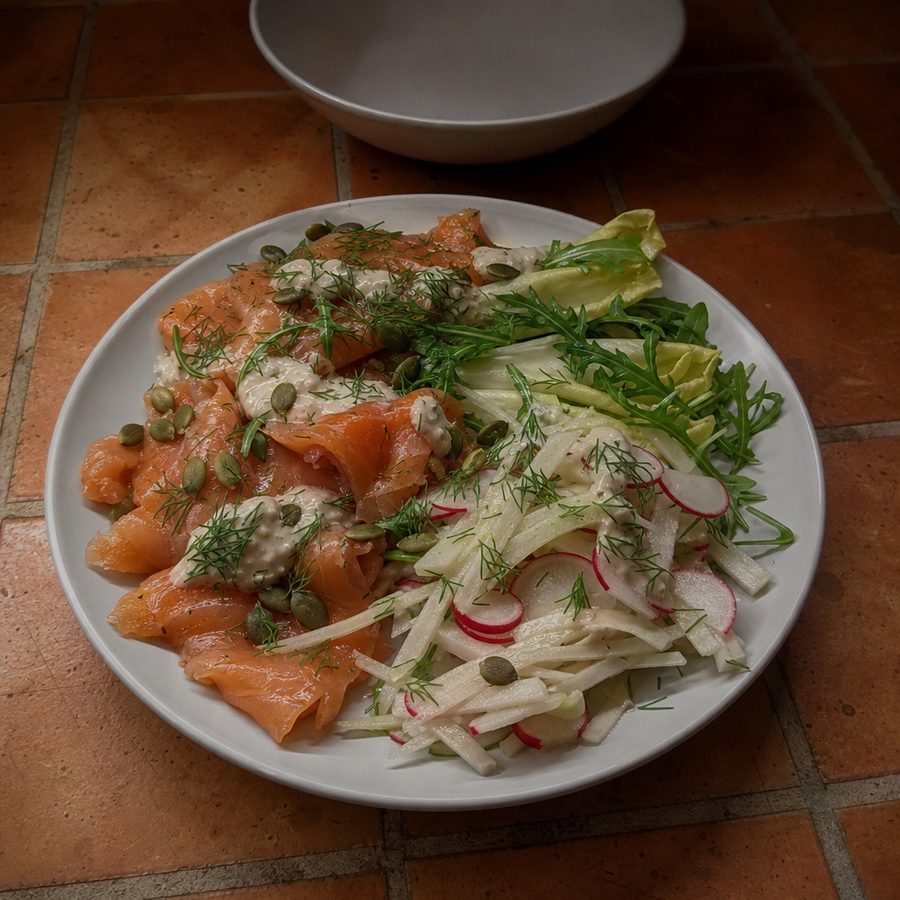
Cold-smoked salmon laid over endive and arugula with kohlrabi and radish pickled in cider vinegar for twenty minutes, and a loose tahini dill sauce spooned across the top.
Why You'll Love This Recipe
There is a particular kind of morning where the idea of standing over a pan is unbearable, and this is the plate I make then. Nothing gets heated. The pickle is the only thing that takes any time at all, and it takes twenty minutes on its own while you do something else. Cold-smoked salmon comes out of the package ready, the endive comes apart into spears with your hands, and the whole plate is built in the time it takes coffee to brew. It looks like something a restaurant sent out, which is not nothing on a Tuesday, and it eats like a real breakfast rather than a snack you talked yourself into.
The pickle is the part worth understanding. Kohlrabi cut into matchsticks and radish sliced thin sit in cider vinegar with a spoonful of maple syrup and a good pinch of salt, and in twenty minutes the salt has pulled enough water out that the vinegar can get in. They go limp at the edges and stay crisp in the middle, which is exactly what you want against something as soft as smoked salmon. Cut them thicker than you think, because paper-thin kohlrabi goes floppy all the way through and you lose the crunch that makes the plate work. The brine left in the bowl is worth spooning over the greens.
What keeps this from being a plate of cold fish and leaves is the tahini. Thinned with lemon juice and cold water until it pours off the spoon in a ribbon, it turns bitter and rich at the same time, and it gives the salmon something to sit against. I stir most of the dill into the sauce rather than scattering it over the top, so the herb runs through every bite and not just two of them. Pumpkin seeds go over at the end for something hard to bite through. Between the salmon, the tahini, and the seeds, this holds me until lunch, which is more than I can say for most cold breakfasts.
Ingredients
- 14 oz cold-smoked salmon, sliced thin
- 2 medium kohlrabi, peeled and cut into thick matchsticks
- 10 radishes, sliced thin
- 1/4 cup apple cider vinegar
- 1 tbsp pure maple syrup
- 2 heads endive, leaves separated
- 4 cups arugula
- 1/4 cup tahini, stirred well
- 3 tbsp fresh lemon juice
- 2 tbsp garlic-infused olive oil
- 1/3 cup chopped fresh dill, divided
- 1/4 cup pumpkin seeds
- 1 tsp freshly ground black pepper
- 1/2 tsp fine sea salt, divided
Instructions
- Start the pickle first: Peel the kohlrabi down past the fibrous layer just under the skin, then cut it into matchsticks about the thickness of a pencil lead. Slice the radishes thin. Toss both with the cider vinegar, the maple syrup, and 1/4 teaspoon of the salt in a small bowl, pressing everything down so the brine covers it. Leave it 20 minutes at room temperature, stirring once.
- Make the tahini dill sauce: Whisk the tahini and the lemon juice together in a bowl. It will seize and go stiff and pale within seconds, which is what tahini does and not a mistake. Keep whisking and add cold water a tablespoon at a time, 3 to 4 tablespoons in all, until it loosens into a sauce that pours off the spoon in a ribbon. Stir in two thirds of the dill and half the black pepper.
- Dress the greens: Separate the endive into spears and trim the bitter core out of each head. Toss the spears and the arugula with the garlic-infused olive oil, a spoonful of brine lifted from the pickle bowl, and the remaining 1/4 teaspoon of salt. Use your hands, and turn the leaves over just a few times so the arugula does not bruise.
- Let the salmon come up in temperature: Lay the salmon out on the plates in loose folds rather than flat sheets, so there are ridges for the sauce to catch in. Leave it on the counter for about 10 minutes before you serve. Straight from the refrigerator the fat in cold-smoked salmon is firm and the flavor stays shut down.
- Build the plates: Drain the pickles well and squeeze them gently in your hand, or the plate goes watery underneath. Pile them beside the salmon, lay the dressed endive and arugula on the other side, and spoon the tahini sauce over the fish rather than over the leaves, which would go slack under it.
- Finish and serve: Scatter the pumpkin seeds and the remaining dill over everything and grind the rest of the black pepper across the top. Taste before you reach for more salt. Between the cure on the salmon and the brine on the pickles there is usually plenty already.
Variations
- Smoked trout: Flake two smoked trout fillets over the plate in place of the salmon for something firmer and smokier.
- Sesame finish: Swap the pumpkin seeds for toasted sesame seeds and add a few drops of sesame oil to the tahini sauce.
- Chive and parsley: Use chives and parsley in place of the dill for a greener, grassier plate that leans less Nordic.
- A little heat: Drop thin rings of jalapeno into the pickle bowl at the start so they soften along with the kohlrabi.
- Make it a bowl: Spoon everything over a cup of cold cooked brown rice per person and add another tablespoon of water to the sauce.
Storage & Leftovers
The pickle is the one part that improves with time. Sealed in its brine in the refrigerator it keeps 5 days and grows sharper and more tender each day, so I often make a double batch on Sunday. Drain and squeeze it fresh each morning rather than letting it sit drained, which turns it limp.
The tahini sauce keeps 4 days in a sealed jar and sets up thick and spoonable when it is cold. Loosen it with a tablespoon of cold water and a squeeze of lemon, whisking hard, and it comes back to a pouring sauce. Stir fresh dill through it rather than relying on the dill already in there.
An assembled plate does not hold, so build it at the table. An opened package of cold-smoked salmon is good for about 3 days in the coldest part of the refrigerator, wrapped tight against the air. Keep the endive and arugula dry and undressed until the moment you eat, since dressed leaves collapse within the hour.
Notes & Tips
- Cut the kohlrabi thicker than feels right: Vinegar and salt soften vegetables faster than you expect. Matchsticks with real thickness to them come out crisp at the core, and shavings come out floppy.
- Whisk the tahini through the seize: The stiff, grainy stage is the sauce coming together, not falling apart. Add cold water slowly and keep the whisk moving and it turns smooth and pale.
- Why garlic-infused olive oil works: The part of garlic that carries the flavor dissolves into fat, and the part that upsets a sensitive gut does not, so the oil brings the taste and leaves the trouble behind in the bottle. Use it raw on the greens here, where nothing cooks off.
- Let the fish sit out ten minutes: Cold-smoked salmon eaten straight from the refrigerator tastes of very little. Ten minutes on the counter softens the fat and the smoke and salt come forward.
- Squeeze the pickles dry: A quick squeeze in your fist is the difference between a clean plate and a pool of pink brine running into the tahini.
- Taste before you salt: Cured fish and pickle brine bring a lot on their own. Season the greens, then taste the built plate and decide.
Nutrition & Mindful Eating
- Salmon, the vinegar pickle, and the tahini are the three things this plate is built on. The fish is soft and rich, the kohlrabi and radish come back at it sharp and crunchy, and the sesame sauce sits between them and pulls the two halves together.
- Cold-smoked salmon is cured and cold-smoked rather than cooked, which is why it stays silky and slippery on the plate. It carries the long chain omega-3 fats that oily fish are known for, along with vitamin D and B12, in a form you can put on a plate in thirty seconds.
- Kohlrabi eats like a sweeter, milder relative of the cabbage it belongs to, and raw in a quick brine it stays crisp all the way through. It is a genuinely good source of vitamin C, which holds up here because nothing goes near heat.
- Tahini is nothing but sesame seeds ground to a paste, so it brings the calcium and copper of the whole seed along with the unsaturated fat that makes the sauce taste rich. Whisked with lemon it turns pale and pourable and stops the plate from feeling austere.
- Dill, lemon, cider vinegar, and coarse black pepper are what keep something this rich feeling awake, and the pumpkin seeds give your teeth something to do. Between the fish and the sesame there is enough protein and fat here to carry you well past the middle of the morning.
- As you eat, notice the moment the vinegar in the pickle meets the fat in the salmon and how the two settle each other, and give this plate a proper sit-down rather than eating it over the sink.
Frequently Asked Questions
What can I use if I cannot find kohlrabi?
Turnip cut the same way is the closest match, sharp and firm with the same white crunch. Jicama works and stays crisper for longer in the brine, and thinly sliced cucumber pickles in about half the time. Whatever you use, cut it thick enough to keep some bite after twenty minutes in vinegar.
My tahini sauce seized into a stiff paste. Did I ruin it?
No, and every batch does this. Sesame paste tightens the moment acid hits it, then relaxes again once there is enough water. Keep whisking and add cold water one tablespoon at a time. It will look broken and grainy, then suddenly turn pale, smooth, and pourable.
Can I get this ready the night before?
The two components that take any work are the ones that keep. Make the pickle and the tahini sauce the evening before, or up to a few days ahead, and store them in separate jars. In the morning you are draining pickles, dressing leaves, and folding salmon onto plates, which is a five minute job.
Does this fit a low-FODMAP breakfast?
It does at this portion. Smoked salmon, endive, arugula, radish, and pumpkin seeds all sit comfortably, kohlrabi is fine at the amount one plate carries, and a quarter cup of tahini split four ways is a modest spoonful each. The savory backbone is vinegar, lemon, dill, and garlic-infused olive oil rather than garlic cloves, so nothing gets stripped out of the recipe.