
Spanish Chicken and Pepper Skillet with Smoked Paprika and Almonds
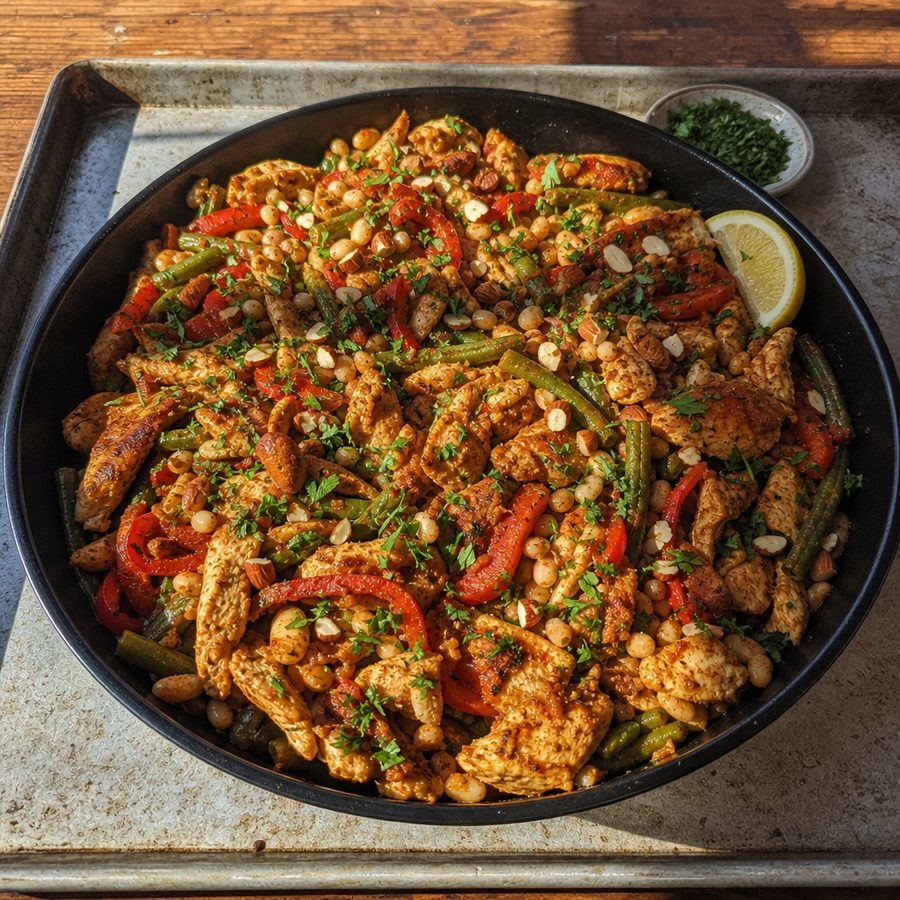
Strips of chicken breast and sweet red peppers cooked down with smoked paprika and green beans, finished with a pounded almond, garlic, and parsley picada.
Why You'll Love This Recipe
Lunch has to be a real plate rather than something eaten over the sink. It is one pan, it is loud and colorful, and it tastes like the little plates you get standing at a bar counter in Seville, where smoked paprika and olive oil do nearly all the work and nothing is fussy. The picada at the end is the Catalan trick I would not skip: almonds, garlic, and parsley pounded together and stirred in with the burner off. It thickens the pan juices slightly and gives the whole skillet a toasted backbone that paprika alone cannot supply.
The method is simply about giving each thing the pan it needs. Chicken strips go in first over real heat and come out while they are still juicy, because breast meat turns stringy the moment it is cooked past done. Then the peppers and onion get the pan to themselves and cook long enough to collapse and sweeten, which is where the body of the dish comes from. Green beans go in with a splash of water and a lid for a few minutes so they steam bright green, the white beans warm through at the end, and the vinegar goes in last, off the heat, where it stays sharp.
What I like about eating it is the range of textures on one plate: soft strips of pepper, beans that still push back a little, creamy cannellini, and chicken with browned edges. It is savory and smoky and just sour enough at the finish that you keep going back for another forkful. There is a real portion of chicken in every serving and enough vegetable volume that the plate looks like a lot of food, which matters at midday. It also holds up beautifully in the refrigerator, so I often cook it on Sunday and eat it through the week.
Ingredients
- 1 1/2 lb boneless, skinless chicken breasts, cut across into 3/4-inch strips
- 3 red bell peppers, seeded and cut into wide strips
- 3/4 lb green beans, trimmed and snapped in half
- 1 cup canned cannellini beans, drained and rinsed
- 1 small yellow onion, halved and sliced thin
- 4 garlic cloves, 3 sliced thin and 1 left whole
- 1/3 cup whole almonds
- 2 tbsp extra virgin olive oil
- 2 tsp smoked paprika, sweet or hot
- 1/4 cup chopped fresh flat-leaf parsley
- 1 tbsp cider vinegar
- 1/4 tsp fine sea salt
Instructions
- Toast the almonds and make the picada: Put the almonds in a dry skillet over medium heat and toast for four to five minutes, shaking often, until they smell nutty and are freckled brown. Tip them into a mortar or a small food processor with the whole garlic clove, half the parsley, and a pinch of the salt, and pound or pulse to a coarse, sandy paste. Set it aside.
- Brown the chicken: Pat the chicken strips dry and season with the remaining salt. Heat 1 tbsp of the olive oil in a 12-inch skillet over medium-high until it shimmers, then lay the strips in a single layer and leave them undisturbed for three minutes, until the undersides are golden. Turn and cook two to three minutes more, until the thickest piece reaches 165°F on an instant-read thermometer. Move the chicken to a plate.
- Sweeten the peppers and onion: Add the remaining olive oil, the pepper strips, and the sliced onion to the same pan and lower the heat to medium. Cook for eight to ten minutes, stirring every couple of minutes, until the peppers have slumped, given up their liquid, and started to catch brown in places. Stir in the sliced garlic and the smoked paprika and cook for forty seconds, just until the paprika smells warm rather than dusty.
- Steam the green beans: Add the green beans and 1/4 cup water, cover the pan, and cook for four to five minutes. The water should be nearly gone and the beans should be bright green and tender with a little resistance left when you bite one. If the pan goes dry early, add another splash.
- Bring it together: Stir in the cannellini beans and the chicken with any juices from the plate, and warm through for two minutes. Take the pan off the burner, stir in the picada, the cider vinegar, and the rest of the parsley, and let it sit for a minute so the paste loosens into the pan juices. Taste and add a little more vinegar if it needs lifting.
Variations
- Smoked paprika and sherry vinegar: Swap the cider vinegar for sherry vinegar if you have it, which is the more Spanish pairing and slightly rounder against the paprika.
- Chickpeas rather than cannellini: Use a cup of drained chickpeas for a firmer, nuttier bean that holds its shape completely through reheating.
- With turkey: Strips of turkey breast work exactly the same way and take about a minute longer per side to brown.
- Greener: Fold two large handfuls of chopped kale in with the green beans and let them wilt under the lid.
- Warm and hot: Use hot smoked paprika and add a pinch of cayenne with the garlic for a skillet with a slow burn behind it.
Storage & Leftovers
This keeps four days in a sealed container in the refrigerator and is one of the better cold-pan lunches I make. The peppers soften a little more overnight and the paprika settles into the chicken, so day two tastes rounder and smokier than day one.
Reheat it in a skillet over medium heat for three or four minutes with a tablespoon of water to loosen the pan juices. The microwave works, though the green beans go softer. A fresh splash of vinegar and a little chopped parsley after reheating brings the whole plate back into focus.
It also freezes for up to two months in flat, sealed portions, with one caveat: the green beans lose their squeak. Thaw overnight in the refrigerator and reheat in a pan. If you know you are freezing half, hold back the picada and stir it in fresh when you reheat.
Notes & Tips
- Bloom the paprika, do not burn it: Forty seconds in warm oil is the whole window. Paprika turns bitter fast over high heat, so lower the burner before it goes in and stir constantly.
- Cut the peppers wide: Thin slivers disappear into the pan. Wide strips keep their shape while still going soft, and they are what makes the skillet look generous.
- Dry the chicken strips: Meat straight from the package is wet, and wet meat steams gray. A minute with paper towel is the difference between browned edges and pale ones.
- Toast the almonds first: Untoasted almonds taste flat in the picada. You want them fragrant and freckled, and they go from that to burnt in under a minute, so stay at the pan.
- Rinse the canned beans well: A good rinse under cold water takes away the thick canning liquid and lets the beans taste like beans in the finished pan.
- Add the vinegar off the heat: Vinegar cooked in a hot pan loses its edge within seconds. Off the burner it stays bright and cuts through the smoke, which is the whole point of it.
Nutrition & Mindful Eating
- The chicken, the two kinds of beans, and the pile of peppers are each doing a different job here. The chicken carries the protein, the cannellini and green beans bring the fiber and the creamy and squeaky textures, and the peppers supply the sweetness that keeps a savory pan from tasting flat.
- Red bell peppers are at their sweetest when they have gone soft and a little blistered, and that same red flesh is unusually generous with vitamin C, more so than most people expect from something they think of as a salad vegetable.
- Cannellini beans go creamy at the edges and soak up the paprika oil around them, and their soluble fiber is the sort that makes a plate settle slowly rather than all at once.
- Almonds pounded with garlic and parsley thicken the pan juices in a way flour never would, and they bring vitamin E and a mild, buttery fat that carries the smoke of the paprika across the whole skillet.
- Smoked paprika, sliced garlic, and a spoonful of cider vinegar are the three things you taste first and last. The paprika is dried over oak fires, which is where the woodsmoke comes from, and the vinegar at the end is what keeps a rich pan tasting bright to the final forkful.
- As you eat, notice how the peppers have gone silky against the snap still left in the green beans, and let the smoke and the vinegar slow you down enough to finish the plate at a table rather than on your feet.
Frequently Asked Questions
Can I use chicken thighs?
Yes, and they are more forgiving. Cut boneless, skinless thighs into strips of the same size and give them an extra two or three minutes in the pan, cooking to 175°F. They will not dry out if you are distracted, which makes them the better choice if you are cooking and answering email at the same time.
My peppers went watery instead of browning. What happened?
Too many strips in too small a pan. Peppers release a lot of liquid, and if they cannot spread out, they sit and boil in it. Use a 12-inch skillet, keep the heat at a steady medium, and resist stirring more than every couple of minutes so the undersides get time against the metal.
Do I have to make the picada?
You can stir in chopped toasted almonds and a little grated garlic instead of pounding them, and it will still taste good. Pounding is what makes the paste dissolve into the pan juices and coat everything rather than sitting on top, so if you have a mortar or a mini food processor, it is two minutes well spent.
Is this enough for a whole lunch on its own?
It is. Between the chicken, the white beans, and the volume of peppers and green beans, a serving fills a dinner plate and eats like a full midday meal. If you are feeding someone with a bigger appetite, a slice of good bread on the side is traditional and welcome.