
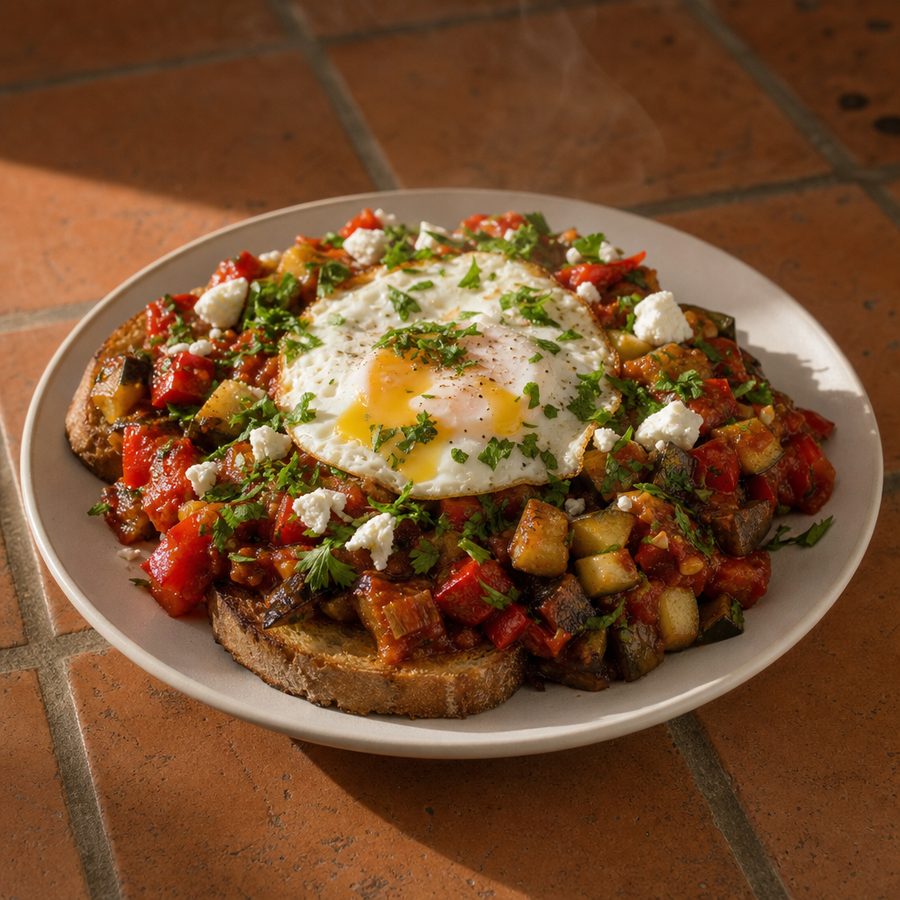
Spanish Pisto on Garlic Toast with Fried Eggs and Goat Cheese
Peppers, eggplant, and zucchini cooked down slowly with tomato, smoked paprika, and oregano, spooned over garlic-rubbed toast and topped with a fried egg and crumbled goat cheese.
Why You'll Love This Recipe
Pisto is what I make when the vegetable drawer has gotten away from me in August. It is the Spanish version of every slow-cooked summer vegetable dish, and the whole trick is patience. You cook each vegetable down until it gives up its water and starts to sweeten, then you let the tomato reduce around all of it until the pan looks glossy rather than wet. Nothing here is fussy and none of it needs to be pretty. I have made it in a battered skillet with a wooden spoon and it was still the best thing on the table. Putting it on toast for breakfast came from leftovers, which is how most of the good breakfasts in my house started.
The eating is soft against crisp, which is the whole reason it goes on bread. The pisto is jammy and silky, closer to a spoonable relish than a stew, and the toast underneath goes from crunchy at the first bite to properly soaked by the last. A fried egg on top breaks and runs down into the vegetables and makes its own sauce, and the goat cheese turns creamy and tangy wherever it meets the heat. Smoked paprika sits underneath everything with a low, dusty warmth, and the oregano is what keeps this tasting Spanish rather than Italian. Use a knife and fork, and do not worry about how the plate looks.
I cook a full pan of pisto on a Sunday and eat it three ways. Sunday it is supper with a spoon, Monday morning it is this, and by Wednesday whatever is left goes cold into a jar under a little more oil. That is the honest reason it is written for four and takes the better part of an hour: you are making a base, not a single meal. On a morning when you want it quickly, warm the pisto in a small pan while the bread griddles and the eggs fry, and you are sitting down in eight minutes. It is also very good at room temperature, which no one expects.
Ingredients
- 3 tbsp extra-virgin olive oil, divided
- 1 large yellow onion, cut into 1/2-inch dice
- 2 red bell peppers, seeded and cut into 1/2-inch dice
- 1 medium eggplant (about 12 oz), cut into 1/2-inch dice
- 2 small zucchini, cut into 1/2-inch dice
- 1 1/2 cups no-salt-added crushed tomatoes
- 5 garlic cloves, 3 minced and 2 left whole and halved for rubbing the toast
- 1 tsp sweet smoked paprika
- 1 1/2 tsp dried oregano, crushed between your fingers
- 1/8 tsp fine sea salt
- 1/2 tsp coarsely ground black pepper
- 4 slices whole grain country bread, cut about 1/2 inch thick
- 4 large eggs
- 1 3/4 oz soft goat cheese, crumbled
- 3 tbsp chopped flat-leaf parsley
Instructions
- Cut everything to the same size: Dice the onion, peppers, eggplant, and zucchini into pieces about half an inch across. Evenness matters more here than precision, because the vegetables go in at different times and you want each batch to cook at the same rate. Mince three garlic cloves and set the other two aside, halved, for the toast.
- Sweat the onion and peppers: Heat 2 tbsp of the olive oil in a wide skillet over medium. Add the onion and peppers with the salt and cook for 10 to 12 minutes, stirring every couple of minutes, until the onion is translucent and the peppers have gone limp and sweet. You want no color on them yet, just softness.
- Add the eggplant and give it time: Stir in the eggplant and the remaining tablespoon of oil. It will drink the oil immediately and look dry, which is normal, so resist adding more. Cook for 8 minutes, stirring now and then, until the cubes have shrunk by half and turned translucent at the edges. That is when eggplant stops being spongy and goes silky.
- Zucchini, garlic, and spice: Add the zucchini, the minced garlic, the smoked paprika, and the oregano and cook for 3 minutes, until the garlic smells sweet and the paprika has bloomed into the oil and stained it orange. Stir constantly here so the paprika does not catch and turn bitter on the bottom of the pan.
- Reduce with the tomato: Pour in the crushed tomatoes and the black pepper, bring it to a slow bubble, then lower the heat and cook uncovered for 12 to 15 minutes. It is ready when a spoon dragged across the bottom leaves a clear track that fills in slowly, and the surface looks glossy rather than watery. Taste and adjust the pepper.
- Griddle the bread and fry the eggs: Toast the bread in a dry pan or under the broiler until it is crisp at the edges, then rub one cut side of each slice with a halved garlic clove while it is still hot. Fry the eggs in a slick of oil over medium until the whites are set and the yolks still move. Pile pisto onto each slice, slide an egg on top, and finish with the goat cheese and parsley.
Variations
- Pisto with white beans: Fold half a cup of rinsed cannellini beans into the pan for the last five minutes so they warm through and take on the tomato.
- Broiled with cheese: Spread the pisto over the toast, top with the goat cheese, and run it under the broiler for two minutes so the cheese blisters before the egg goes on.
- Sherry vinegar finish: Stir a teaspoon of sherry or red wine vinegar in off the heat, which sharpens the tomato and makes the whole pan taste brighter.
- Greens folded through: Add a large handful of chopped collard greens or kale with the tomato and let them wilt down into the vegetables as it reduces.
Storage & Leftovers
The pisto itself keeps five days in a sealed container in the refrigerator and improves for the first two. The vegetables go on trading flavor overnight, the tomato settles, and the paprika, which can taste a little sharp on day one, rounds out completely. Store it on its own and build the plates fresh, because toast and egg do not wait for anybody.
Reheat it in a small skillet over medium for four or five minutes, stirring, until it bubbles at the edges. A splash of water loosens it if it has tightened in the cold. The microwave works if you are moving fast, though the surface can go a little flat, and a fresh thread of olive oil stirred in at the end brings the shine back.
It freezes beautifully for three months in flat, sealed portions, which is the main reason I make a big pan. Thaw overnight in the refrigerator and reheat in a pan rather than from frozen, since the zucchini releases water as it thaws and you want a few minutes of open heat to cook that off before it goes onto bread.
Notes & Tips
- Cook it in stages, not all at once: Everything dumped in together steams and comes out gray. Onion and peppers first, then eggplant, then zucchini, so each one has a few minutes of direct heat before the next arrives.
- Do not chase the eggplant with more oil: It soaks up whatever you give it and looks dry a minute later. Give it the tablespoon it is owed and keep stirring. Once the cells collapse it releases oil back into the pan and everything goes glossy.
- Bloom the paprika, do not burn it: Smoked paprika needs about 30 seconds in warm oil to open up and turns acrid past a minute or two. Add it with the garlic, stir the whole time, and get the tomatoes in right behind it.
- Rub the garlic on hot toast: The cut clove melts against a hot, dry surface and leaves almost nothing behind on a cool one. Rub it the second the bread comes off the heat, and rub with the flat cut face rather than the tip.
- Fry the eggs last: A fried egg has a window of about a minute where the white is set and the yolk still runs. Build the toasts first, have the plates ready, and cook the eggs into a waiting plate rather than the other way around.
Nutrition & Mindful Eating
- The peppers, eggplant, zucchini, and tomato are the whole substance of this plate, and the egg and goat cheese sit on top rather than underneath. Long, slow cooking concentrates all four vegetables, so what is mostly vegetable still eats like a full breakfast, with the bread bringing the whole grain underneath it.
- Eggplant is what makes pisto silky. The flesh is full of tiny air pockets that collapse in hot oil and turn creamy, and its fiber softens completely rather than staying stringy, which is why the finished pan spreads like a relish.
- Red bell peppers are left on the plant until they turn, which is where the sweetness and the deep color come from, and they carry vitamin C that holds up through a long cook better than most people expect.
- One egg per plate is what makes this breakfast rather than a side dish. The yolk breaks into the vegetables and becomes the sauce, and it brings choline and vitamin D along with protein that gives the plate its shape.
- Smoked paprika and oregano are what you taste first. The paprika is dried over oak smoke before it is ground, so a single teaspoon turns the pan dusky and warm, and the crushed oregano keeps a faint bitterness underneath all that sweet vegetable.
- As you eat, notice the toast going from crisp to soaked as you work across it, and let this be a plate you sit down to rather than one you finish standing at the counter.
Frequently Asked Questions
Do I have to salt the eggplant first?
No. Salting and draining was worth doing when eggplants were routinely bitter, and modern ones are not. What matters far more is giving the cubes enough time in hot oil to collapse. If your eggplant is old and spongy with big brown seeds, that is the one worth a 20 minute salt and a squeeze in a towel.
Can I make it without the egg?
Yes, and it is still a real plate. Crumble a little more goat cheese over the top so there is something soft and rich against the bread, or spoon the pisto over thick yogurt instead of toast. The vegetables carry the dish either way, and the egg is there for the yolk running down into them.
Why is my pisto watery?
Almost always a pan that is too small or a lid that stayed on. Zucchini and eggplant are mostly water and that water has to leave, so use the widest skillet you own and cook the last stage uncovered. If it is already loose, just keep it on low heat for another 5 to 10 minutes and it will pull together.
What kind of bread works best?
Something with an open crumb and a real crust, cut thick. A slice that is too soft turns to paste under all that tomato. Day-old bread is better than fresh here, and griddling it in a dry pan rather than a toaster gives you the hard, dry surface that holds up to the garlic rub.