
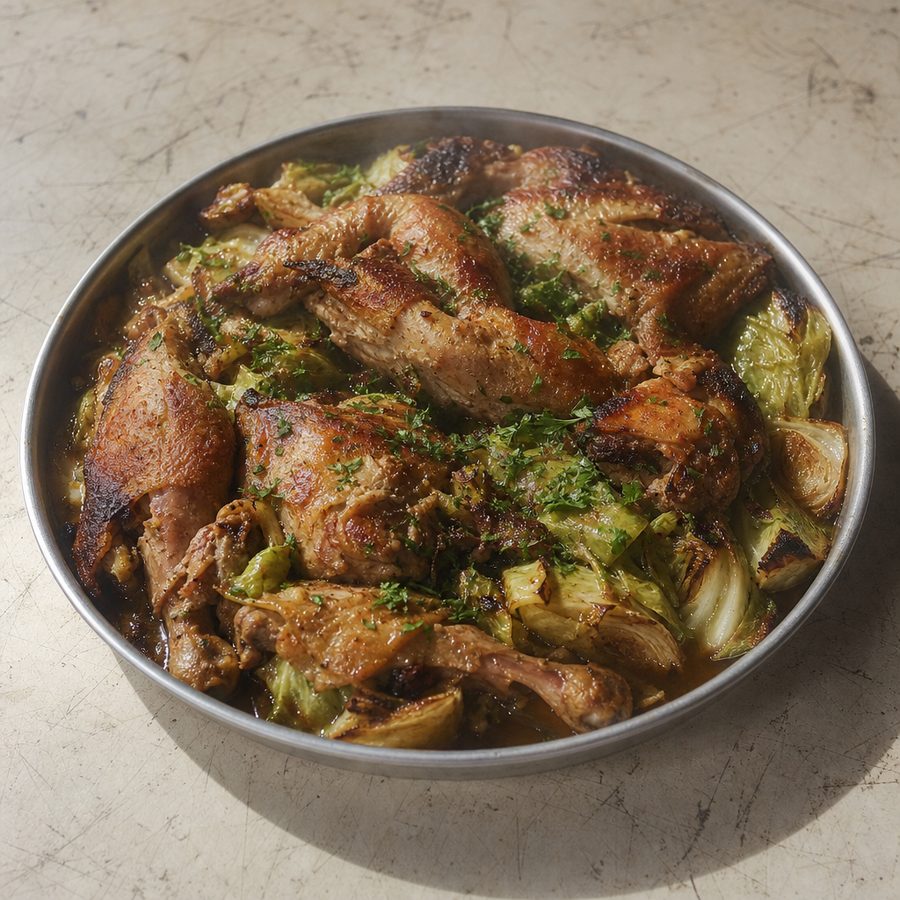
Spatchcocked Chicken over Roasted Cabbage Wedges
A whole chicken flattened and roasted hot over thick cabbage wedges, so every drop of fat and juice lands in the cabbage rather than in the bottom of the pan.
Why You'll Love This Recipe
A Sunday when I want the house to smell like something for a few hours, and only one pan to wash at the end of it. A whole chicken is still the cheapest way to feed four people properly, and flattening it means the whole bird is done in about fifty minutes rather than an hour and a half. The cabbage underneath is the part people are skeptical about right up until they eat it. It goes into the pan raw, in thick wedges, and it spends the entire roast catching fat and juice, so by the end it is sweet, brown at the edges, and the thing everyone reaches for second.
Spatchcocking is one cut with a pair of kitchen shears, up either side of the backbone, and then you press hard on the breastbone until the bird lies flat. That flatness is the whole point of the method. Everything sits at the same height, so the thighs and the breast finish within a few minutes of each other and the skin browns evenly all the way across. Set the oven to 450°F (230°C) and leave it alone. A lower oven is the one way this dish goes wrong: you get pale slack skin, and cabbage that steams in its own water rather than browning in the fat coming down onto it.
What lands on the table has real weight to it. The chicken brings the protein and the skin renders enough fat that the cabbage needs no more oil than the spoonful it starts with. Cabbage roasted this way stops behaving like a side vegetable, and the wedges hold together well enough to cut with a knife and fork. Cider vinegar goes over everything at the end, off the heat, where it stays sharp and cuts straight through the drippings. Leftovers are arguably better the next day: pull the meat off the bones, chop the cabbage through the pan juices, and warm the whole lot in a covered skillet.
Ingredients
- 1 whole chicken (about 4 lb), backbone removed and flattened
- 1 medium head green cabbage (about 2 lb), cut through the core into 8 wedges
- 6 cloves garlic, thinly sliced
- 3 tbsp olive oil, divided
- 1 tbsp fresh thyme leaves
- 1/2 cup chicken broth
- 2 tbsp apple cider vinegar
- 1/4 cup chopped fresh parsley
- 2 tsp fine sea salt, divided
Instructions
- Flatten the chicken: Set the chicken breast side down on a board. With kitchen shears, cut up one side of the backbone and then the other, and lift the backbone out. Turn the bird over, open it up, and press hard on the breastbone with the heel of your hand until it cracks and the chicken lies flat, since a flat bird has every part of it the same distance from the heat and cooks through at one rate. Pat the skin dry.
- Season it and heat the oven: Rub the bird all over with 1 tablespoon of the olive oil, then season with 1 1/4 teaspoons of the salt and the thyme leaves, working some of both under the skin over the breast. Leave it on the counter while the oven heats to 450°F (230°C) with a rack in the middle.
- Set the cabbage in the pan: Cut the cabbage through the core into 8 wedges so that each one stays held together at the base rather than falling into loose leaves. Lay them cut side down in a large roasting pan or on a rimmed sheet pan in a single layer, tuck the sliced garlic between them, drizzle with the remaining 2 tablespoons of oil, and season with the rest of the salt. Pour the broth into the bottom of the pan, because the fat rendering off the bird will otherwise smoke on bare metal for the better part of an hour.
- Roast: Set the chicken skin side up directly on top of the cabbage and roast for 45 to 55 minutes. Leave the oven door shut for the first 35 minutes, since every look drops the temperature and the skin needs steady high heat to tighten and brown. The skin should come out deep brown and tight, and the cabbage edges standing up around the bird should be dark.
- Check the doneness: The chicken is ready when the thickest part of the thigh reads 170°F (77°C) and the juices run clear where the leg meets the body. If the skin is coloring faster than the thigh is cooking, lay a loose sheet of foil over the top for the last 10 minutes.
- Rest, then finish the pan: Move the chicken to a board and rest it for 10 minutes, or the juices run out onto the board rather than staying in the meat. Stir the cider vinegar into the juices in the pan, spoon them over the cabbage, scatter the parsley, and carve the bird into four pieces.
Variations
- Red cabbage: Swap in red cabbage for a sweeter, deeper-colored pan, and add a second splash of vinegar so the color stays bright.
- Apple in the pan: Tuck two apples, cored and cut into thick wedges, between the cabbage for the last 25 minutes.
- Sage rather than thyme: Rub the bird with chopped fresh sage for a rounder, more autumnal note against the cabbage.
- Lemon finish: Trade the cider vinegar for the juice of a whole lemon stirred into the pan juices off the heat.
- Leeks underneath: Scatter two sliced leeks around the cabbage so they soften into the drippings and turn into something close to a sauce.
Storage & Leftovers
Carve the meat off the bones before it goes into the refrigerator and store it in a sealed container with the cabbage and pan juices for up to 4 days. Meat left on the carcass dries out at the edges overnight, and the juices are what keep the breast from going papery.
Reheat in a covered skillet over medium-low with a spoonful of broth, about 5 minutes, or spread it on a sheet pan under the broiler for 3 minutes if you want the skin to come back. A microwave works but turns the cabbage watery and the skin soft.
The picked meat freezes well for up to 3 months in a sealed bag with a little of the pan juice poured in. Roasted cabbage does not freeze, so eat that within the week. Simmer the backbone and carcass with an onion for a couple of hours and you have broth for the next one.
Notes & Tips
- Dry the skin: Wet skin steams and stays pale. Pat the bird thoroughly with paper towels, and if you have time, leave it uncovered in the refrigerator for a few hours first.
- Cut the wedges through the core: The core is what holds each wedge together. Cut around it and you end up with loose leaves that burn before the rest is tender.
- Use the widest pan you have: Cabbage crowded into a small pan steams. A half sheet pan or a large roasting pan gives every wedge a cut face against hot metal.
- Do not open the oven early: The first 35 minutes are when the skin sets. Every look costs you heat and lengthens the roast.
- Trust the thigh, not the breast: A spatchcocked bird cooks evenly enough that the thigh is the honest reading. At 170°F (77°C) the dark meat is tender and the breast is still juicy.
- Save the backbone: It goes in a bag in the freezer, and three or four of them make a pot of broth worth having.
Nutrition & Mindful Eating
- The chicken, the cabbage, and the pan juices work as one thing here. The bird gives the plate its protein and its fat, the cabbage gives it sweetness and fiber, and the drippings pull the two together so nothing on the plate eats dry.
- Chicken roasted on the bone stays juicier than any boneless cut you can buy, and the dark thigh meat carries iron and zinc alongside the protein, which is a good part of why a plate of this eats like a full dinner.
- Cabbage is mostly water and fiber, which is why a wedge this size fills a plate so honestly, and roasting it under the bird concentrates its sweetness while it still gives you a real amount of vitamin C.
- Garlic sliced thin goes soft and mild in the fat, and it brings the kind of fiber your gut bacteria feed on. The cider vinegar stirred in at the end is what keeps a pan this rich from sitting heavy.
- Roasted cabbage eats slower than it looks. The browned outer leaves go almost crisp, the middle stays soft and sweet, and between that texture and the protein in the chicken this holds you comfortably through the evening.
- As you eat, notice how far apart the charred outer leaves and the sweet soft middle of a wedge taste, and let the first few bites be slow enough that you register how much of the bird you actually want.
Frequently Asked Questions
Do I need special equipment to spatchcock a chicken?
A sturdy pair of kitchen shears, which cut through a chicken backbone in about thirty seconds. A heavy chef knife works if you are confident. If neither appeals, every butcher counter will do it for you at no charge, and most supermarket meat departments will as well if you ask.
My cabbage came out wet rather than browned. What happened?
Either the wedges were crowded or the oven ran cool. Cabbage releases a lot of water, and it needs space and a genuinely hot oven to drive that off before it can brown. Use the largest pan you own, keep the wedges in one layer, and do not add extra broth.
Can I cook the chicken ahead of time?
You can, though the skin is best straight out of the oven. Roast it earlier in the day, keep it at room temperature for up to two hours, and warm it through at 400°F (200°C) for 8 minutes before carving. For a longer head start, season the flattened bird and refrigerate it uncovered overnight, which dries the skin and helps it crisp.
Does this fit an AIP elimination phase?
Yes. There are no grains, dairy, eggs, nuts, seeds, or nightshades in it, and the seasoning is thyme, garlic, salt, and cider vinegar. Check that your broth carries no added spice blend, since that is where nightshade ingredients usually hide in a store-bought carton.