
Spinach and Garlic Stuffed Pork Loin with Roasted Fennel
A boneless pork loin butterflied, filled with garlicky wilted spinach and lemon, rolled, tied, and roasted over fennel wedges until the outside is deep gold.
Why You'll Love This Recipe
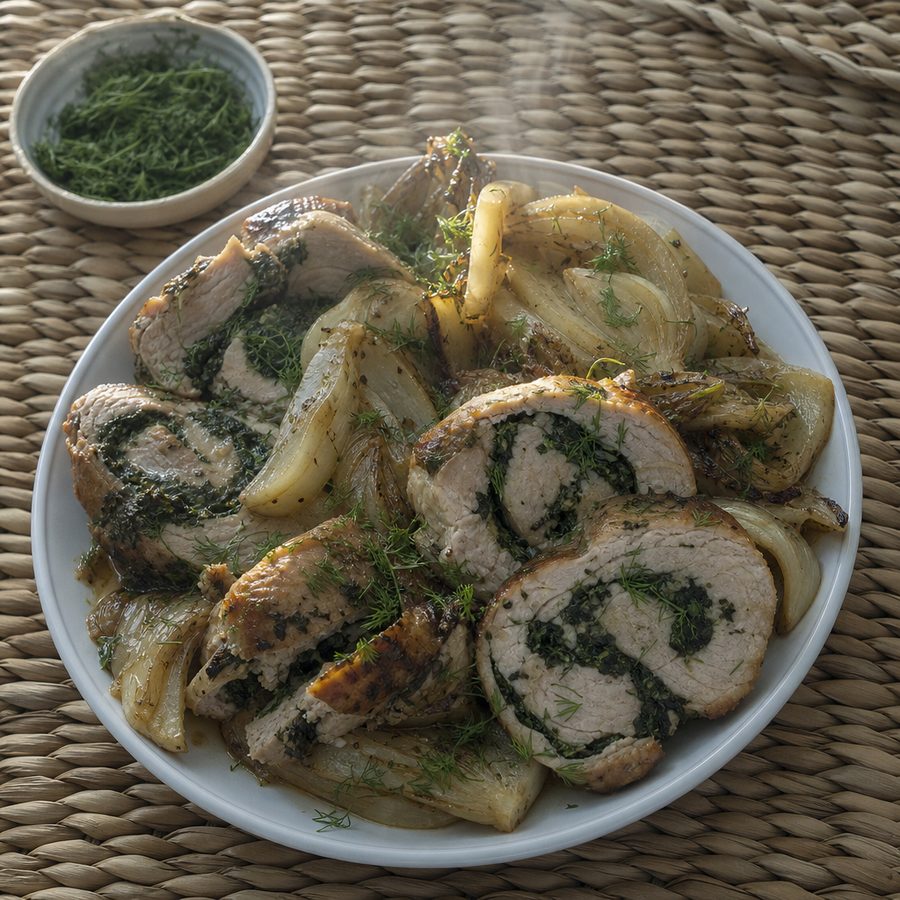
I make this when I want dinner to look like something without spending the evening on it. A rolled roast reads as a project and is really about twenty minutes of knife work, and the payoff is that green spiral running through every slice, which nobody expects from a plain pork loin. It is the dinner I bring out when family visits and half the table is eating one way and half another, because a stuffed roast and a pan of roasted fennel do not announce that anyone is on a program. Slice it at the table. It is a nicer thing to hand around than a platter of chops.
Two techniques carry this. The first is butterflying, which sounds harder than it is: lay one hand flat on the loin, cut in horizontally about two thirds of the way down, and open it like a book, then pound the thick spots so the whole sheet is even. The second is squeezing the spinach. Ten ounces of raw leaves cook down to a handful, and that handful holds a startling amount of water. Press it hard in a sieve before it goes on the meat, because water trapped in the roll steams the pork from the inside and loosens the whole spiral when you slice it.
Pork loin is mild and close-grained, which is a polite way of saying it has nothing to hide behind, so it wants both the garlic and spinach on the inside and the lemon and thyme on the outside. Pull it at 145°F (63°C) and let it rest ten full minutes. Those minutes are what keep the juices in the meat rather than on the board. The fennel underneath goes soft and sweet in the pork fat and the wedges pick up brown at the edges, and between the roast and the fennel there is enough protein and enough fiber here to end the day properly.
Ingredients
- 2 1/2 lb boneless pork loin roast, in one even piece
- 10 oz fresh spinach
- 2 medium fennel bulbs (about 1 lb), cored and cut into 3/4-inch wedges
- 2 shallots, minced
- 6 cloves garlic, minced
- 3 tbsp olive oil, divided
- 1 tbsp fresh lemon juice, plus the zest of 1 lemon
- 1 tbsp fresh thyme leaves
- 1 tsp dried rubbed sage
- 3/4 cup chicken broth
- 1 1/4 tsp fine sea salt, divided
Instructions
- Make the spinach filling: Heat 1 tablespoon of the olive oil in a large skillet over medium. Cook the shallots for 3 minutes until soft, add the garlic and the sage, and cook 1 minute more. Add the spinach in handfuls and toss until it has all collapsed, about 3 minutes. Take it off the heat and stir in the lemon zest.
- Squeeze it dry: Tip the spinach into a sieve and press it hard with the back of a spoon until no more liquid comes out, then chop it coarsely and spread it on a plate to cool. Take your time over it, because a wet filling steams inside the roll and the whole thing unrolls itself in the pan.
- Butterfly and fill the loin: Heat the oven to 400°F (200°C). Lay the loin on a board with one hand flat on top and cut in horizontally, two thirds of the way through, then open it like a book. Pound the thick areas to an even 3/4 inch, since a loin that is thicker at one end cooks to two different temperatures. Season the cut face with 1/2 teaspoon of the salt and spread the spinach over it, leaving a 1-inch border.
- Roll and tie: Roll the loin up snugly from a long side and tie it with butcher's twine at 1 1/2-inch intervals, working from the middle out, so that the filling gets pushed evenly toward both ends rather than out of one of them. Rub the outside with 1 tablespoon of the oil, the thyme, and 1/2 teaspoon salt.
- Sear, then roast over the fennel: Heat the remaining tablespoon of oil in an oven-safe skillet or roasting pan over medium-high and brown the roll on all sides, about 8 minutes total. Scatter the fennel wedges around it with the remaining 1/4 teaspoon salt, pour in the broth, and roast for 40 to 50 minutes, until the thickest part of the pork reads 145°F (63°C).
- Rest, then slice: Move the roast to a board and let it rest for 10 minutes before cutting, tented loosely with foil, because a rolled roast cut straight from the oven loses its juices and its spiral at the same moment. Return the pan to medium heat, stir the lemon juice into the fennel and juices, and scrape up anything stuck to the bottom. Snip off the twine, cut the roast into 3/4-inch slices, and spoon the pan juices over the top.
Variations
- Herb swap: Use fresh rosemary in place of the thyme, chopped fine, when you want the outside of the roast to taste more resinous and forward.
- Olive and lemon filling: Add a handful of chopped kalamata olives to the spinach for a saltier, brinier spiral that needs less salt on the meat.
- Root vegetables underneath: Swap the fennel for parsnip or turnip wedges, adding 10 minutes to the roasting time and tossing them in the pork fat halfway through.
- Chard or kale filling: Swiss chard or kale can replace the spinach, though both need a few extra minutes in the pan and a harder squeeze afterward.
- Apple and sage: Cook a diced apple with the shallots for a sweeter filling that leans into the sage, which suits a cold-weather table.
Storage & Leftovers
Sliced leftovers keep in a sealed container in the refrigerator for up to 4 days. Store the slices lying flat with the pan juices poured over them rather than stacked dry, since a close-grained roast firms up quickly in the cold and the juices are what keep it tender.
Reheat covered in a low oven at 300°F (150°C) for about 12 minutes, or in a skillet with a spoonful of broth over low heat. High heat tightens pork this cut and drives the moisture out fast. Cold slices are also very good on greens with a little olive oil and lemon.
The roast freezes best whole and unsliced, wrapped tightly for up to 2 months, and thawed overnight in the refrigerator before slicing. Roasted fennel does not freeze well and turns to threads, so eat that part within a few days or roast a fresh pan.
Notes & Tips
- Buy the loin, not the tenderloin: They are different cuts with different shapes. A loin roast is a wide, thick rectangle that butterflies into a proper sheet, while a tenderloin is narrow and will not hold much filling.
- Even thickness beats neat edges: Nobody sees the inside of the roll, so pound the thick spots freely. An even sheet rolls into an even cylinder and cooks at one rate all the way through.
- Squeeze the spinach twice: Press it once in the sieve, then again in a clean towel if it still feels damp. Wet filling is the single most common reason a rolled roast unravels.
- Tie from the middle out: One loop in the center, then work toward each end. Starting at one end pushes the filling ahead of you and you end up with a bare tail.
- 145°F (63°C) and not a degree more: Pork at 145°F (63°C) is juicy with a faint blush at the center, which is exactly right. By 160°F (71°C) this cut is firm and dry and no amount of pan juice will bring it back.
- Rest before you cut: Ten minutes on the board. Slicing early sends the juices onto the cutting board and takes the spiral with them.
Nutrition & Mindful Eating
- The pork, the spinach, and the fennel each do a different job on this plate. The roast carries the substance, the spinach spiral keeps every slice moist and adds something dark green in the middle of the meat, and the fennel roasting underneath brings sweetness and fiber.
- Pork loin is close-grained and mild, and it is one of the better food sources of thiamin, a B vitamin that is harder to come by than most. Cooked to 145°F (63°C) and rested, it slices into tender rounds with real protein behind them.
- Spinach collapses to a fraction of its raw volume, which is how ten ounces of leaves end up as a thin green ribbon, and that concentration is why the filling brings folate, magnesium, and plant iron along with it.
- Fennel roasted in pork fat loses its sharp anise edge and turns sweet and soft at the cut faces, and it brings potassium and fiber to a plate built around a roast.
- Garlic, thyme, and lemon zest do the seasoning here, the garlic sweet and cooked on the inside and the lemon sharp on the outside, so the roast tastes bright at the edges and savory in the middle with very little salt on it.
- As you eat, look at the spiral in the slice before you cut into it and notice how the lemon in the filling meets the sweetness of the fennel, then set your fork down between slices and let dinner take a while.
Frequently Asked Questions
Can I use pork tenderloin instead?
You can, but use two of them and cut the roasting time to about 20 minutes, since a tenderloin is thinner and cooks much faster. Butterfly each one, fill it, and tie it the same way. Two smaller rolls also slice into neater rounds than one large loin.
My spiral fell apart when I sliced it. Why?
Almost always wet spinach or a loose roll. Press the filling until it stops dripping, keep a 1-inch clear border so the filling does not squeeze out as you roll, and tie at 1 1/2-inch intervals so every slice has a piece of twine holding it. Resting the roast also helps it set.
Can I stuff and tie it in advance?
Yes, and it is better that way. Roll and tie the roast up to a day ahead and keep it covered in the refrigerator, then take it out 30 minutes before it goes in the pan so it roasts evenly. Cook the fennel and the pork together on the day.
Does this fit an AIP elimination phase?
It does. There are no grains, legumes, dairy, eggs, nuts, seeds, or nightshades here, and the seasoning is garlic, shallot, thyme, sage, and lemon rather than a spice blend. Buy a plain pork loin rather than a pre-seasoned or brined one, since those usually carry pepper and other additives.