
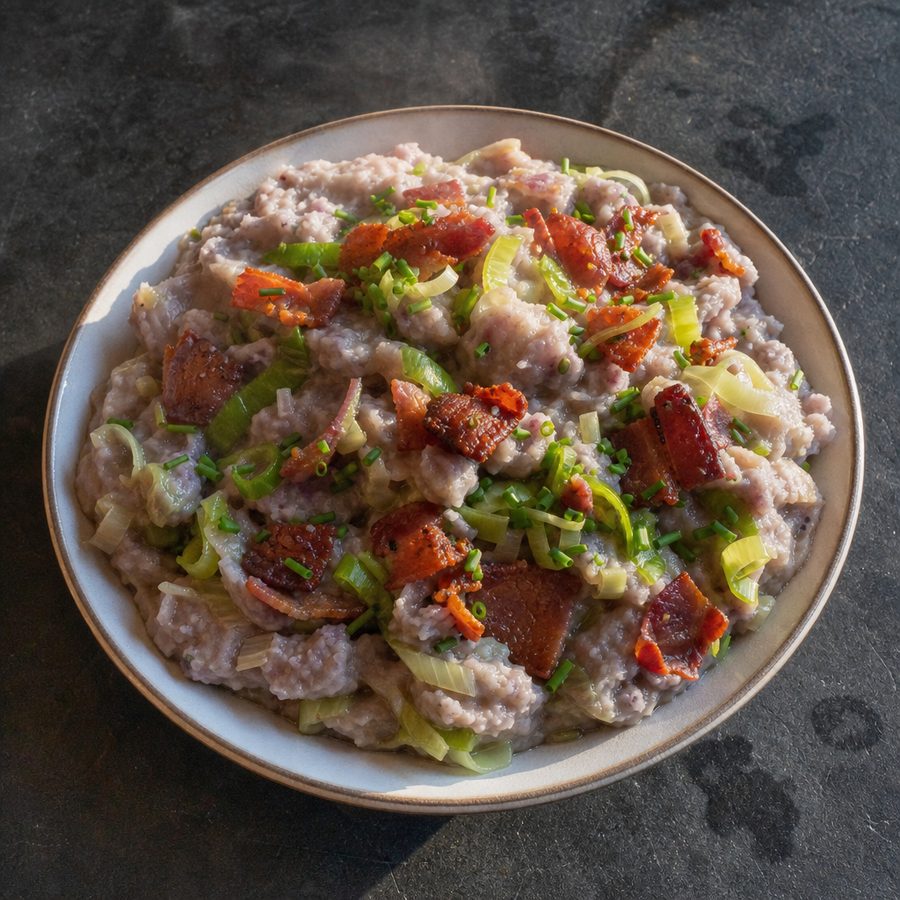
Taro and Leek Breakfast Mash with Bacon
Taro boiled tender and mashed with hot bone broth and olive oil, folded with slow-softened leeks and topped with crisp bacon and chives for a savory spoon breakfast.
Why You'll Love This Recipe
This is the bowl I put in front of somebody who says they cannot do breakfast without something soft and starchy. It is the texture of a good mashed potato and it eats with a spoon, standing at the counter or sitting down with a fork if you are civilized. I make it on Sunday and eat it Monday and Tuesday, because it reheats better than almost anything else in this category. If taro is new to you, look for the hairy brown ones the size of a fist in the produce section near the yams, and buy one more than you think you need.
Taro has to be handled a little differently from a potato and it is worth knowing why. The raw corm carries crystals that will make your hands itch, so peel it under running water or wear gloves, and understand that the itch goes away entirely once it is cooked. It boils in about 20 minutes and comes out drier and finer than a potato, which is exactly why hot bone broth and olive oil beaten into it work so well. Mash it by hand. A food processor will turn it into wallpaper paste faster than you can stop it, and I speak from experience.
The leeks are what make this a breakfast rather than a side dish. They go into the bacon fat with the garlic and cook slowly until they are silky and sweet, which takes about ten minutes and cannot be hurried over high heat without turning them bitter. A splash of cider vinegar at the end cuts through the fat, and the bacon gets crumbled over the top rather than folded in so it stays crisp against all that softness. If you are cooking for the week, the mash and the leeks keep well together and the bacon is worth crisping fresh each morning.
Ingredients
- 1 1/2 lb taro, peeled and cut into 1-inch chunks
- 2 large leeks, white and pale green parts only, halved and sliced thin
- 6 slices bacon
- 1 1/2 cups chicken bone broth
- 2 tbsp olive oil
- 3 cloves garlic, minced
- 1 tsp fresh thyme leaves
- 2 tsp apple cider vinegar
- 3 tbsp chopped fresh chives
- 1/2 tsp fine sea salt, divided
Instructions
- Cook the bacon: Lay the bacon in a cold skillet and set it over medium heat. Cook for 8 to 10 minutes, turning once, until the fat has rendered and the slices are crisp. Move them to a plate and leave 2 tablespoons of the fat in the pan.
- Peel and boil the taro: Peel the taro under cold running water or wearing gloves, since the raw corm can irritate bare hands, and cut it into 1-inch chunks. Cover with cold water in a saucepan, bring to a boil, and simmer 18 to 22 minutes, until a knife goes through with no resistance. Drain well.
- Soften the leeks: While the taro cooks, add the sliced leeks, the garlic, and the thyme to the reserved bacon fat over medium-low. Cook 8 to 10 minutes, stirring often, until the leeks are completely soft and pale gold with no crunch left. Stir in the vinegar and take the pan off the heat.
- Warm the broth: Bring the bone broth to a bare simmer in a small pot. Cold liquid poured into hot starch seizes it and leaves the mash stiff and lumpy, so the broth going in hot is what keeps this smooth.
- Mash it: Return the drained taro to its warm pot and mash by hand with a masher or a fork. Work in the hot broth in three additions, then the olive oil, until the mash is thick and creamy but still soft enough to slump on a spoon. Season with half the salt and taste.
- Fold and serve: Fold the leeks and all their fat through the mash. Divide among four bowls, crumble the bacon over the top, scatter the chives, and finish with the rest of the salt only if it needs it, since the bacon brings a good deal of its own.
Variations
- No pork: Skip the bacon, start the leeks in 2 extra tablespoons of olive oil, and fold flaked smoked trout over the top at the end.
- Half and half: Use half taro and half parsnip for a sweeter mash that browns nicely if you crisp the leftovers in a skillet.
- Sauerkraut on top: Spoon a little drained sauerkraut over each bowl for a sharp fermented note against the fat.
- Green mash: Wilt a few handfuls of chopped swiss chard into the leeks in their last 2 minutes so there is something green through it.
- Sausage version: Brown 3/4 lb of ground pork with sage in place of the bacon and fold half of it through the mash.
Storage & Leftovers
The mash and leeks keep together in a sealed container in the refrigerator for up to 4 days and set firm as they chill, which is normal for taro. Keep the crisped bacon in a separate container at room temperature for a day or in the refrigerator after that, so it does not go soft against the wet mash.
Reheat in a saucepan over low with 3 or 4 tablespoons of broth, stirring until it loosens and steams through, about 5 minutes. It comes back almost exactly as it was, which is unusual for a starch mash and is one of the reasons I make a double batch on a Sunday.
Freezing works for up to 2 months, though the texture goes slightly grainy on thawing. Thaw overnight in the refrigerator, reheat with extra broth, and beat it hard with a spoon as it warms. The leeks come through the freezer better than the taro does.
Notes & Tips
- Protect your hands: Raw taro makes bare skin itch. Peel it under running water or wear gloves and the problem disappears, along with any trace of it once cooked.
- Start the bacon cold: A cold pan renders the fat slowly and evenly, which gives you crisp bacon and the clean fat the leeks are going to cook in.
- Hot broth only: Cold liquid into hot starch gives you a stiff, lumpy mash. Ninety seconds in a small pot solves it permanently.
- Cook the leeks past soft: Ten slow minutes turns them sweet and silky. Six fast ones leaves them squeaky, and you will taste the difference in every bite.
- Wash the leeks properly: Grit lives between the layers. Slice them first, then swish the slices in a bowl of cold water and lift them out, leaving the sand behind.
- Season last: The bacon and the broth both bring salt of their own, so hold back until the bowl is assembled and then adjust.
Nutrition & Mindful Eating
- Taro, leeks, and bacon are the three things making this work. The taro gives it the soft body, the leeks give it sweetness and depth, and the bacon on top gives each spoonful something salty and crisp to land on.
- Taro is a starchy root that mashes soft and fine with a faint sweetness behind it, and it brings both potassium and a good amount of fiber, including the resistant kind that feeds the bacteria living in your gut.
- Leeks cooked slowly in fat go silky and sweet in a way no quick saute achieves, and the prebiotic fiber they carry is easier on a tender stomach when they have been softened this thoroughly.
- Bone broth mashed into the starch is what makes this creamy, and it brings the collagen and the gelatin that give a broth its body along with a savory depth that water could never add.
- Cider vinegar and chives are small additions doing heavy work. The acid cuts the bacon fat so the bowl does not sit heavy first thing, and the raw chives on top give a clean allium bite against all that softness.
- As you eat, notice how the crisp bacon breaks against the smoothness underneath it, and take the bowl somewhere you can sit for five minutes rather than eating it standing over the stove.
Frequently Asked Questions
What can I use if I cannot find taro?
Yuca, also sold as cassava, is the closest match in both texture and cooking time, though you must cut out the woody core before boiling. Celeriac or parsnip also mash well here and taste sweeter, and either one needs about 5 minutes less in the water.
Why did my mash turn gluey?
It went into a machine. Taro has enough fine starch that a blade blender or a food processor will make it stretchy and paste-like in seconds. Mash by hand, and stop as soon as the lumps are gone rather than working it smooth.
Can I make this ahead for the week?
Yes, and it is one of the few starch mashes that genuinely holds. Make the mash and the leeks on Sunday, portion them, and crisp two slices of bacon each morning while the bowl reheats. The whole morning routine runs about 8 minutes.
Does this fit an AIP elimination phase?
It does, as long as your bacon is cured without paprika, pepper, or sugar-free additives you do not recognize. Read the label, since spice blends hide in cured pork more often than anywhere else in the store. Everything else here is root, allium, herb, and broth.