
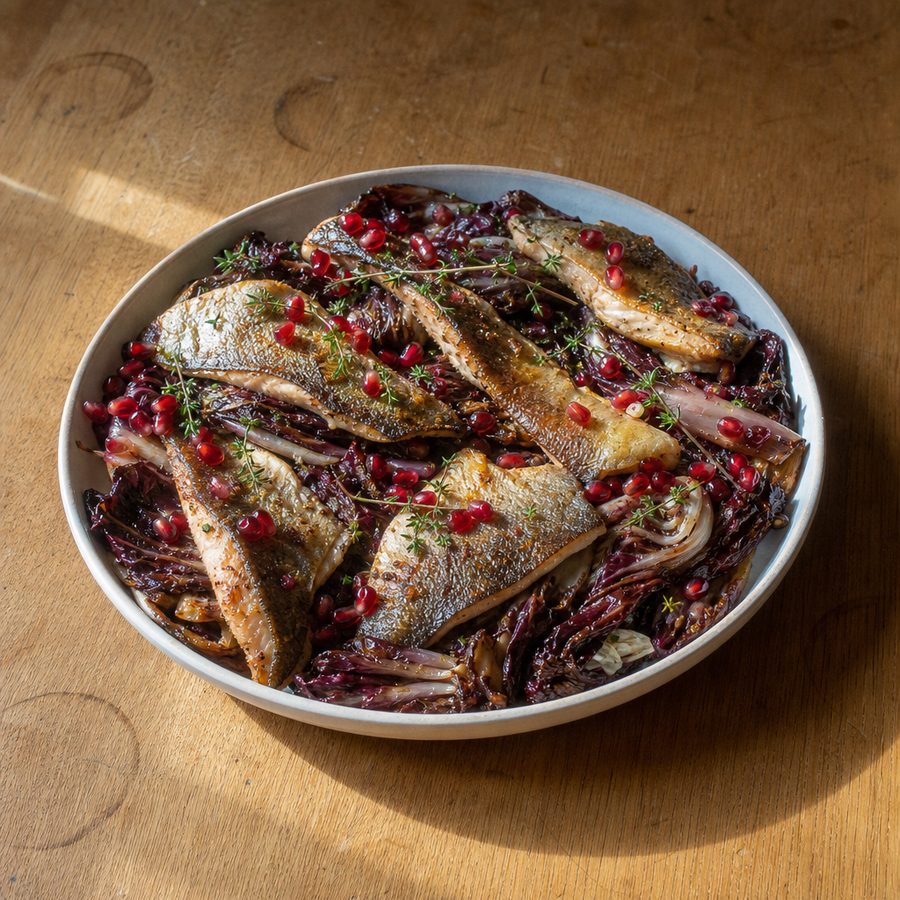
Trout with Roasted Radicchio and Pomegranate
Trout roasted over wedges of radicchio and sliced shallot, finished with balsamic and cold pomegranate seeds for a sharp, savory breakfast off one sheet pan.
Why You'll Love This Recipe
I put this together for people who have decided breakfast has to be either eggs or fruit and are running out of road on both. It is a sheet pan, it takes about forty minutes with barely ten of them hands-on, and it looks like something you would be served rather than something you made half asleep. The colors alone are worth it, deep purple leaves and ruby seeds against pink fish. I make it on a Sunday and eat the second half cold on Monday, which is honestly the version I like best.
Radicchio is the ingredient people are wary of and the one that rewards you most. Raw it is aggressively bitter, but a hot oven and a good coat of olive oil change it completely. The leaves wilt, the cut faces caramelize and go almost sweet, and what bitterness remains turns into something closer to the pleasant edge of dark chocolate. Cut the head through the core so the wedges hold together on the pan, and let them get real color before the fish goes on. Sliced shallot roasts alongside and melts into the leaves, sweetening everything it touches.
Trout takes almost no time, which is why it goes onto the pan partway through rather than at the start. Eight to ten minutes gets you fish that flakes cleanly with a fork and still looks glossy at the center, and the fat in it means it forgives you if you look away for a minute. Balsamic goes over the hot pan so it clings and thickens slightly, and the pomegranate seeds go on last, straight from the fridge. Cold against hot, sharp against sweet, crisp against soft, all in one forkful.
Ingredients
- 4 trout fillets (about 1 1/3 lb total)
- 1 large head radicchio (about 10 oz), cut through the core into 6 wedges
- 3/4 cup pomegranate seeds
- 2 1/2 tbsp olive oil, divided
- 1 large shallot, thinly sliced
- 4 tsp balsamic vinegar
- 1 tbsp fresh thyme leaves
- 1 tsp fine sea salt, divided
Instructions
- Heat the oven and cut the radicchio: Heat the oven to 425°F (220°C). Cut the radicchio through the core into six wedges so each one holds together, and slice the shallot thinly. Line a large sheet pan with parchment.
- Roast the radicchio and shallot: Toss the radicchio wedges and shallot with 1 1/2 tablespoons of the olive oil and half the salt, then spread them cut side down on the pan. Roast for 12 to 14 minutes, until the cut faces are browned and the outer leaves have gone dark and crisp at the tips.
- Season the trout: While the radicchio roasts, pat the fillets dry and rub them with the remaining olive oil, the rest of the salt, and half the thyme. Drying the fish is what lets the surface firm up rather than steam.
- Roast the fish over the leaves: Slide the pan out, turn the radicchio wedges cut side up, and lay the trout fillets skin side down on top of them. Return to the oven for 8 to 10 minutes, until the fish is opaque through and flakes when you press the thickest part with a fork, about 130°F (54°C). Trout is thin and races past that, so check early. The FDA figure for seafood is 145°F (63°C) if you would rather cook it through.
- Dress and finish: Drizzle the balsamic over the hot pan so it sizzles and clings to the leaves. Scatter the pomegranate seeds and the remaining thyme over everything and serve straight from the pan while the seeds are still cold.
Variations
- Orange and fennel: Add a sliced fennel bulb to the pan with the radicchio and finish with orange segments in place of the pomegranate.
- Endive and radicchio: Halve two heads of endive and roast them alongside for a milder, sweeter mix of bitter leaves.
- Herb change: Use chopped rosemary rather than thyme for a more resinous pan that stands up to the balsamic.
- Smoked trout, no oven for the fish: Roast the radicchio alone, then drape smoked trout over the warm leaves so it barely heats through.
- Bigger plate: Roast a handful of halved brussels sprouts alongside the radicchio to turn this into something that carries you further into the day.
Storage & Leftovers
Keep leftovers in a sealed container in the fridge for up to three days. This is one of the few fish dishes I genuinely like cold, since the radicchio firms up and the balsamic keeps working into the leaves overnight. Add the pomegranate fresh rather than storing it on top.
If you want it warm, use a 300°F (150°C) oven for six or seven minutes rather than the microwave, which turns trout chalky and fills the kitchen with the smell of it. A covered skillet over low heat works about as well.
This does not freeze. Radicchio collapses to a wet mess on thawing and pomegranate seeds burst and go dull, so cook what you plan to eat within a few days and buy the fish close to when you want it.
Notes & Tips
- Cut through the core: The core is what holds a wedge together. Cut around it and the leaves fall apart on the pan and scorch before the centers soften.
- Cut side down first: The flat faces are where the caramelization happens. Start them face down and only turn them when the fish goes on.
- Do not crowd the pan: Radicchio steams and stays bitter if the wedges touch. Use the biggest sheet pan you own so the hot air can reach every side.
- Pat the trout dry: Surface water has to evaporate before the fish begins to roast. Ten seconds with a paper towel makes the difference between firm and flabby.
- Pull the fish a shade early: Trout carries on cooking on a hot pan for a minute after it leaves the oven. Take it out when the center is barely opaque.
- Pomegranate straight from the fridge: Cold seeds against hot leaves is half the pleasure of this dish. Add them at the table, never in the oven.
Nutrition & Mindful Eating
- Trout, roasted radicchio, and pomegranate make a plate of sharp contrasts. The fish gives it richness and protein, the leaves give it bitterness and bulk, and the seeds give it a cold sweet pop that keeps the whole thing from settling into one note.
- Trout is an oily fish with a fine, sweet flesh, and it carries the long chain omega-3 fats along with vitamin D and B12, which are not easy to find together in many foods.
- Radicchio belongs to the chicory family, and the bitterness that defines it comes from compounds that gently stimulate digestion. Roasting turns that bitterness sweet at the browned edges while keeping the fiber intact.
- Pomegranate seeds are crisp, tart, and full of juice, and the polyphenols behind their deep red color have been studied for their antioxidant activity.
- Olive oil and balsamic are the entire dressing, and the oil does more than carry flavor. It helps you absorb the fat-soluble vitamins in the leaves and it is what lets the radicchio caramelize rather than dry out.
- As you eat, let the cold burst of a pomegranate seed land against the warm soft trout, and take a moment partway through to notice how satisfied you already are.
Frequently Asked Questions
Radicchio is too bitter for me. Can I fix that?
Roasting is the fix, and time in the oven is what does it. If you are still sensitive to it, soak the cut wedges in cold water for ten minutes and dry them well before oiling, which draws out a good deal of the bitterness. Radicchio also mellows further as it cools.
Can I use a different fish?
Salmon is the natural swap and roasts in the same window, though the fillets are usually thicker so give them two extra minutes. Mackerel is excellent here and stands up to the bitterness. Smoked trout works with no cooking at all, laid over the roasted leaves at the end.
Where do I get pomegranate seeds without the mess?
Most supermarkets sell them already seeded in a tub in the chilled produce section, which is what I use in winter. If you are seeding your own, halve the fruit and knock the back of each half with a wooden spoon over a bowl, which takes about two minutes per fruit.
Does this work during an AIP elimination phase?
It does. There are no nightshades, dairy, eggs, nuts, or seeds on the pan, and the dressing is olive oil, balsamic, and thyme. Check your balsamic label, since a few bottles carry added sulfites or caramel color you may prefer to avoid during elimination.