
Turkey and Collard Green Skillet with Rutabaga
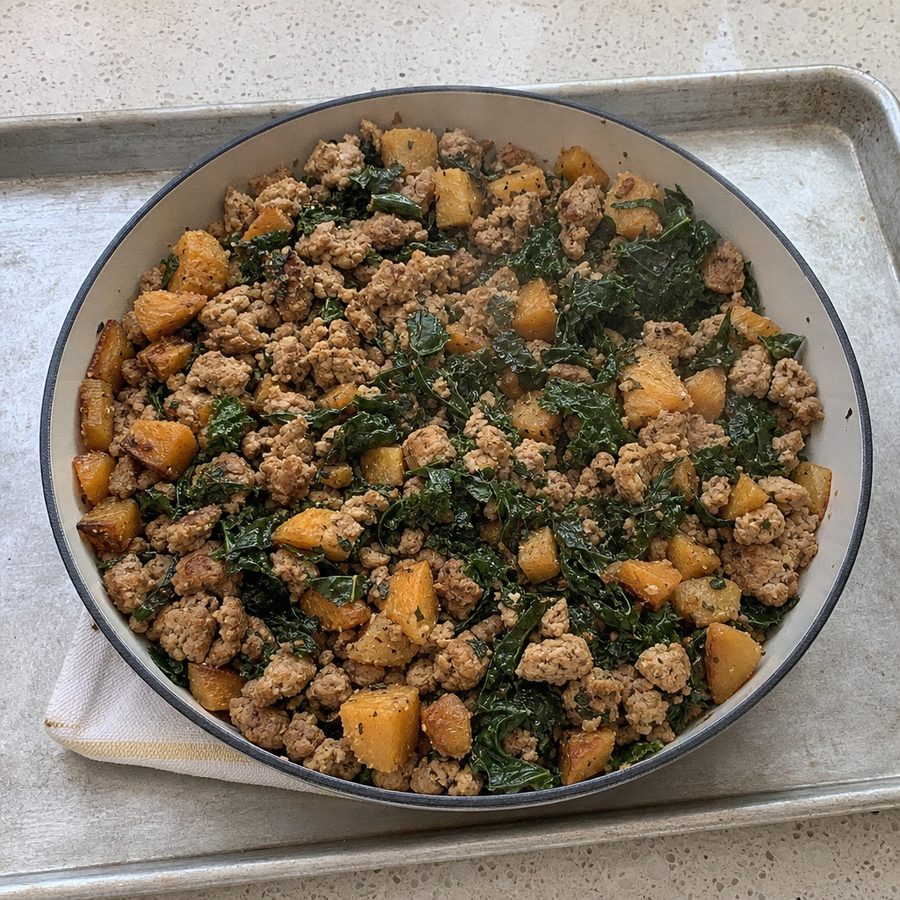
Browned ground turkey folded through golden rutabaga and slow-wilted collard greens, seasoned with fresh sage and finished with cider vinegar, all in one skillet.
Why You'll Love This Recipe
This is a Southern breakfast plate rebuilt for a morning when you need real food and have one pan to give it. Ground turkey is cheap, cooks in 8 minutes, and takes on whatever you season it with, which makes it the workhorse of a week of elimination-phase cooking. I make this on Sunday and eat it Monday and Tuesday, because it holds better than almost anything else in this chapter. If your mornings are rushed and your breakfasts have drifted toward fruit and coconut, a skillet like this changes how the rest of the day goes.
Collards are the ingredient people cook badly and then avoid. They are tough leaves with a thick central rib, so the rib comes out and the leaves get cut into ribbons, and then they want liquid and time rather than a quick toss in oil. Half a cup of broth and 8 to 10 minutes under a lid turns them dark, silky, and faintly sweet, and the pan liquid they leave behind is what the vinegar goes into at the end. The rutabaga is browned first and hard, because a rutabaga that has only been softened tastes of very little, while one with caramelized faces tastes like a turnip crossed with a carrot.
Turkey is mild, so the sage is not optional. It goes in with the garlic and perfumes the fat, which then carries through the greens and the rutabaga, and it is what makes a plain skillet taste like a breakfast sausage without any of the seasoning blends that are off the table right now. The cider vinegar at the end lifts everything. What you get is a big, warm bowl with a serious amount of protein in it and enough fiber underneath to keep the morning even, which is roughly the definition of a breakfast that works.
Ingredients
- 1 1/4 lb ground turkey (93/7)
- 1 medium rutabaga (about 1 lb), peeled and cut into 1/2-inch cubes
- 1 bunch collard greens (about 9 oz), stems removed and leaves cut into ribbons
- 1 small yellow onion, diced
- 3 cloves garlic, minced
- 2 tbsp olive oil, divided
- 1 tbsp chopped fresh sage, or 1 tsp dried
- 1/2 cup chicken broth
- 1 tbsp apple cider vinegar
- 3/4 tsp fine sea salt, divided
Instructions
- Prep the vegetables: Peel the rutabaga with a knife, since the wax and the skin are too thick for a peeler, and cut it into half-inch cubes. Strip the collard leaves off their ribs, stack them, roll them into a cigar, and slice across into half-inch ribbons.
- Brown the turkey: Heat 1 tablespoon of the oil in a large skillet over medium-high. Add the turkey in large clumps with a quarter teaspoon of the salt and leave it alone for 4 minutes so it browns, then break it up and cook 4 minutes more until it is cooked through with no pink left and the edges are golden. Move it to a bowl.
- Brown the rutabaga: Add the remaining tablespoon of oil to the pan. Add the rutabaga with another quarter teaspoon of salt in a single layer and cook without stirring for 5 minutes, until the undersides are deep gold. Toss and cook 6 to 7 minutes more, until a knife meets only slight resistance.
- Add the aromatics: Stir in the onion and cook for 3 minutes until it turns translucent. Add the garlic and sage and cook for 45 seconds, until the pan smells sweet and herbal rather than sharp.
- Wilt the collards: Add the collard ribbons in handfuls, turning them with tongs as they collapse. Pour in the broth, cover, and cook over medium-low for 8 to 10 minutes, until the greens are dark and tender and most of the liquid has cooked away.
- Combine and finish: Return the turkey and its juices to the pan with the remaining salt and cook uncovered for 2 minutes. Take the skillet off the heat, stir in the cider vinegar, taste, and serve hot straight from the pan.
Variations
- Pork and sage: Swap the turkey for ground pork, which is the classic partner for sage and makes the pan considerably richer.
- Apple in the pan: Add a diced tart apple with the onion for a sweet note against the bitter greens.
- Sweet potato swap: Use cubed sweet potato in place of the rutabaga when you want the skillet sweeter and softer.
- Kale or mustard greens: Trade the collards for kale, which needs about 4 minutes less, or mustard greens for a much sharper plate.
- Broth-heavy bowl: Double the broth and serve it as a loose brothy bowl rather than a hash, which suits a cold morning.
Storage & Leftovers
This keeps in a sealed container in the refrigerator for 4 days and is the rare breakfast that tastes better on day two, once the sage and the pan juices have worked through the greens. Cool it uncovered for 20 minutes before the lid goes on so it does not steam itself.
Reheat in a skillet over medium heat for 4 to 5 minutes with a splash of broth or water, left alone for the first 2 minutes so the rutabaga picks up an edge again. A microwave works in 90 seconds if you are short on time, though everything comes out softer.
It freezes well in flat portions for up to 3 months, which is unusual for a dish with greens in it. Collards hold their texture through freezing far better than spinach or chard do. Thaw overnight in the refrigerator and reheat in a pan rather than from frozen.
Notes & Tips
- Strip the collard ribs: The center rib stays tough no matter how long you cook it. Hold the stem and pull the leaf away with your other hand, which takes about 20 seconds a leaf.
- Peel the rutabaga with a knife: Most are coated in food-grade wax and the skin under it is thick. A peeler will not get through either, and the waxy layer tastes of nothing.
- Brown the turkey in clumps: Breaking it up right away gives you gray crumbles. Let it sit in large pieces for the first 4 minutes and you get browning, which is most of the flavor.
- Do not rush the greens: Collards need liquid and a lid. If they still squeak against your teeth they are not finished, and another 5 minutes will fix it.
- Add the vinegar off the heat: A tablespoon at the end wakes the whole pan up. Added while it is boiling, the sharpness cooks off and you are left with a dull sweetness.
- Cut everything the same size: Half-inch cubes and half-inch ribbons cook at rates that line up, which is what lets this be a single skillet instead of three.
Nutrition & Mindful Eating
- Turkey, rutabaga, and collards make a full plate between them. The meat carries the protein, the rutabaga brings sweetness and body, and the greens bring the minerals and the bulk that make a skillet like this eat like a meal rather than a side.
- Ground turkey is mild and takes on seasoning readily, and it is dense in protein for how light it eats. It also brings selenium and B vitamins, which is part of why a pan of this holds you through a long morning.
- Collard greens turn dark and silky under a lid, and they bring calcium and vitamin K in a leaf sturdy enough to take 10 minutes of heat. Cooking them with a little fat in the pan is what makes those vitamins easier for your body to take up.
- Rutabaga is a cross between a cabbage and a turnip and tastes like it, sweet with a peppery finish. Browning the cut faces brings out that sweetness, and the fiber in it is what keeps the skillet steady rather than sharp.
- Sage and cider vinegar are the whole seasoning, and together they do the job a sausage blend usually does. The vinegar going in off the heat is what makes the greens taste bright rather than flat.
- As you eat, follow the sage and the vinegar as they turn up in different bites, and pause partway down the bowl to ask whether you are still hungry or simply still eating.
Frequently Asked Questions
What does rutabaga taste like?
Sweeter than a turnip and a little peppery, somewhere between a turnip and a carrot, with a dense texture that browns well. If you cannot find one, use turnip, celeriac, or kohlrabi at the same weight, and expect turnip to cook a few minutes faster.
Can I use a different meat?
Yes. Ground chicken behaves the same way, ground pork makes it richer and pairs beautifully with the sage, and ground beef makes it heartier. Keep the weight the same and add a little less oil for pork or beef, since both render more fat than turkey.
My collards are still tough. What do I do?
Give them more time and more liquid. Collards are sturdy leaves and 10 minutes under a lid is a minimum, not a maximum. Add another quarter cup of broth, cover, and keep going until a ribbon is tender enough to cut with the side of a fork.
Does this fit an AIP elimination phase?
It does. There are no grains, legumes, dairy, eggs, nuts, seeds, or nightshades in it, and sage, garlic, onion, and cider vinegar do the seasoning. Read your broth label, since many boxed broths carry pepper, paprika, or yeast extract.