
Turkish Karniyarik, Stuffed Eggplant with Beef and Peppers
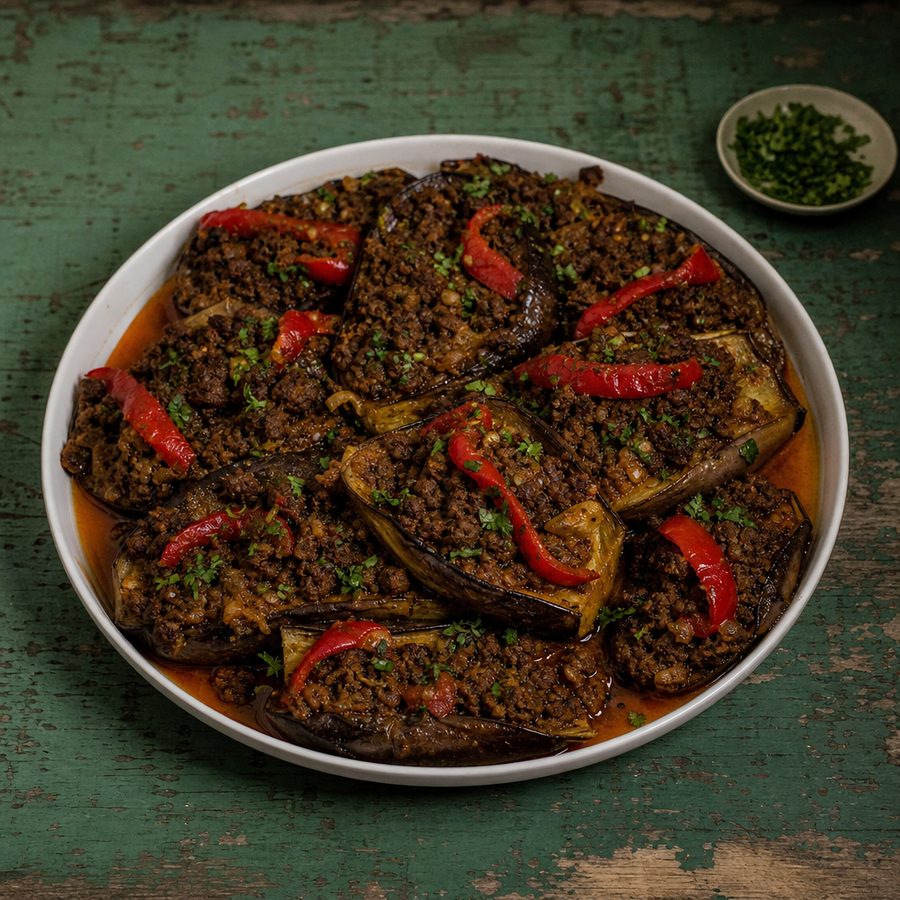
Whole eggplants roasted until collapsing, split down the middle, and filled with cumin-scented ground beef, onion, and parsley, then baked again in a shallow pool of tomato with a strip of pepper laid over each one.
Why You'll Love This Recipe
Karniyarik means split belly, which tells you most of what you need to know about the dish. It is the stuffed cousin of imam bayildi, the same soft eggplant and the same sweet onion base, with spiced meat in the middle. Turkish cooks traditionally deep fry the eggplants first, and I roast them instead: a hot oven and a good coating of olive oil give you the same collapsing softness and the same faintly smoky edge, with a much easier pan to wash afterward. Look for small, narrow eggplants rather than the big globe kind, since they hold their shape through two rounds of heat.
The filling is where the seasoning lives. Onion cooked properly soft, garlic, cumin, paprika, and a good handful of parsley folded in at the end, all bound with a spoonful of tomato paste that has been cooked until it darkens. Three quarters of a pound of beef is enough for four eggplants because the vegetable is the main event here, not the meat. Keep the mixture on the loose side, since it firms up as it bakes, and season it more assertively than seems necessary while it is in the pan. The eggplant around it is mild and will take the edge off.
This is a dish that likes to sit. I pull it out of the oven and leave it for ten minutes, sometimes twenty, and it is better at that temperature than it is straight from the heat. It is also good at room temperature the next day, which is how a lot of Turkish home cooking is eaten. A spoonful of thick yogurt on the side is traditional and worth doing, and a plain rice pilaf turns it into a Sunday table rather than a Wednesday one. Four eggplants feed four people generously, and if there are two of you, the second night is the better one, since everything has had a day to settle into everything else.
Ingredients
- 4 small Italian eggplants (about 1 1/2 lb total), stems left on
- 3/4 lb ground beef
- 2/3 cup canned crushed tomatoes
- 3/4 cup beef broth
- 1 red bell pepper, cut lengthwise into 4 wide strips
- 1 small yellow onion, chopped fine
- 2 tbsp extra virgin olive oil, divided
- 1 1/2 tbsp tomato paste
- 1/2 cup flat-leaf parsley, chopped
- 4 garlic cloves, minced
- 1/2 tsp fine sea salt
- 1 tsp ground cumin
- 1 tsp sweet paprika, or Turkish pul biber for heat
- 1/2 tsp freshly ground black pepper
Instructions
- Stripe and roast the eggplants: Heat the oven to 425°F. Peel the eggplants in stripes with a vegetable peeler, leaving alternating bands of skin, which keeps them from collapsing entirely while letting the flesh go soft. Rub them all over with 1 tbsp of the olive oil and a pinch of the salt, set them in a baking dish, and roast for twenty two to twenty five minutes, turning once, until the skins have wrinkled and a knife slides through with no resistance.
- Cook the filling: While they roast, heat the remaining 1 tbsp oil in a skillet over medium, add the onion and a pinch of salt, and cook for six to seven minutes until soft and translucent. Add the beef, breaking it up with a spoon, and cook for six to eight minutes until it is browned all over with no pink left. Stir in the garlic, cumin, paprika, and black pepper and cook one minute more.
- Darken the tomato paste: Push the meat to one side, add the tomato paste to the clear space, and let it fry for a minute until it turns a deeper red and smells toasted. Stir it through the meat, add 1/4 cup of the broth, and simmer for two minutes until it is glossy rather than wet. Take it off the heat and fold in most of the parsley, keeping a little back for serving.
- Split and fill: Lower the oven to 375°F. Set the roasted eggplants in the dish and cut a deep slit down the length of each one, stopping short of both ends and of the base. Press the sides gently apart with two spoons to open a pocket, season the inside with the rest of the salt, and pack the filling in, mounding it generously. Lay a strip of red pepper along the top of each.
- Bake again in tomato: Stir the crushed tomatoes into the remaining broth and pour it around the eggplants rather than over them, so the tops stay dry. Bake uncovered for twenty five minutes, until the pepper strips have softened and browned at the edges and the sauce has reduced to a shallow layer that coats the base of each eggplant. Rest for ten minutes, spoon the sauce over, and scatter the reserved parsley.
Variations
- Imam bayildi: Leave the meat out and fill the eggplants with onion, garlic, tomato, and parsley cooked slowly in olive oil, then bake and eat at room temperature.
- With pine nuts and currants: Fold two tablespoons of each into the filling for the sweeter, Ottoman-style version.
- Cheese-topped: Scatter grated pasteurized mozzarella or kasar over the eggplants for the last eight minutes of baking so it melts and blisters.
- Zucchini instead: Halve four large zucchini lengthwise, scoop out a channel, and use the same filling with a shorter first roast of twelve minutes.
Storage & Leftovers
Karniyarik keeps four days in the refrigerator, covered, and the flavor deepens overnight as the spices settle into the eggplant. Store it in its sauce and keep the eggplants upright so the filling stays in place.
Reheat it covered in a 325°F oven for fifteen to eighteen minutes, which is gentle enough that the eggplant does not turn watery. It is also genuinely good cold or at room temperature, dressed with a squeeze of lemon, which is how you will often find it on a Turkish table in summer.
I would not freeze this. Eggplant that has been baked twice already turns to water on thawing, and the filling separates from the shell. The meat mixture on its own freezes perfectly well for three months if you want to get ahead, so make a double batch of it and roast fresh eggplants when you want the dish.
Notes & Tips
- Buy small, narrow eggplants: Long Italian or Japanese eggplants have thinner skin, fewer seeds, and less bitterness than big globes, and they roast to softness in half the time.
- Oil the eggplants, not the pan: Rubbing the oil directly onto the skin is what gives you an even bronze surface. Oil poured into the dish pools underneath and fries one side while the top dries out.
- Cook the onion before the beef goes in: Onion added at the same time as the meat steams in the released juices and stays sharp. Six minutes on its own first is what makes the filling taste sweet underneath the spice.
- Keep the slit shallow at the ends: Stop an inch from the stem and an inch from the tip. A cut that runs the full length turns the eggplant into two halves and the filling falls out in the oven.
- Pour the sauce around, not over: The tops should stay exposed so the pepper strips brown and the filling develops a crust. Sauce poured over the top steams everything into one soft texture.
- Let it rest before serving: Ten minutes out of the oven lets the eggplant firm up enough to lift cleanly with a spatula, and the sauce thickens around the base while it waits.
Nutrition & Mindful Eating
- A pound and a half of eggplant against three quarters of a pound of beef tells you how this plate is built. The vegetable carries the volume and nearly all of the fiber, the beef brings the protein and the spice, and the tomato underneath ties the two together.
- Eggplant roasted until it collapses turns creamy without any dairy in sight, and the flesh brings fiber along with the purple-skinned pigment nasunin, which sits in the peel and is one reason the stripes of skin are worth keeping.
- Ground beef gives the filling its savory depth and carries protein along with iron and zinc, and browning it properly before the spices go in is what develops the flavor that the mild eggplant borrows.
- Cumin and paprika bloomed in the hot pan for a minute release their oils into the fat, which is where they belong. That single minute is the difference between spices you taste and spices you merely see.
- Parsley folded in off the heat stays green and grassy against the richness, and a handful this size brings a real amount of vitamin K and vitamin C rather than sitting there as a garnish.
- As you eat, notice how soft the eggplant has become against the texture of the meat, and let the ten minutes it rested be a signal to slow down for the meal rather than eat it standing up.
Frequently Asked Questions
Do I have to peel the eggplant in stripes?
It is not decoration. Full skin turns leathery through two bakes and traps steam, while fully peeled eggplant collapses into mush. Alternating bands give you soft flesh with enough structure left to hold the filling.
Can I use ground lamb or turkey?
Both work. Lamb is the more traditional choice in much of Turkey and gives a richer result. Ground turkey is milder, so add another half teaspoon of cumin and be a little more generous with the salt and pepper.
My eggplants tore open when I filled them. Does it matter?
Not really, though tearing usually means they were roasted a few minutes too long. Push the sides back together, spoon a little extra sauce over the split, and bake as written. They will hold together well enough once the filling sets.
What do you serve alongside?
Thick strained yogurt is the classic partner, and a plain rice or bulgur pilaf catches the sauce. A cucumber and tomato salad with plenty of lemon rounds it out and takes about four minutes to put together.