
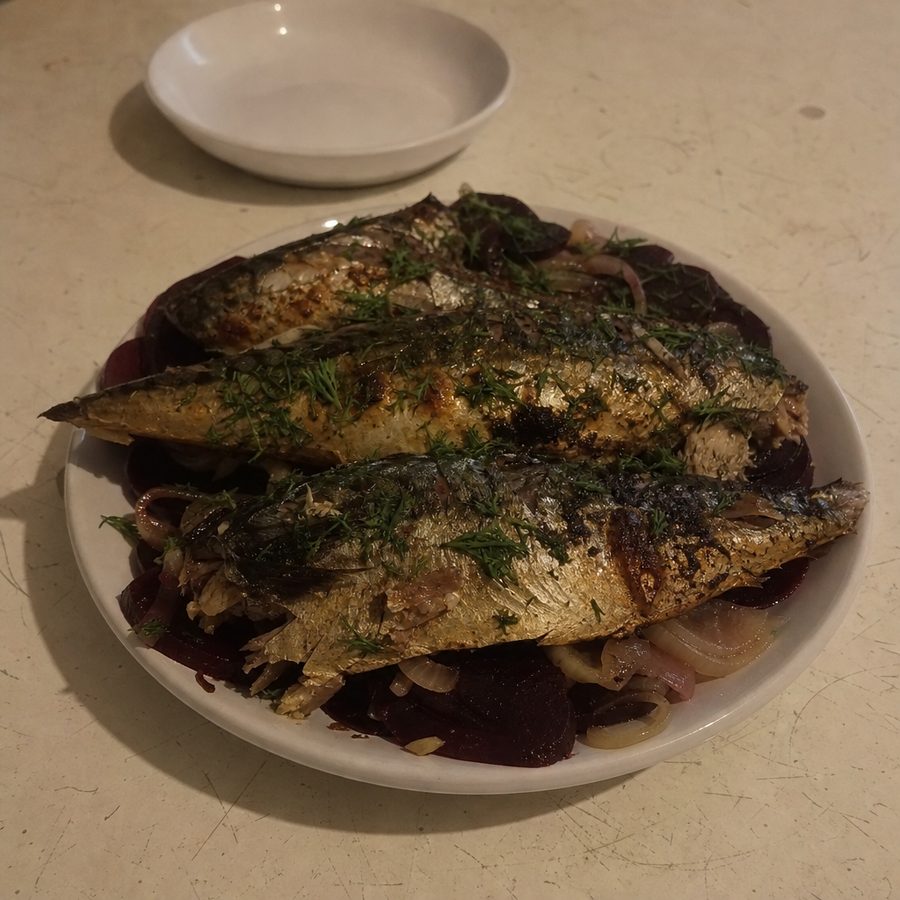
Whole Roasted Mackerel over Beets and Onion
Four whole mackerel roasted on a bed of sliced beets and onion, so the fat and juices run down into the vegetables, finished with dill and cider vinegar.
Why You'll Love This Recipe
I make this on a Tuesday in the middle of winter, when I want something that eats like an occasion and costs about the same as a pound of ground turkey. Whole mackerel sits at the counter looking difficult and is the easiest fish in the case. Nobody has to fillet anything. You slide a knife through the skin a few times, tuck garlic and dill sprigs into the belly, and lay the fish over a sheet pan of beets that has already had half an hour to itself. The kitchen fills up with roasting beets and hot fish skin, which is a far better smell than that sentence makes it sound, and twenty minutes later dinner is on the table.
The timing is the only thing to get right, and it comes down to the beets going in on their own first. Sliced a quarter inch thick and turned in oil, they want a solid thirty minutes at 425°F (220°C) before the fish joins them, or you end up with cooked mackerel over crunchy beets and no way back. Once the fish goes on top, the fat renders straight down through the split skin and lands in the beets, which is the entire reason to cook the two together. Beets are sweet enough to stand up to a fish this rich, and the cider vinegar and chopped dill that go over at the end cut the fat so the pan tastes bright rather than heavy.
Mackerel has a real flavor, closer to a small tuna than to cod, and people who say they dislike oily fish usually mean they have only met it cold out of a tin. Hot from the oven it comes away from the frame in wide flakes that taste rich and faintly sweet, and there is enough fat in a whole fish to hold you through a long evening. Eat the fish the day you cook it, since it is at its best in the first hour. The beets are the opposite and are better cold the next day with more vinegar over them, which I have eaten standing at the refrigerator more times than I have planned to.
Ingredients
- 4 whole mackerel, cleaned and gutted (about 10 oz each, 2 1/2 lb total)
- 1 1/2 lb beets (about 4 medium), peeled and sliced 1/4 inch thick
- 1 large onion, halved and sliced thin
- 6 cloves garlic, thinly sliced
- 4 tbsp olive oil, divided
- 2 tbsp apple cider vinegar
- 2 tbsp fresh lemon juice
- 1/2 cup chopped fresh dill, plus 4 sprigs for the cavities
- 1 1/2 tsp fine sea salt, divided
Instructions
- Heat the oven and dress the beets: Heat the oven to 425°F (220°C) with a rack in the lower third. Peel the beets and slice them 1/4 inch thick, then toss them and the sliced onion on a large rimmed sheet pan with 3 tablespoons of the olive oil and 3/4 teaspoon of the salt. Spread everything into a single overlapping layer.
- Roast the beets alone: Roast for 30 minutes, turning the slices once at the halfway mark. They are ready for the fish when the thin edges have darkened and a slice bends without snapping. Undercooked beets will not catch up once the fish is on top, so give them the full time.
- Prepare the mackerel: While the beets roast, pat the fish dry inside and out. Cut three shallow diagonal slashes through the skin on each side, down to the bone. Rub the fish all over and inside the cavities with the remaining tablespoon of oil and 3/4 teaspoon of salt, then fill each cavity with sliced garlic and a sprig of dill.
- Roast the fish over the beets: Push the beets and onion into an even layer and lay the mackerel on top, leaving a little space between them. Roast for 18 to 20 minutes. The fish is done when the flesh in the thickest part behind the head is opaque all the way to the backbone and the dorsal fin pulls out with no resistance.
- Dress the pan off the heat: Take the pan out and spoon the cider vinegar and lemon juice over the fish and the beets while everything is still hot. Scatter the chopped dill over the top and let the pan sit for 3 minutes so the juices settle into the vegetables.
- Serve and eat around the bone: Lift each fish onto a plate with two spatulas and pile beets and pan juices alongside. To eat, run a knife down the backbone, lift the top fillet away, then take the whole frame off in one piece to reach the fillet underneath.
Variations
- Whole trout: Swap in four whole trout of the same size and roast them for 20 to 22 minutes, since trout runs a little thicker through the shoulder.
- Beets and apple: Add a sliced apple to the pan for the last 20 minutes so it collapses into the beets and pulls them sweeter.
- Golden beets: Use golden beets when you want the same sweetness with none of the red staining on the plate or your hands.
- Mint and parsley: Trade the dill for a handful of chopped mint and parsley scattered together at the end for a fresher, less anise finish.
- Orange in place of lemon: Finish with the juice of half an orange along with the vinegar for a rounder, sweeter edge against the oily fish.
Storage & Leftovers
Cooked mackerel keeps for 2 days in a sealed container in the refrigerator, though it is best the day it is roasted. Pull the fillets off the bones before storing so the flesh sits flat and cold rather than drying against the frame overnight.
The beets keep better than the fish, up to 4 days, and I deliberately roast extra for that reason. They eat well cold with an extra splash of cider vinegar, or warmed for a few minutes in a covered skillet with a spoonful of water to loosen them.
Reheat the fish gently or not at all. A covered skillet over low heat for 3 minutes is enough, and a microwave will drive the oil out and leave the flakes flat. Cold mackerel flaked over the leftover beets is honestly the better use of what is in the container.
Notes & Tips
- Score the skin properly: Three cuts a side, right down to the bone, let the heat into the thick shoulder so the fish cooks evenly and the fat can render out.
- Dry the fish first: Wet skin steams and sticks to the pan. Wipe the fish inside and out with paper towels before the oil goes on and the skin will crisp and release.
- Slice the beets evenly: A quarter inch is the number. Thicker slices are still hard when the fish is done, and a mandoline gets you there faster than a knife.
- Give the beets their half hour alone: This is the step people skip and then blame the recipe. The beets need a real head start before the fish shades them from the heat.
- Two spatulas to move the fish: A whole roasted mackerel will break at the middle if you lift it from one point. Support the head end and the tail end together.
- Acid after the oven, not before: Vinegar and lemon added at the end stay sharp. Added before roasting they cook flat and do nothing for the fat in the fish.
Nutrition & Mindful Eating
- Mackerel, beets, and onion each do a different job in the same pan. The fish carries the richness and most of the substance, the beets bring sweetness and fiber underneath it, and the onion melts down into the juices and pulls the two together.
- Mackerel is an oily fish and the oil is the point. It carries the long-chain omega-3 fats that have been studied for their role in calming inflammation, along with vitamin D and B12, and that same fat is what keeps the flesh moist through a hot oven.
- Beets roast into something closer to candy than to a root vegetable, and the deep red color comes from betalains, pigments with real antioxidant activity. They bring folate and fiber along with that sweetness, which is why a plate of them satisfies more than their softness suggests.
- Onion sliced thin and left to soften under the fish goes sweet and silky, and the fiber in it feeds the bacteria living in your gut. Cooking it this long also makes it easier on stomachs that find raw onion difficult.
- Dill and cider vinegar go on once the pan is out of the oven, where the heat cannot dull them. That sharp green lift against a rich fish is what makes the plate taste finished, and it is the reason you reach for the salt less often.
- As you eat, notice how easily the flakes come away from the frame and how sweet the beets have gone underneath, and let the bones be a reason to slow down and pay attention to what is on your fork.
Frequently Asked Questions
Can I use fillets rather than whole fish?
Yes. Lay 8 mackerel fillets skin side up over the beets and roast for 8 to 10 minutes. You lose the juices that a whole fish holds in its cavity, so add an extra tablespoon of olive oil to the pan and check them early, since fillets go from done to dry quickly.
How do I know when a whole fish is cooked?
Two checks, and both are quick. Tug the dorsal fin along the back, which slides out cleanly once the fish is done, and look into the slashes to see whether the flesh has turned opaque right down to the bone. A thermometer in the thickest part should read about 140°F (60°C), a little under the 145°F (63°C) the FDA gives for seafood, since a whole fish carries on cooking on the bone after it leaves the oven.
Can I roast the beets ahead of time?
You can, up to 2 days. Roast them fully, refrigerate them on the pan, and bring them back to room temperature while the oven heats. Spread them out, give them 10 minutes in the hot oven to warm through, then lay the fish on top and carry on as written.
Is this suitable during an AIP elimination phase?
It is. There are no grains, dairy, eggs, nuts, seeds, or nightshades here, and the seasoning is garlic, dill, lemon, cider vinegar, and salt. Buy fish that has been gutted but not brined or seasoned, since some counters season whole fish before they wrap it.