
Bacon-Wrapped Pork Tenderloin
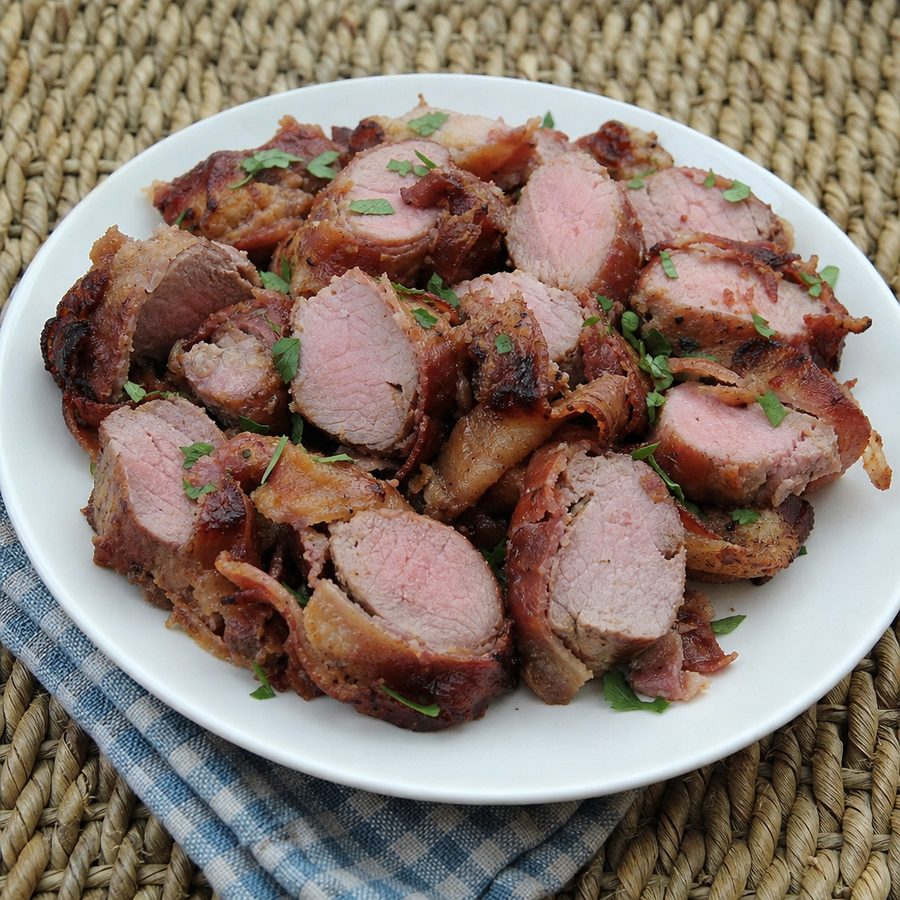
Pork tenderloin wrapped snugly in bacon and roasted until the pork is juicy and the bacon turns deep and crisp.
Why You'll Love This Recipe
This is a simple, protein-forward dinner for anyone who wants an everyday cut turned rich and satisfying without a long ingredient list. Pork tenderloin has almost no marbling running through it, which makes it quick-cooking but also easy to dry out; wrapping it in bacon solves both problems at once and turns an everyday piece of meat into something worth serving to guests. It carves into neat rounds as well, which is most of the reason it looks like more work than it actually was.
A bacon jacket and a two-stage cook are what carry this. Searing the wrapped loin in a hot skillet renders and crisps the outside of the bacon for browned, savory flavor and texture, and finishing in the oven lets the interior come up to temperature evenly. As the bacon renders, its fat bastes the pork underneath, seasoning it and keeping the surface from drying while the meat roasts.
It is satisfying because the contrast does the heavy lifting: crisp, salty bacon against tender, mild pork, with plenty of protein to leave you full. Pulling the meat at 145°F (63°C) and resting it keeps the center blushing pink and juicy rather than gray and firm, so each round is moist and easy to eat. With only pork, bacon, and salt, the flavors are clean and the meal comes together on a weeknight.
Ingredients
- 2 pork tenderloins (about 1 lb each)
- 7 slices bacon
Instructions
- Preheat and prep: Preheat the oven to 400°F (200°C) and set an oven-safe heavy skillet, such as cast iron, aside for searing. Pat the pork tenderloins dry with paper towels; drying the surface helps the bacon adhere and the meat brown.
- Season: Trim off the thin, silvery membrane along the top of each tenderloin by sliding a knife just under it and pulling it away. Leave the pork itself unseasoned, because the bacon you wrap around it salts the meat as it roasts.
- Wrap in bacon: Lay the bacon slices out and wrap each tenderloin snugly, overlapping the slices like shingles so the whole surface is covered. Tuck the ends underneath and, if needed, secure any loose ends with toothpicks so the bacon stays put during cooking.
- Sear: Set the skillet over medium-high heat until hot. Add the wrapped tenderloins and brown them, turning with tongs, until the bacon is golden on all sides, about 2 to 3 minutes per side. This gives the bacon a head start on crisping before it goes in the oven.
- Roast: Transfer the skillet to the preheated oven and roast until an instant-read thermometer pushed into the thickest part of the meat reads 145°F (63°C), about 20 minutes. The bacon should be deep brown and crisp on top.
- Rest and slice: Move the tenderloins to a cutting board, remove any toothpicks, and rest for 8 minutes so the juices settle and the slices stay moist. Slice crosswise into rounds and serve.
Variations
- Thick-cut bacon: Wrap with thick-cut bacon for a meatier, chewier crust. Because it renders more slowly, give it a little longer in the oven and check that it has crisped before pulling the meat.
- Pancetta wrap: Swap the bacon for thin slices of pancetta for a saltier, more delicate wrap that crisps into lacy edges. Watch it closely, as it browns faster than standard bacon.
- Prosciutto finish: Wrap in prosciutto instead of bacon for a thinner, silkier layer. It will not crisp as hard as bacon and cooks quickly, so shorten the sear.
- Hard cheese crust: After searing, press a layer of finely grated hard cheese onto the top of each loin before it goes in the oven so it melts and browns; this adds dairy.
- Basted in rendered fat: Spoon some of the rendered bacon fat from the skillet over the loins partway through roasting for an even richer, glossier finish.
Storage & Leftovers
Refrigerate leftover sliced pork in an airtight container for up to 3 to 4 days. Store it in one layer if you can, so the bacon does not sit in pooled juices and go soft.
To reheat without drying the meat, warm the slices in a skillet over medium heat or in a 325°F (163°C) oven just until hot through, a few minutes. A quick pass under the broiler or a minute in a hot dry skillet re-crisps the bacon if it has softened in the fridge.
To get ahead, wrap the seasoned tenderloins in bacon and keep them covered in the refrigerator for up to a day before cooking; let them sit at room temperature for about 15 minutes before searing so they cook evenly.
Notes & Tips
- Buy the right cut: Reach for pork tenderloin, the long, slim muscle, not pork loin, which is a wider, thicker roast. The two are often shelved side by side and cook very differently, and this method is built for the smaller, quick-cooking tenderloin.
- An instant-read thermometer is worth it: Tenderloin goes from juicy to dry in a matter of minutes. A thermometer pulled at 145°F (63°C) takes the guesswork out and is the single best way to keep it tender.
- Choose thin-sliced bacon for crispness: Standard thin-cut bacon renders and crisps in the time it takes the pork to reach temperature. Very thick bacon can still be flabby when the meat is done, so save it for when you plan to roast a little longer.
- Toothpicks keep the wrap tight: If your bacon slices are short or slippery, secure the loose ends with toothpicks before searing. Remove them before slicing, and count them so none are missed.
- Salt with a light hand: Bacon brings a lot of salt on its own, so season the pork lightly. You can always add a pinch more at the table, but you cannot take it back once it roasts in.
- Rest before you cut: Give the meat its full rest before slicing so the juices redistribute instead of running out onto the board. Slicing too soon leaves you with drier rounds and a puddle.
Nutrition & Mindful Eating
- Pork tenderloin and bacon come from the same animal and solve each other's problem. The tenderloin is the mild, fine-grained muscle that cooks fast, and the bacon around it renders slowly and keeps the meat basted while it does.
- Tenderloin is the most delicate cut on the pig, close-grained and gentle in flavor, and it wants to come off the heat while the middle is still faintly pink. That is where the texture lives, and the meat carries protein along with more thiamine than almost anything else you will cook.
- Bacon laid in overlapping strips becomes a shell rather than a garnish. It tightens as it roasts and holds the loin in a neat cylinder, and the fat it gives up runs down into the meat and takes the smoke with it.
- Sear the wrapped loin in a hot pan before it goes in the oven and the bacon sets and browns properly rather than staying pale and soft. That first crust is the difference between good and forgettable.
- Sliced thick and fanned out, a few pieces make a proper dinner. The protein in the pork does most of the holding, and the rendered bacon fat around each slice is what makes it taste like an occasion.
- As you eat, let it rest before you cut and watch how little juice runs out, then take the first slice with a bit of the crisp bacon edge attached and slow down enough to taste both at once.
Frequently Asked Questions
Why does my bacon stay soft while the pork finishes?
Two things usually cause this: bacon that is too thick to render in the roasting time, or skipping the sear. Brown the wrapped loin well in a hot skillet first, use thinner-cut bacon, and if it is still soft when the meat hits temperature, give the top a minute under the broiler.
How do I keep such a quick-cooking cut from drying out?
Pull it at 145°F (63°C) rather than cooking it further, and let it rest the full time before slicing. The bacon wrap also shields and bastes the meat as it roasts, which helps, but the thermometer is what saves it.
What is the difference between pork tenderloin and pork loin here?
Tenderloin is the narrow, quick-cooking muscle this recipe is written for. Pork loin is a much larger, thicker roast that needs a longer, lower cook, so it will not work with these times and temperatures.
Can I make this on the grill instead of in the oven?
Yes. Sear the wrapped loin over direct heat to crisp the bacon, then move it to a cooler part of the grill, cover, and cook to 145°F (63°C). Watch for flare-ups, since the rendering bacon fat can catch.