
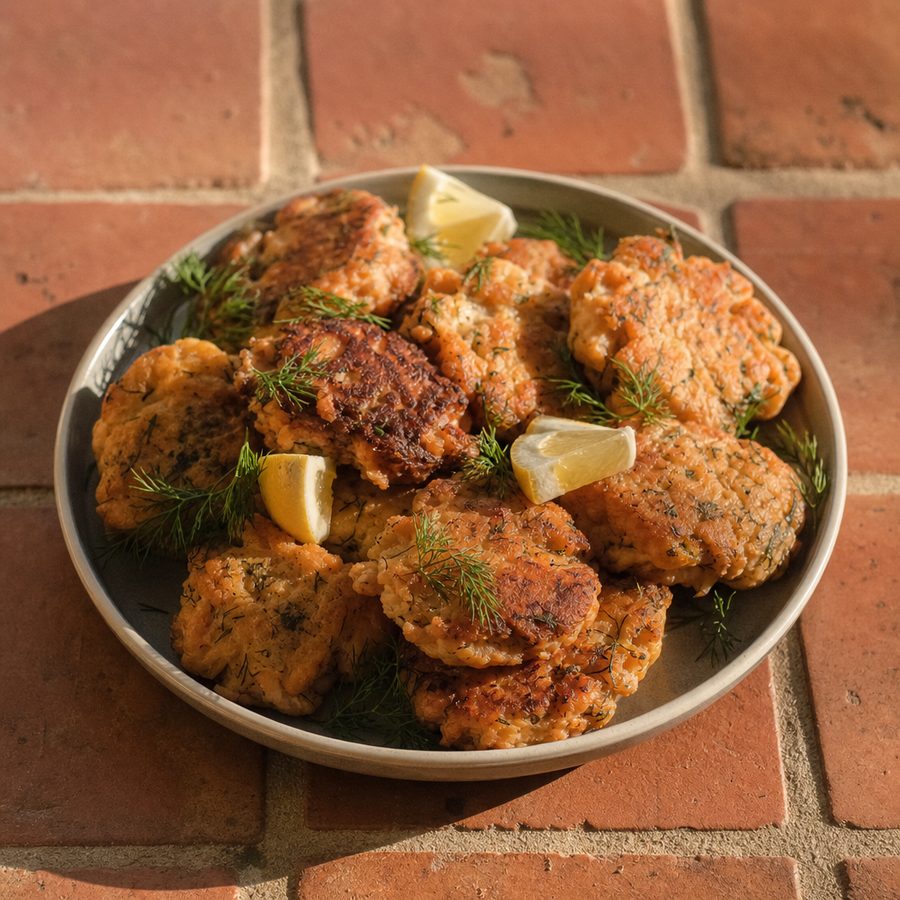
Mediterranean Baked Salmon Cakes With Dill
Tender oven-baked salmon cakes bound with egg and almond flour, brightened with fresh dill, lemon juice, and a touch of dijon mustard.
Why You'll Love This Recipe
A bunch of fresh dill is more dill than most recipes ask for, and a few days too long in the refrigerator turns it limp and dark at the stems. This is what I make with the rest of the bunch. Enough of it goes in that you smell dill before the tray is out of the oven, and the dijon and lemon underneath keep it from reading flat. The cakes are good warm or cold, straight from the refrigerator or packed for later, and they hold their shape once cooled, so they suit anyone who wants a savory, protein-forward bite that is not sweet and does not lean on bread or crackers.
The binder is what decides whether these hold. Eggs set as they bake and lock the flaked salmon into a cohesive patty, while almond flour absorbs excess moisture so the cakes hold together without a heavy crumb coating. Dijon mustard and lemon juice cut the richness of the fish, and fresh dill lifts the whole thing with a clean, grassy note. Baking rather than pan-frying gives you a golden exterior with no puddle of oil and far less fuss.
Protein and fat in the salmon and the eggs, a combination slow to leave the stomach, which is what keeps you comfortable between meals. They are rich enough to count as a real snack, and the dill and lemon keep every bite from reading heavy. Almond flour rather than breadcrumbs is also what lets them hold together for anyone avoiding wheat, and it browns better than a crumb coating does in a dry oven.
Ingredients
- 12 oz cooked salmon, flaked
- 2 eggs
- 1/3 cup almond flour
- 2 tbsp chopped fresh dill
- 1 tbsp lemon juice
- 2 tsp dijon mustard
- 1/2 tsp salt
Instructions
- Start with cooked salmon, flaked coarse: This wants twelve ounces of cooked salmon. From raw, set the fillet skin side down in a wide pan with a splash of water, cover, and steam over medium heat for 8 to 10 minutes, until the flesh is opaque and flakes easily or reads 145°F (63°C). Lift it off the skin, cool it a few minutes, and flake it coarsely, because fine shreds turn the cakes pasty while coarse flakes keep some texture.
- Heat the oven and prep the dill and lemon: Heat the oven to 400°F (200°C) and line a baking sheet with parchment, which matters here because these cakes have no breadcrumb crust and will stick to bare metal. Finely chop the dill and squeeze the lemon.
- Mix until a squeezed handful holds: Combine the flaked salmon, eggs, almond flour, dill, lemon juice, dijon, and salt in a bowl, stirring and pressing gently with a fork until the mixture is evenly moistened and holds together when you squeeze a handful. That squeeze is the test worth doing, since a mixture that falls apart in your hand will fall apart on the tray.
- Shape them firmly, about three-quarters of an inch: Divide the mixture and form evenly sized patties about three-quarters of an inch thick, pressing firmly so they stay compact, and set them on the sheet with space between each. Press harder than feels polite: there is no breadcrumb here and the egg and almond flour need contact to bind.
- Bake 18 minutes, turning once: Bake for about 18 minutes, carefully turning each cake once with a thin spatula at the halfway mark, until the outsides are golden and the centers are set rather than wet. Let them rest a couple of minutes on the sheet before serving, since they firm as they cool and lift cleanly a minute later where they would break straight out of the oven.
Variations
- Pantry shortcut: Use well-drained canned salmon in place of the fresh fillet to skip the cooking step entirely; pick out any large bones and flake it as usual.
- Briny and bold: Fold in chopped capers and pitted olives for a saltier, more savory bite; taste before adding the full salt since these bring their own.
- Herb swap: Trade the dill for chopped fresh parsley or mint for a different fresh note that still pairs well with salmon and lemon.
- Creamy and tangy: Crumble in a little feta before shaping for a richer, tangier cake; note that this adds dairy.
- Warm spice: Stir in a pinch of red pepper flakes or smoked paprika for gentle heat and a deeper, smoky background flavor.
Storage & Leftovers
Cooled salmon cakes keep in an airtight container in the refrigerator for up to three days. Let them cool completely before sealing so condensation doesn't make them soggy.
To reheat, warm them in a 350°F (175°C) oven or toaster oven for about 8 minutes until heated through and the outside crisps back up. A microwave works in a pinch but softens the exterior, so the oven is worth it if you have the time. They're also good cold, eaten straight from the container.
For make-ahead, shape the raw patties and refrigerate them uncovered on the lined sheet for a few hours, then bake when you want them fresh. Baked cakes also freeze well: freeze them in a single layer, transfer to a bag, and reheat from frozen in the oven, adding a few extra minutes.
Notes & Tips
- Cool the salmon first: Let the cooked, flaked salmon cool before you mix in the eggs so the eggs don't start to scramble from residual heat, which keeps the binding even.
- Check that it holds: Before shaping, squeeze a small handful of the mixture; if it crumbles apart, work in a little more almond flour a spoonful at a time until it stays together.
- Chill for easier shaping: If the mixture feels loose and sticky, rest it in the fridge for fifteen minutes before forming the patties, which firms up the fat and makes them much easier to handle.
- Buy the freshest dill: Look for dill with perky, deep-green fronds and no yellowing; wrap the extra in a damp paper towel in the fridge and it will keep for several days for another use.
- Double the batch: These reheat and freeze so reliably that it's worth making a large batch at once so you have a ready snack on hand all week.
- Serve them up: A dollop of plain yogurt with extra lemon and dill makes a quick dipping sauce, and the cakes are just as good alongside a crisp green salad or sliced cucumber.
Nutrition & Mindful Eating
- Salmon, egg and almond flour do the structural work here. The fish brings the flavor and the fat, the egg sets in the oven and holds everything in place, and the almond flour gives the cakes a soft, tender crumb inside.
- Salmon is what makes these worth eating warm from the tray. It stays moist and comes apart in soft pink flakes, and it carries the omega-3 fats and vitamin D that are built into an oily fish like it.
- Almond flour is finely ground and faintly sweet, and it toasts as the cakes bake so the outsides pick up a little color and a nutty smell, with vitamin E and soft fat riding along in it.
- Dill, lemon and Dijon are the sharp edge of this recipe. The dill is grassy and slightly anise-like, the mustard gives a low hum of heat underneath, and the lemon squeezed over at the table pulls all of it forward.
- Two or three of these hold you longer than their size suggests, and the protein in the salmon along with the fat in the almond flour is doing most of that work, so they eat like a small meal.
- As you eat, feel the crisp edge give way to the soft center and let the dill and lemon arrive after the fish does, then let a couple of cakes be their own small pause in the afternoon.
Frequently Asked Questions
Can I use canned salmon instead of cooking fresh?
Yes. Drain it well, pick out any large bones, and flake it just as you would the fresh fillet, then continue with the recipe. It's the fastest way to make these.
Why did my cakes fall apart?
Usually the mixture was too wet or wasn't pressed firmly enough. Make sure the salmon is well drained, work in a little more almond flour until a squeezed handful holds together, and press each patty compact before baking.
What can I use instead of almond flour?
The almond flour absorbs moisture and binds the cakes, so a nut-free swap like fine gluten-free breadcrumbs will also work, though it changes the makeup by adding grain. Use about the same amount and adjust until the mixture holds.
Can I pan-fry these instead of baking?
You can. Cook them in a lightly oiled skillet over medium heat until golden on each side and set through, flipping once. Baking is used here because it needs no added oil and cooks them evenly, but the skillet gives a crisper crust.