
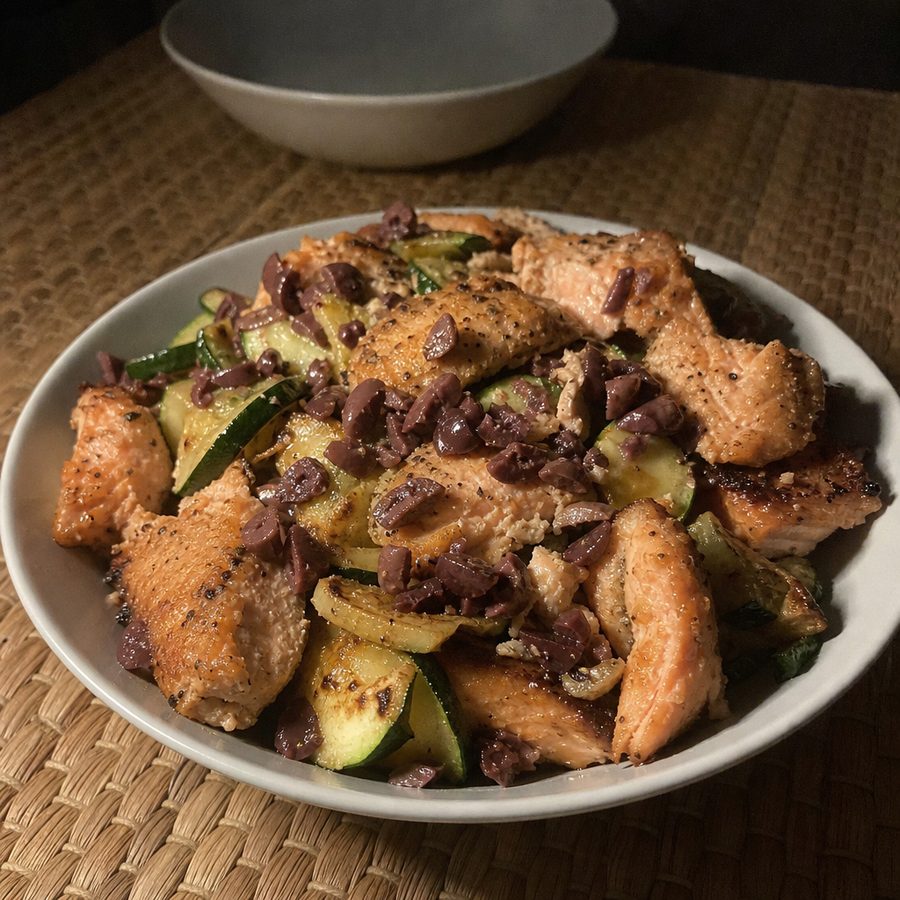
Baked Salmon With Olive Tapenade and Zucchini
Tender baked salmon topped with a bright kalamata and lemon tapenade, served over roasted zucchini planks for an easy Mediterranean dinner that comes together in one pan.
Why You'll Love This Recipe
A real dinner on the table without standing over the stove is the point. If you like salmon but find plain fillets boring, the olive tapenade gives you something sharp and briny to look forward to, and the zucchini rounds it out so you are not reaching for bread or rice. It suits busy weeknights and anyone who likes the flavors of the Mediterranean table without a long ingredient list.
Baking the salmon skin-side down on a hot pan keeps the flesh moist while the underside firms up, so you get gentle, even heat instead of a scorched exterior. The tapenade goes on before baking so the olives, garlic, and lemon soften and season the fish as it cooks. Roasting the zucchini first drives off water and concentrates its flavor, which keeps the plate from turning watery once everything comes together.
It satisfies because the fat in the salmon and olive oil makes each bite feel substantial, and the olives bring the salt and depth that usually take a long braise to build. You finish the plate feeling fed, not heavy, and the brightness from lemon and parsley keeps it from tasting rich in a tiring way. It is the kind of dinner that holds up whether you are cooking for one or four.
Ingredients
- 1 1/4 lb salmon fillets (4)
- 3 zucchini, planks
- 1/2 cup kalamata olives
- 3 tbsp olive oil
- 4 cloves garlic
- 2 tbsp lemon juice
- 1/3 cup parsley
- 2 tsp oregano
- 1/3 tsp salt
Instructions
- Heat the oven: Set your oven to 425°F (220°C) and line a large sheet pan with parchment. Cut 3 zucchini lengthwise into planks about a half inch thick so they roast evenly without turning soft.
- Season the zucchini: Toss the zucchini planks with 1 tablespoon of the olive oil, half the 2 teaspoons oregano, and a pinch of the salt. Spread them in a single layer and roast for 8 minutes while you build the tapenade.
- Make the tapenade: Chop the 1/2 cup kalamata olives and mince 4 cloves garlic. Stir them with 1 tablespoon olive oil, the 2 tablespoons lemon juice, the 1/3 cup chopped parsley, and the rest of the oregano into a coarse, spoonable topping.
- Add the salmon: Pat the 1.25 lb salmon fillets dry and rub with the last tablespoon of olive oil and the remaining salt. Nudge the zucchini to the pan edges, set the fillets skin-side down in the center, and spoon the tapenade over each.
- Bake to doneness: Return the pan to the oven for 10 to 12 minutes, until the salmon flakes at the edges and reads 125 to 130°F (52 to 54°C) at the thickest point. The center should look barely opaque and moist, not dry.
- Rest and serve: Let the fillets rest for 3 minutes so the juices settle. Plate each over a share of zucchini and finish with any tapenade left on the pan.
Variations
- Swap the fish: Trade the salmon for trout fillets and bake the same way, pulling them at 145°F (63°C) when they flake easily.
- Add capers: Stir a tablespoon of rinsed capers into the tapenade for an extra layer of briny sharpness.
- Make it spicy: Add a pinch of crushed red pepper to the tapenade if you like a little heat behind the olives, keeping in mind it is a nightshade and takes the plate off the autoimmune protocol.
- Change the vegetable: Roast asparagus spears or bell pepper strips in place of the zucchini when you want a different base; peppers are a nightshade, so stay with the asparagus if you are on the autoimmune protocol.
- Go herb-forward: Fold fresh chopped dill or mint into the parsley for a greener, cooler finish on the fish.
Storage & Leftovers
Cool leftovers to room temperature within an hour, then keep the salmon and zucchini in an airtight container in the fridge for up to three days. Store the fish and vegetables together, since the tapenade keeps everything moist and the flavors settle nicely overnight.
Reheat the salmon gently to protect its texture. Warm it covered in a 275°F (135°C) oven for about 10 minutes, or in short bursts in the microwave at half power, just until heated through. High heat dries out the fish fast, so stop as soon as it is warm.
To get ahead, make the tapenade up to two days in advance and keep it chilled, and slice the zucchini the morning of. When dinner nears, roast the zucchini, top the raw fillets, and bake, so only the fish needs cooking to order.
Notes & Tips
- Dry the fish: I always pat the fillets dry before oiling them, since surface moisture steams the fish instead of letting it firm up.
- Watch the temperature: Pull the salmon at 125 to 130°F (52 to 54°C) and let carryover heat finish it, so it stays silky rather than chalky.
- Chop olives fine: Cut the kalamatas small so the tapenade spreads evenly and every bite gets a bit of that briny flavor.
- Roast zucchini first: Give the planks a head start so they lose their water and do not leave a puddle under the salmon.
- Taste before salting: Olives are salty on their own, so I check the tapenade before adding the pinch of salt to the fish.
- Save the pan juices: Spoon the oil and lemon left on the parchment back over the plate rather than letting it go to waste.
Nutrition & Mindful Eating
- The salmon, the tapenade and the zucchini roast together and trade with each other. The olives salt the fish, the fish drips down into the squash, and lemon squeezed over at the end lifts all three.
- Kalamata olives chopped coarse rather than smooth keep enough texture to feel like a topping, and they are strong enough that a spoonful seasons a whole fillet, bringing their monounsaturated fat and vitamin E with them.
- Zucchini roasted hot enough to color at the edges loses its wateriness and turns sweet and almost creamy, which is a very different vegetable from the raw one, and it holds onto its fiber through the cooking.
- Salmon takes well to a salty topping because its own fat is rich enough to meet it, and that same fat is what keeps the fillet supple in the oven while carrying its omega-3s.
- Dried oregano crumbled between your fingers wakes up in the heat, the garlic mellows as it roasts, and parsley thrown on raw at the end keeps the plate from tasting entirely of the oven.
- As you eat, taste for the salt of the olives against the sweetness the squash picked up in the oven, and slow down enough to find the point where you are satisfied.
Frequently Asked Questions
Can I use a different fish?
Yes. Trout, arctic char, or thick cod fillets all work; cook salmon and char to 125 to 130°F (52 to 54°C), and cook cod or trout to 145°F (63°C) until they flake.
My salmon came out dry, what happened?
It likely went past 130°F (54°C). Use a thermometer, pull the fish early, and let it rest a few minutes so carryover heat finishes the job gently.
Can I make it ahead for leftovers?
You can. Bake fully, chill within an hour, and eat within three days; reheat low and slow at 275°F (135°C) so the fillets warm without drying out.
Is there any starch on the plate?
None at all. Omega-3 salmon, olive oil, olives, and zucchini are the whole dish, which is about as close to the Mediterranean table as a weeknight dinner gets.