
Salmon En Papillote With Asparagus And Dill
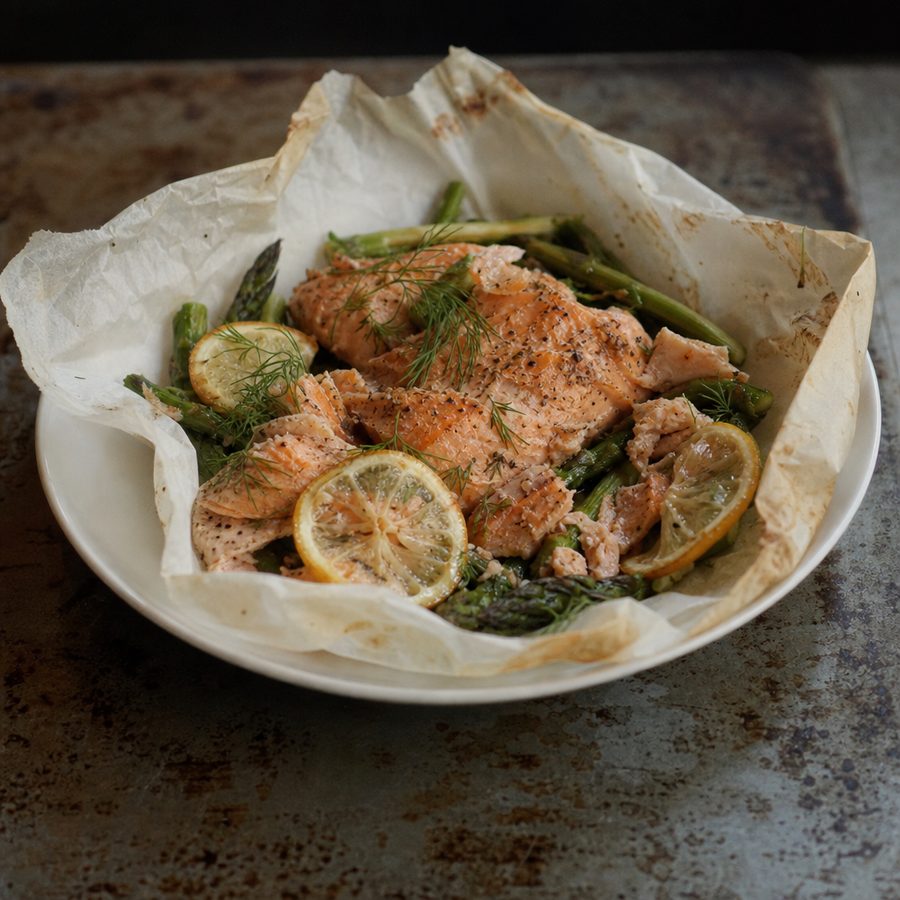
Salmon fillets steamed in parchment with crisp asparagus, sliced shallot, garlic, and fresh dill, finished with olive oil and a squeeze of lemon.
Why You'll Love This Recipe
This is a quiet, weeknight-friendly dinner for anyone who wants a clean, protein-rich plate without a sink full of pans. Each person gets their own sealed parchment packet holding a salmon fillet on a bed of asparagus, shallot, and garlic, brightened with lemon and fresh dill. It comes together in one motion, bakes hands-off, and leaves almost nothing to wash, which makes it as good for a solo dinner as it is for feeding the whole table at once.
Steaming in parchment is the method the whole dish rests on. When you crimp the paper shut, the moisture from the salmon, the lemon juice, and the vegetables turns to steam and has nowhere to escape, so the fish cooks gently in its own aromatic vapor rather than drying out in open oven heat. That trapped steam is why the salmon stays moist and the asparagus keeps a little bite, and it also concentrates the shallot, garlic, and dill into the juices that collect at the bottom of the packet, so every drop of flavor lands back on the plate instead of evaporating away.
Rich, tender fish against crisp green asparagus, with the sharp lift of lemon and dill over both. Salmon brings substantial protein and the long-chain omega-3 fats that support heart and brain health, while asparagus adds fiber and a fresh, grassy contrast. Olive oil rounds everything with its softening richness, and because the whole thing cooks in its own juices, you get a full, savory meal that feels light rather than heavy.
Ingredients
- 4 salmon fillets (about 680 g total)
- 1 bunch asparagus, trimmed
- 2 shallots, thinly sliced
- 3 tbsp olive oil
- 2 tbsp fresh lemon juice
- 3 tbsp chopped fresh dill
- 3 garlic cloves, minced
- 3/4 tsp salt
Instructions
- Crease the parchment down the middle: Heat the oven to 400°F (200°C), tear off a large square of parchment for each fillet, and fold each square in half to crease a center line before opening it flat again. That crease is what you fold back along later, and a packet built without it never seals cleanly at the fold.
- Prep the vegetables and aromatics: Snap the woody ends off the asparagus, slice the shallots thin, mince the garlic, and chop the dill. Everything goes into the packet raw, so slice the shallot thinly enough that it softens in eighteen minutes of steam, since a thick slice stays sharp and crunches against the fish.
- Build a bed of vegetables under the fish: Working on one half of each square near the crease, divide the asparagus, shallot, and garlic into an even bed and lay a salmon fillet on top of each. The fish sits on the vegetables rather than beside them because the bed lifts it off the parchment, so it steams evenly instead of poaching in the juices that gather underneath.
- Season the fish, not the paper: Drizzle each fillet with olive oil and lemon juice, then sprinkle with salt and the dill, keeping the seasoning on the fish itself. Anything scattered onto the parchment simply stays there when the packet is opened, and inside a sealed parcel there is no chance to correct it later.
- Crimp the edges into a sealed half-moon: Fold the empty half of the parchment over the fish to meet the other edge, then start at one corner and make small overlapping folds all the way around the open edges, crimping tightly, to form a sealed half-moon. The seal is the whole technique, because the fish cooks in trapped steam and a packet that leaks bakes it dry instead.
- Bake 16 to 18 minutes, until the packets puff: Arrange the packets on a baking sheet and bake 16 to 18 minutes. They will puff as steam builds inside, which is the sign the crimping held. The salmon is done when it flakes easily and reads 145°F (63°C) at the thickest part.
- Open them away from your face: Move each packet to a plate and open it carefully, cutting or tearing the top and leaning back from the burst of steam, which is hotter than the oven and will scald. Serve the salmon and asparagus in the parchment, spooning the pooled juices over the top, since those juices are lemon, olive oil, and everything the shallots gave up.
Variations
- Lemon-thyme: Swap the fresh dill for fresh thyme leaves and add a few thin lemon slices on top of each fillet before sealing, for a more herbal, less anise-like finish.
- Green bean: Replace the asparagus with trimmed thin green beans; they steam in the same time and give a similar snap under the fish.
- Fennel and orange: Use thinly sliced fennel in place of the shallot and a squeeze of fresh orange juice alongside the lemon for a sweeter, licorice-scented packet.
- White fish: Trade the salmon for a firm white fish such as cod or halibut; this swaps in a milder fish, so check for doneness a couple of minutes earlier since thinner fillets cook faster.
- Garlic-caper: Add a spoonful of rinsed capers to each packet with the shallot and garlic for a briny, savory kick that plays off the lemon.
Storage & Leftovers
Refrigerate leftover salmon and asparagus in an airtight container for up to three days. If you can, lift the fish and vegetables out of the parchment and spoon the juices over them before sealing the container, so they keep some moisture in the fridge.
Reheat gently to protect the texture. A low oven, around 275°F (135°C), in a covered dish for about ten minutes warms it through without toughening the fish; a brief, low-power turn in the microwave works in a pinch. Fully cooked salmon reheats fast, so stop as soon as it is warm to keep it tender.
To get ahead, build the packets completely, then refrigerate them sealed and unbaked for up to a day. Slide them straight into the preheated oven when you are ready, adding a couple of extra minutes since they start out cold.
Notes & Tips
- Match the thickness: Try to buy fillets of even thickness so they finish at the same time; a thick center-cut piece may need the full baking window, while a thin tail-end piece can be done a couple of minutes sooner.
- Pick lively asparagus: Look for asparagus with tight, closed tips and firm stalks. Medium-thick spears hold up best to steaming; very thin ones can go limp in a sealed packet.
- Skin on or off: Leave the skin on if your fillets have it; it holds the fish together in the packet and slips off easily once cooked if you would rather not eat it.
- Check doneness without unwrapping: You can gently press the top of a puffed packet, but the surest test is a thermometer through the paper into the thickest part of the fish, pulling it at 145°F (63°C).
- Adjust the brightness: Taste before serving and add another squeeze of lemon or a pinch of salt to the juices if it needs lift; the flavors mellow as they steam and sometimes want a final touch.
- Serve alongside: The pooled juices are worth catching, so pair the packets with something to soak them up, like cauliflower rice or a simple green salad.
Nutrition & Mindful Eating
- Salmon and asparagus finish at almost the same moment inside a sealed packet, which is the whole reason this works. The fish poaches in its own juices while the spears steam just past raw, and the shallot melts into both.
- Asparagus is the ingredient to buy well here. Thin spears turn silky and sweet in the packet within minutes, and they carry folate and a fine fiber that survives this kind of gentle cooking.
- Salmon cooked this way stays translucent at the center and comes apart in large soft flakes under a fork, and the protein in a fillet this size is dense enough to make a light-looking dinner eat like a full one.
- Shallot sliced thin goes sweet and almost jammy in the trapped steam, gentler than an onion would be, and the garlic beside it loses its raw edge entirely and settles into background depth.
- Lemon juice drizzled over the fish and a generous amount of dill perfume the steam rather than sitting on top of it, so the flavor works its way through the whole packet and not just the surface.
- As you eat, watch the steam come off the fish and notice how little effort the flakes take to separate, and let that softness set an unhurried pace for the rest of the meal.
Frequently Asked Questions
Can I use frozen salmon?
Yes, but thaw it fully first. Move the fillets to the fridge overnight or set them sealed under cold running water until soft, then pat them dry so the packet steams the fish rather than the ice water.
Do I have to use parchment, or can I use foil?
Foil works and seals tightly, but it does not let you see the puff and it can pick up a metallic edge from the lemon juice. Parchment is my preference here; if you use foil, still crimp the edges well to trap the steam.
How do I know the salmon is cooked without cutting into it?
The fish flakes easily with a fork and turns opaque, and a thermometer at the thickest point reads 145°F (63°C). The packet will also puff with trapped steam, which is a good sign it is cooking through.
My asparagus came out too soft. What happened?
Very thin spears overcook quickly in a sealed packet. Use medium-thick asparagus, or if you only have thin stalks, pull the packets at the lower end of the baking window.