
Spaghetti Squash with Mushroom Marinara
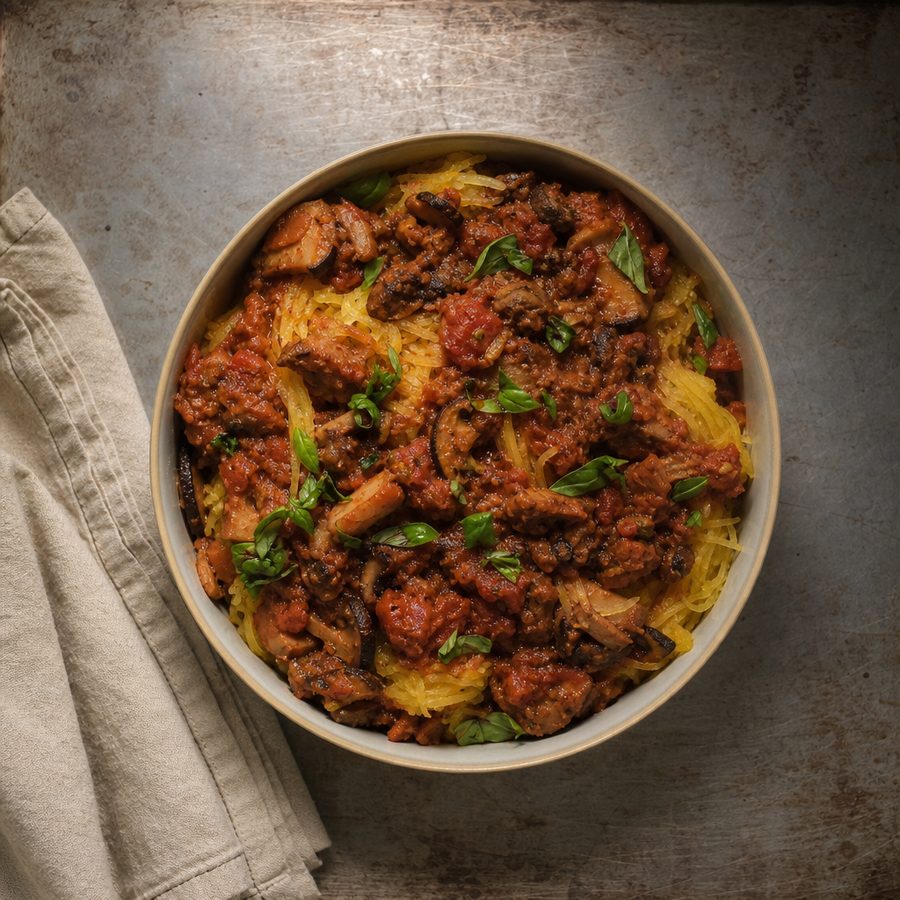
Tender roasted spaghetti squash strands piled with a thick, savory marinara of golden mushrooms, crushed tomatoes, and toasted walnuts, finished with fresh basil and a snowfall of nutritional yeast.
Why You'll Love This Recipe
This is a warming, weeknight-friendly dinner for anyone who loves a hearty bowl of pasta and marinara but wants something lighter on the starch and heavier on the vegetables. Roasted spaghetti squash gives you those familiar tangled strands to twirl, while a robust mushroom-and-walnut sauce does the work a meat ragù usually would. It's the kind of plate that satisfies a comfort-food craving without leaving you heavy afterward.
Give the mushrooms space and stop stirring. Mushrooms hold a lot of water, and if you crowd them or stir constantly they steam and turn gray. Giving them room and time to release that liquid, cook it off, and then caramelize builds a deep, almost meaty savoriness. The chopped walnuts, toasted right in the pan, add a tender bite and a richness that gives the sauce real body against the bright tomatoes.
Fiber-rich squash, earthy mushrooms, heart-friendly olive oil and walnuts, and bright tomatoes and basil. The walnuts bring plant protein and staying power, so the meal fills you up and holds you. Finished with basil and nutritional yeast, which lends a savory, faintly cheesy note, it eats like a generous, satisfying bowl rather than a compromise. It is the rare plate that scratches the pasta-night itch and still leaves room for the rest of the evening.
Ingredients
- 1 large spaghetti squash
- 6 cups sliced mushrooms
- 2 cups crushed tomatoes
- 2/3 cup walnuts, chopped
- 1 onion, diced
- 5 cloves garlic, minced
- 1 1/2 tsp oregano
- 4 tbsp olive oil
- 1/2 cup basil
- 4 tbsp nutritional yeast
- 1/2 tsp salt
Instructions
- Roast the squash: Preheat the oven to 400°F (200°C). Carefully halve the spaghetti squash lengthwise through the stem and scoop out the seeds and stringy pulp with a spoon. Brush the cut faces with olive oil and set them cut-side down on a rimmed baking sheet, since a cut face against hot metal steams the flesh and caramelizes the edge at the same time. Roast for about 35 minutes, until a fork slides in easily and the shell gives slightly when pressed, then let it cool enough to handle and drag a fork lengthwise through the flesh to pull it into loose strands.
- Prep the vegetables: While the squash roasts, slice the mushrooms, dice the onion, mince the garlic, and roughly chop the walnuts. Tear or thinly slice the basil and set it aside for serving, because basil blackens the moment it meets a hot pan.
- Brown the mushrooms and onion: Heat the olive oil in a large skillet over medium-high heat. Add the mushrooms and onion in an even layer and cook, stirring only occasionally, until the mushrooms have released their liquid, that liquid has cooked off, and everything is deeply golden and caramelized, about 8 to 10 minutes. Do not rush this part, because the browning is where the sauce gets its meaty depth.
- Add garlic, oregano, and walnuts: Stir in the minced garlic, oregano, and chopped walnuts. Cook, stirring, until the garlic is fragrant and the walnuts smell toasty, about 1 to 2 minutes, and take care not to let the garlic scorch, since scorched garlic turns bitter and there is no taking it back out.
- Simmer the sauce: Pour in the crushed tomatoes. Reduce the heat to medium-low and simmer, stirring now and then, until the sauce is thick and glossy and no longer watery, about 15 minutes, so it clings to the squash strands rather than pooling underneath them. Stir in the salt, then taste and adjust.
- Assemble and serve: Mound the warm squash strands onto plates or into shallow bowls, tipping off any water that has collected under them first, because spaghetti squash goes on weeping as it sits and will thin the sauce. Spoon the mushroom marinara over the top, then finish with the fresh basil and a generous sprinkle of nutritional yeast.
Variations
- Spicier arrabbiata style: Add a good pinch of crushed red pepper flakes along with the garlic and oregano for a marinara with a slow, building heat.
- Extra green: Stir a few big handfuls of baby spinach or chopped kale into the sauce in the last couple of minutes of simmering, cooking just until wilted.
- Deeper umami: Swap some of the sliced button mushrooms for cremini or reconstituted dried porcini to push the savory, woodsy flavor even further.
- Herb-forward finish: Fold chopped fresh parsley into the sauce and add a little grated lemon zest with the basil at the end for a brighter, more aromatic plate.
- Roasted garlic version: Roast the whole squash and a foil packet of garlic cloves together, then smash the softened garlic into the sauce instead of adding it raw for a mellower, sweeter depth.
Storage & Leftovers
Store leftovers with the squash and sauce in separate airtight containers in the refrigerator for up to four days. Keeping them apart matters here, because the squash strands will weep water and go soggy if they sit under the sauce for days.
To reheat, warm the sauce in a small pan over medium heat until it bubbles, adding a splash of water if it has thickened too much. Reheat the squash separately in a skillet or microwave just until hot, drain off any water it releases, then plate and top with fresh sauce, basil, and nutritional yeast.
For make-ahead, the mushroom marinara is your friend: it actually deepens in flavor overnight and keeps well, so make it a day or two in advance. You can also roast and shred the squash ahead, refrigerate the strands, and reheat both components the night you want to eat.
Notes & Tips
- Pick a heavy squash: Choose a spaghetti squash that feels heavy for its size with a hard, matte, unblemished shell and a dry stem still attached; a shiny skin or a soft spot near the stem means it was picked early or is past its prime.
- Microwave to soften for cutting: If the raw squash is too hard to halve safely, pierce it a few times and microwave it for a few minutes to soften the shell just enough to cut without the knife slipping.
- Salt the strands lightly: Spaghetti squash can taste watery on its own, so a small pinch of salt tossed with the hot strands before you sauce them wakes up their mild flavor.
- Walnuts are flexible: The chopped walnuts add richness and a meaty bite, but if you're cooking for someone who avoids them you can leave them out and lean on extra mushrooms for body instead.
- Double the sauce: This mushroom marinara freezes beautifully, so make a big batch and freeze half flat in a bag; it reheats into a fast dinner over any roasted vegetable or grain later.
- Adjust the finish to taste: The nutritional yeast is what gives the dish its savory, cheesy edge, so start with a light sprinkle, taste, and add more at the table until it tastes right to you.
Nutrition & Mindful Eating
- The squash, the mushrooms and the walnuts hold three different textures against each other. The strands are soft and faintly sweet, the mushrooms are dark and chewy, and the walnuts stay crunchy right through the sauce, so the bowl never goes uniform.
- Spaghetti squash roasted cut side down steams itself inside its own shell, and when you drag a fork across it the flesh comes away in long strands. It tastes mild and slightly sweet, with fiber and a great deal of water in every strand.
- Mushrooms browned properly, in a hot pan with room around them, go deeply savory and almost meaty, and that browning is where the flavor lives. They bring B vitamins and selenium into the sauce along with all that umami.
- Walnuts chopped into the sauce add a crunch and an oiliness that soaks into the tomato, and they carry alpha-linolenic acid, the plant form of omega-3 fat, inside that richness.
- Crushed tomatoes simmered in olive oil with onion, garlic and dried oregano turn sweet and thick, and cooking them in fat is what makes their lycopene easier to take up. Nutritional yeast and torn basil go on at the table, one savory and nutty, the other green and immediate.
- As you eat, twirl the strands and take your time catching the sauce, and let the earthy smell of the mushrooms and the basil set a slower pace than a bowl of anything usually gets.
Frequently Asked Questions
How do I know when the spaghetti squash is done roasting?
The flesh should be tender enough that a fork slides in with no resistance and separates cleanly into strands, and the shell will give slightly when you press it. If the strands still feel crunchy or hard to pull apart, give it another five to ten minutes, since underdone squash won't shred properly.
My sauce turned out watery. What happened?
Usually it means the mushrooms didn't fully brown before the tomatoes went in, so their water diluted the sauce, or it didn't simmer long enough. Let it simmer uncovered a while longer until it thickens and turns glossy, and next time cook the mushrooms until their released liquid has fully evaporated before adding anything else.
Can I use dried basil instead of fresh?
Fresh basil is added at the end for its bright, aromatic lift, and dried won't give the same effect there. If fresh is all you can't get, stir a small amount of dried basil into the sauce while it simmers instead, but the fresh finish is worth seeking out.
Why is my squash coming out mushy instead of in strands?
Mushy squash is almost always overcooked; the longer it roasts past tender, the more the strands break down. Pull it as soon as a fork meets the flesh easily, and let it cool a few minutes before shredding so the strands hold their shape.